Category 3. Building safety for young Londoners
This category includes examples of practice that are making a positive difference to outcomes for children and young people through early support initiatives with those at risk of poor outcomes.
Sponsored by the London Adolescent Safeguarding Oversight Board
Practice Spotlight Navigation Panel:
Practice Spotlight 2026 – ‘New & Emerging Practice’
Summary of 2026 submissions
We were delighted to receive eleven submissions for this year’s Practice Spotlight, demonstrating the varied and innovative ways agencies are building safety for young Londoners through new and emerging practice.
This year’s panel was chaired by LIIA’s Adolescent Safeguarding Policy Lead. We are grateful to colleagues from across the sector, including strategic representatives from the London Adolescent Safeguarding Board, the Mayor’s Office for Policing and Crime, and Safer London, who carefully reviewed the submissions.
Across all submissions, there was clear evidence of the opportunities presented by technology, reform and partnership working to build safety for young people. There are valuable learnings to support the application of reforms from trailblazers and early adopters, including the Southall Pilot: One System, One Family, Total Protection; ROTH Conferencing in Barking and Dagenham; and the Family and Care Proceedings Trailblazer in the Royal Borough of Kensington and Chelsea and Westminster.
The availability and accessibility of technology to support work with young people was evident in the piloting of Virtual Reality headsets to enhance digital youth work in Newham and Sutton. We look forward to hearing more about the impact of this innovation on outcomes for young people. The Phone Pledge in Brent highlights the benefits of a pan-borough approach to supporting young people in schools across the Borough.
The role of “participation as protection” is highlighted through the work of Abianda and the meaningful ways in which they engage and nurture young women with lived experience, both within their organisation and alongside partner agencies. A similarly empowering, trauma-informed approach is demonstrated through Merton’s powerful case study, prioritising accessible, tailored support for young victims. In Wandsworth, a responsive approach to groupwork enables peers to come together to reflect, connect and learn from one another, while ensuring interventions can be adapted to local and individual need.
We would like to thank all contributors and panellists for enabling and supporting the sharing of new and emerging practice to build safety for young Londoners. Happy reading!
Abianda – Embedding young women with lived experience of criminal exploitation & violence; why participation is protection and builds safety
Summary of project: This practice example highlights work in the last couple of years at Abianda to embed young women with lived experience of criminal exploitation & violence into the organisation, and how this has built safety for those young women.
Key Contact: Alex Honnan-MacDonald
Read about this practice
Setting the Scene: the context and problem you are solving
Abianda is a London-based Charity that works with young women and girls affected by criminal exploitation and violence, associated with ‘gangs’ and county lines and we provide training, at local and national levels, to the professionals who work with them.
Abianda’s vision is that young women and girls are free from oppression and harm caused by criminal exploitation and violence.
Our mission is to support young women to develop independence and agency. We do this through:
- The provision of specialist one-to-one, group and contextual safeguarding services, which increase safety, skills, self-advocacy, independence and agency;
- Working with national and local services to challenge and change their approaches, through the delivery of our training and systems change programmes;
- Building a network of young women and girls who can disrupt and re-design policy and practice to create lasting impact.
At Abianda, we recognise that criminal exploitation flourishes within the deep structural inequalities of our society, which are reinforced through intersectionality, where overlapping forms of discrimination such as race, gender, class, and disability shape how harm is experienced and how support is accessed. The root cause of criminal exploitation, ranging from poverty and deprivation, to education failure and exclusion, are often complexities that services can struggle to respond to.
Through Abianda’s 12 years of work across sectors, we have seen that young women and girls are often invisible within the services and systems that should protect them from harm caused by criminal exploitation. If systems continue without girls and young women’s specific needs in mind, services will fail to address the underlying drivers of exploitation, leaving girls and young women misunderstood, excluded from crucial decisions, and ultimately unsupported.
We centre a key principle: Young women and girls are the experts in their own lives and see participation as a form of protection. When young women are meaningfully involved in shaping the systems around them, safety is not something done to them, but something built with them.
You can watch CEO Abi Billinghurst discuss ‘Participation as Protection’ when safeguarding young women and girls affected by criminal exploitation and violence.
How: what you did and how it was delivered to meet the identified need
Abianda embeds participation and builds safety through a combination of direct 1:1 support and group work, systems change, Community Contextual Safeguarding and Abianda’s Systems Change Expert Team, made up of young women with lived experience of criminal exploitation and violence, are embedded within Abianda and actively shape services, influence policy, and drive sector change. When embedding lived experience safety must be actively built, maintained, and continuously reflected on. We acknowledge that we cannot mitigate all ‘risk’ and that young women may still encounter challenges within their work at Abianda and within their personal lives. What matters is how these are anticipated, responded to, and supported.
“Being embedded allows us to create safety for other young women because we are able to use our lived experience to help shape the work Abianda does which in turn helps the work to centre young women’s needs and helps young women participating feel as though they are being heard and seen.” – Systems Change Expert
Some examples of how we strive to build safety:
- Diversity, Equity, Belonging & Inclusion (DEBI)
- Sits at the heart of this work and without it, you cannot build safety
- We developed a clear organisational ‘code of conduct’ (renamed ‘Abianda at its Best’) alongside young women
- It includes our organisational stance on ‘calling-in’ any acts of discrimination with a view to support all team members learn and develop
- We value the lived and learned experience of the whole team.
Trust and consistency
- Providing regular check-ins and clear points of contact in the organisation for support
- A wellbeing plan that invites young women to explain what will support them to be at their best whilst working alongside us
- Creating space for honest dialogue, including the ability to have and manage difficult conversations around organisational decisions and processes
- Clear boundaries
- Conversations with all team members about the different roles and responsibilities within the organisation, to manage expectations
- Young women are not expected to share personal experiences, but are supported to do so safely if they choose
- Supports young women and other team members navigate the dual position young women have as they are both team members and young women accessing an activity that Abianda provides
- Transparency and shared decision-making
- Being open about how decisions are made and having a ‘delegation of decision making’ process in place, that explains where influence sits and what might be outside of their remit of responsibility
- If certain decisions do sit outside of their responsibility, this is explained clearly and other options for involvement are explored
Impact: evidence of the difference it has made to children and families
Participation as protection is not separate from building safety, it is central to it. By embedding young women’s lived experience at the heart of our organisation, Abianda is building safety and increasing independence and agency for young women who access all our activities, including systems change work. Abianda has a more nuanced understanding of risk and safety in the context of criminal exploitation, including safeguarding processes and the different systems young women come into contact with and it has strengthened our ability to influence wider systems and services to respond more effectively and safely.
“Being embedded allows us to be involved in decisions that affect our lives which gives us a sense of control and self respect…Being embedded provides opportunities for conversations about the misunderstandings about safety and learning about what might have been missed with young women.” -Systems Change Expert.
Next Steps: what you are doing next to develop or expand this practice
Building on this work, Abianda is:
- Developing a formal Systems Change Plan to strengthen how lived experience informs sector change
- Expanding pathways for young women to lead research, develop and deliver training and workshops to professionals and other young women
- Developing a process for young women and girls accessing our 1:1 direct support to be able to contribute their voices
- Strengthening our data and evidence base to demonstrate impact
- Deepening partnerships across sectors to embed gender-responsive, participatory approaches
Evolve: advice you would give to others seeking to replicate your model
For organisations seeking to embed lived experience:
- Start with how your organisation will building safety for lived experience to be embedded
- Be clear about boundaries and expectations
- Have different ways to engage
- Be prepared to learn and adapt
- Invest time and resource
- Share power genuinely and transparently – and if you can’t at all times, acknowledge this and be transparent about why
- Recognise participation as protection, when young people shape systems and services, those systems become safer, including the system of your organisation
“Being embedded gives us a voice as young women which is validating and shifts the usual experience of being silenced and punished for speaking up. By including our voices we can then improve the safety of other young women because we influence service design” – Systems Change Expert
London Borough of Barking & Dagenham – Risk Outside the Home (ROTH) Conferencing
Summary of project: ROTH Conferences are a safeguarding response for adolescents at risk of extra familial harm, aimed at developing safety plans in collaboration with parents, caregivers and young people as experts in their own experience, to intervene in the contexts causing harm.
Key Contact: Linda Helliar
Read about this practice
Setting the Scene: the context and problem you are solving
In 2020 LBBD was chosen to be a Contextual Safeguarding Scale-Up partner with the University of Bedfordshire piloting contextual approaches to vulnerable adolescents. There was a recognition that traditional child protection plans do not work for adolescents who are at risk outside the home (ROTH) and a piece of work was started to explore this in more depth and look for an alternative way to address this. This initial work was unfortunately hampered by the Covid pandemic and change of key individuals involved.
Audit and inspection had identified some areas of practice that we needed to strengthen, including safety planning for children at risk outside the home (ROTH), understanding of adolescent neglect, how we addressed the needs of siblings and the need for more pro-active disruption activity to reduce risk in contexts of concern.
Therefore, at the end of 2024 we decided to revisit the work undertaken with the University focusing on contextual conferencing for adolescents at risk outside the home.
How: what you did and how it was delivered to meet the identified need
Our plan to revisit this work was ratified at our Vulnerable Adolescent Strategic group ensuring partner agency and senior manager buy-in and support.
A small task and finish working group was established to look at pathways for vulnerable adolescents within social care systems, operationally and from an IT perspective. The working group included representatives from safeguarding and quality assurance, adolescent and youth justice services, and performance and analytics.
Regular, meetings and tabletop exercises mapped a pathway within the existing child protection pathway from referral through Conference to plan, ensuring compliance with safeguarding requirements and an ability to report on ROTH activity. This included adapting existing electronic forms and designing ROTH specific exemplars. In recognition that risk to the child was contextual, the words “child protection” were removed from the ROTH vocabulary.
The Conference pathway was designed with 3 potential outcomes:
ROTH CIN – under S.17 and requiring consent.
ROTH Plan- aligns with a traditional CP Plan while explicitly recognising that the harm is extrafamilial.
Traditional CP Plan -where the Conference identifies risk to the child is attributable to parental omission or commission.
Regular meetings and training sessions were held with CP Chairs, identified as key to independent oversight. These looked at ROTH processes, pathways, thresholds and planning.
Decision made to keep children at risk outside the home already on traditional CP and CIN Plans under those umbrellas unless a significant event requiring a Conference occurred, at which point they could convert to ROTH.
ROTH champions were recruited within social care, the wider council, voluntary and community sector, health and education to support wider education of the new approach and dissemination of best practice.
A range of alternative Conference venues were identified to mitigate risks to children in different areas in the community.
Extensive training was offered to social care and partners through the Council training offer and the safeguarding partnership.
Impact: evidence of the difference it has made to children and families
As of March 1st 2026, 13 children had been considered through a ROTH Conference.
Of these, 9 children are supported as ROTH CIN, 3 children are supported through ROTH Plans, and one child is supported through a traditional CP Plan.
Case example:
J is 17 of Black Caribbean heritage. He lives with his father in LBBD having moved from another borough due to contextual safeguarding concerns. These included his home being targeted by other young people, J being stabbed and his father being threatened with a weapon.
Following J’s move, a transfer in Child Protection Conference was requested to facilitate case transfer. Upon review, the decision was made to convene a ROTH conference as the cause of harm was extra-familial. J, his father, and originating authority attended the meeting. At this, significant concerns were discussed resulting in J being supported through a ROTH Plan.
The focus of the plan was to build support networks in LBBD whilst disrupting sources of harm in the previous borough. This required significant co-ordination cross-borough for all agencies. J’s father received support regarding his response to harm occurring outside the home. We believe that the status of ROTH Plan, being equivalent to a CP Plan, supported in progressing the disruption plans around J across several boroughs.
The robust, co-ordinated partnership response to contextual harm and engagement between partners, J and his family, resulted in a quick reduction in risk. J was supported to engage in education, something he had not achieved in his previous borough, and is engaged with services around his emotional wellbeing. His father has been supported and been integral to the safety planning. Due to significant and sustained changes, J has now stepped down to a ROTH CIN Plan. The family continue to receive support, but the level of intervention is proportionate to current risks.
We have been invited by LIIA to present the ROTH conference pathway to London practice leads as it is aligned to the MET’s current position on children at risk outside the home needing to be seen as children in need of child protection responses. It is also viewed as an approach that could be adopted by the new multi-agency child protection teams.
Next Steps: what you are doing next to develop or expand this practice
One of the most significant learnings is that change takes time. Embedding new practice is an ongoing challenge that requires tenacity and continuous input.
Ongoing monitoring of the system through observation of ROTH conferences and dip sampling to identify areas of good practice and those needing further development is crucial.
Training and recruitment of champions is ongoing and regular de-brief sessions are held with CP Chairs to ensure ongoing learning from conferences.
Working with IT colleagues to continually tweak the recording system to ensure best practice and reporting ability for ROTH.
Next step is to include responses to ROTH into planning for children in our care.
Evolve: advice you would give to others seeking to replicate your model
- Senior leadership & partner buy-in via the Safeguarding Children’s partnership prior to and during development is crucial.
- Establish a multi-agency task and finish group at development phase that can make the necessary changes within systems and practice.
- Have an agreed reporting mechanism in place for strategic oversight and sign off that ensures that partners are also committed to the new process.
- Identify a designated coordinator to maintain ongoing oversight of new processes ensuring that practice is consistent and in line with expectations.
- Be open to changing processes based on feedback and regular de-brief sessions.
- Ensure CP Chairs are trained and committed to the process prior to launch, ensuring they are confident with threshold.
- Plan for ongoing workshops and practice development across the partnership.
London Borough of Barking & Dagenham – Building safety and wellbeing for homeless 16-17 year olds
Summary of project: Support to 16-17 years olds who are homeless or at risk of homelessness.
Key Contact: Kurt Oliver
Read about this practice
Setting the Scene: the context and problem you are solving
We have significantly improved our response to keeping adolescents who are homeless or at risk of homelessness safe and well. Our Ofsted inspection report in 2023 found that our response to children who are homeless or at risk of becoming homeless needed to improve. The report concluded we did not take sufficient account of children’s needs, and some children were not given access to an advocate and independent advice about their entitlements. A programme of work over the last three years has addressed this.
How: what you did and how it was delivered to meet the identified need
To respond to the need identified, we have developed and implemented the following:
- We appointed a Dedicated Homeless Lead Social Worker to drive best-practice standards, ensuring seamless integration between social care and housing colleagues for truly holistic child-centred support.
- A streamlined referral process ensures young people can access critical support faster and more easily than ever before.
- We have embedded detailed quality assurance activity using findings to drive improvement.
- Through intensified collaboration with the Children’s Rights Officer. The officer sees the young person independently and joins the assessment with housing, providing independent advice
- Improved participation with young people, including through participation and focus groups whereby young people have contributed to and improved service design.
- Rapid restorative interventions are now available from our Specialist Intervention Service to support young people who present as homeless through restorative intervention and application of Family group meetings. Young people can also get support from Lifelong Links reconnecting with positive people in their lives.
- We have strengthened partnership working with Education, CAMHS, and substance use specialists, creating a comprehensive safety net.
- Partnership with commissioning colleagues led to suitable semi-independent accommodation facilities for young people who require this type of placement, this includes a ‘short term’ crisis placement whilst assessment take place.
- Our 16-17 Homeless Protocol sets out a clear process and expectations that staff follow to provide effective, consistent responses and support complaint with National guidance for homeless 16 /17-year-olds.
- We have established The Children’s Homeless Strategic Group. This now provides high-level governance and oversight to deliver and maintain the progress we have achieved and build on this.
- We organised for Coram young ambassadors to visit the Vineries (Housing Provision) where several of our young people are placed. They facilitated a session with our young people who found the session exciting as they were able to share experiences and bring ideas to service improvements. Coram were impressed with the level of collaboration and the holistic offer for young people.
Impact: evidence of the difference it has made to children and families
Overall, the impact is that adolescents who are homeless or at risk of this receive a more consistent response, focused on safety and wellbeing. Audit evidences that all young people get a timely response and are not left homeless. In 2025-6, housing allocations were consistently made within 48 hours of referral demonstrating effective joint working and timely responsiveness to young people presenting as homeless.
Between April 2025 and March 2026, a total of 45 young people aged 16–17 presented as homeless or at significant risk of homelessness. Of these, 26 young people were accommodated under Section 20, 14 young people were supported under Section 17 arrangements where accommodation was needed but family linked support remained viable, and 5 young people were able to return home or access alternative outcomes. Restorative work introduced early and where parents or carers were able to engage meaningfully with support is particularly effective.
Young people feel heard through meaningful participation and advocacy support.
Advocacy is well-embedded, taken up in 84% of cases in 2025-26. When taken up, advocacy resulted in young people having a better understanding of rights and entitlements, and decisions were better-informed. This advocacy complimented detailed information letters and leaflets co-designed with young people setting out the difference between Sec 17 and Section 20 options.
As a result of participation, services and support have improved. For example, young people told us that we need to raise awareness of homelessness pathways and support. As a result, we run quarterly training and ran awareness raising for schools designated safeguarding leads.
Next Steps: what you are doing next to develop or expand this practice
We will continue to strengthen practice, drive continuous improvement in partnership with young people. Young people have asked us for clearer information on timeframes. In direct response to their feedback, we are now co-designing updated clear, accessible guidance to provide greater transparency and certainty around service delivery timeframes.
Evolve: advice you would give to others seeking to replicate your model
To replicate our model for improving adolescent homelessness services, we recommend focusing on three core pillars: strategic governance, youth-led design, and journey-based learning.
- Establish Strong Governance: Prioritising service improvements as a strategic priority. Effective governance provides the necessary oversight to keep progress on track and ensure accountability.
- Engaging with young people has been a key part of our improvement journey, listening to and acting on the views and experiences of young people. This, in turn, has enabled young people to feel safe and heard.
- Reflecting on children’s journeys and the previous involvement of services has enabled lessons to be learned, and improvements to be made at an operational and strategic level.
London Borough of Brent – Brent PHONE Pledge
Summary of project: Working together to protect and support our pupils while helping families navigate the challenges of digital technology.
Key Contact: Sabrina Edwards
Read about this practice
Setting the Scene: the context and problem you are solving
We all want the very best for our children in Brent – for them to thrive academically, socially, and emotionally. As technology is becoming an increasingly central part of children’s lives, evidence and local experience shows that unrestricted access to smartphones and social media is having a negative impact on pupils’ mental health, sleep, attention, and overall wellbeing. Schools and families are also becoming more concerned about children’s exposure to risks such as cyberbullying, harmful online content, and inappropriate use of technology during the school day.
Within this context, school leaders across Brent recognised that individual school policies alone are not enough to address the growing challenge. There is inconsistency in expectations between schools, uncertainty among parents and carers, and increasing pressure on staff to manage smartphone use alongside learning and safeguarding priorities.
In response, Brent school leaders came together to agree a shared, borough wide commitment: the PHONE pledge. The pledge was developed to provide a clear, collective approach to promoting healthy digital habits, protecting children’s wellbeing, and supporting families to navigate the challenges of modern technology. It articulates a shared responsibility between schools, families, and the local authority, ensuring that expectations are consistent and clearly communicated.
The PHONE pledge set out five key commitments: protecting children’s safety and wellbeing; helping families and staff with clear guidance and support; observing and reviewing approaches to ensure fairness and effectiveness; nurturing pupils’ digital literacy and responsible online behaviour; and educating the wider school community through shared best practice across the borough.
Many Brent schools were already limiting smartphone use during the school day, but the pledge formalised this practice and strengthened it through collective action. It also encourages families to consider delaying smartphones for non educational use until children were older, reinforcing consistent messages between home and school.
The introduction of the PHONE pledge has marked a united, proactive response to a shared problem, demonstrating how borough wide collaboration can protect childhood, support learning, and promote healthier, safer use of technology for all children in Brent.
How: what you did and how it was delivered to meet the identified need
The response to concerns about children’s smartphone use in Brent was developed through a structured combination of strategic leadership, evidence gathering and collaborative system working.
The work began within the Designated Safeguarding Lead (DSL) network, where mobile phone use emerged as a growing safeguarding and wellbeing concern. To build a clearer picture of practice across the borough, the DSL network designed and distributed a survey on mobile phone use in schools. The findings highlighted significant variation in approaches, increasing pressures on staff, and uncertainty among parents and carers, reinforcing the need for a coordinated, borough wide response.
In response to this evidence, a dedicated steering group was established to develop a shared approach to smartphones in schools. The group was facilitated by a School Effectiveness Lead Professional (SELP) and included headteachers from across Brent, ensuring representation from different phases and local clusters. To inform the work and avoid duplication, the facilitating SELP held initial discussions with neighbouring local authorities, including Harrow, Barnet and Westminster, to understand their approaches and draw on emerging regional learning.
The steering group met through a series of online sessions, during which the purpose, scope and focus of the work were discussed, tested and refined over time. Shared online documents were set up to enable collaborative drafting, allowing all members to contribute asynchronously, comment on emerging ideas and build collective ownership of the developing pledge.
Steering group members also acted as links back to their respective clusters, sharing early drafts of the pledge with other school leaders and bringing feedback into the steering group discussions. This ensured the final approach was grounded in operational reality, reflected the diversity of school contexts, and had broad professional buy in.
- Once agreement was reached, the SELP facilitator led on translating the shared principles into practical delivery mechanisms. This included:
- Developing template letters for schools, inviting them to sign up to the PHONE pledge
- Creating a simple online form to enable quick and accessible sign up
- Drafting template parent and carer letters, to be issued once the list of participating schools was finalised, ensuring clear and consistent communication with families
To support visibility and consistency, the SELP also worked closely with the communications team, who developed the pledge into a poster for schools. This helped embed the pledge within school communities and reinforced shared expectations around healthy and safe smartphone use.
Through this approach, the initiative moved from identifying need, to co designing a solution, to delivering practical tools that enabled schools to adopt a consistent, borough wide response. The combination of cross authority learning, professional collaboration, and clear operational support ensured the PHONE pledge was both strategically robust and practical to implement.
Impact: evidence of the difference it has made to children and families
As this is a new and emerging initiative, it is too early to evidence measurable long term impact on children and families. However, early indicators suggest the PHONE pledge is beginning to make a positive difference at both system and school community level.
Early qualitative impact has been seen through strong engagement from schools. A growing number of schools have voluntarily signed up to the pledge, indicating appetite for a shared, borough wide approach and confidence in the principles underpinning it. Feedback from headteachers suggests that the pledge has helped legitimise and strengthen existing school policies on smartphone use, giving leaders greater confidence to act collectively rather than in isolation.
Next Steps: what you are doing next to develop or expand this practice
As an emerging borough wide initiative, the next phase of the PHONE pledge will focus on embedding, strengthening and evaluating the approach, while continuing to build shared ownership across schools and families.
A key priority is to increase participation and consistency across Brent. This will involve continued promotion of the pledge through existing professional networks, targeted engagement with schools that have not yet signed up, and ongoing review of communications to ensure messages to parents and carers remain clear, consistent and focused on wellbeing and safeguarding.
To support visibility and sustainability, work will begin on developing a small, recognisable PHONE pledge logo. This will enable participating schools to display their involvement on school websites, letterheads and communications, clearly signalling that they have signed up to the borough wide commitment.
The work will also be extended through the development of a shared resource bank for schools. This will bring together practical materials to support implementation of the pledge, such as example policies, parent communications, assemblies, curriculum resources, staff guidance and signposting to external support. The resource bank will be shaped by schools’ contributions and emerging practice, enabling peer learning and reducing duplication of effort across the borough.
Evaluation and learning will form a further strand of development. Follow up engagement through the DSL network and headteacher forums will be used to gather qualitative feedback on how the pledge is being implemented, the conversations it is enabling with families, and any early changes schools are observing.
As the work matures, there will be opportunities to strengthen pupil voice and parental engagement, ensuring future developments are informed by lived experience. Ongoing dialogue with neighbouring local authorities will continue to support shared learning and potential regional alignment.
Evolve: advice you would give to others seeking to replicate your model
For others seeking to replicate this model of practice in their local context, several key learning points have emerged through reflection on the development of the PHONE pledge.
- Start with shared evidence and professional concern: Using an existing professional network, such as Designated Safeguarding Leads, to surface concerns and gather baseline information helped build a shared understanding of the issue and created momentum for action. Beginning with evidence rather than solutions supported constructive, non polarised discussion.
- Invest time in co design and consensus building: Bringing together headteachers from different phases and contexts and allowing time for the purpose, scope and focus of the work to evolve was critical. The iterative nature of the discussions meant the final approach felt credible, realistic and owned by the system, rather than imposed. In hindsight, allowing even more structured time for early discussion may have accelerated agreement later in the process.
- Use skilled, neutral facilitation: Having a School Effectiveness Lead Professional act as a neutral facilitator helped maintain trust, manage differing views and keep the work moving forward. This role was particularly important in translating professional dialogue into practical outputs, such as agreed principles and shared communications.
- Learn from others early on: Initial conversations with neighbouring local authorities provided reassurance, avoided duplication and helped situate the work within a wider regional context. On reflection, this cross authority learning could have been embedded even earlier to further strengthen confidence and alignment.
- Keep the approach values led and light touch: Framing the work around wellbeing, safeguarding and partnership, rather than enforcement or compliance, was essential in securing buy in. Avoiding language associated with inspection or judgement helped schools feel safe to engage and participate voluntarily.
- Support implementation with simple, visible tools: Providing practical resources — such as template letters, a clear sign up process, shared documents and a recognisable pledge logo — reduced burden on schools and supported consistency. Making participation visible helped reinforce collective ownership and clarity for families.
Overall, the key learning is that system level change around sensitive issues benefits from pace with permission: moving forward decisively, while allowing time for trust, dialogue and shared ownership to develop. This balance has been central to the early success of the model and would be a core recommendation for others seeking to replicate it.
London Borough of Ealing – Families First Partnership: Southall Pilot
Summary of project: This spotlight report provides an early insight into the impact and learning from the Families First Southall pilot. We are proud to showcase the FFP Southall pilot which is an ambitious and forward-thinking initiative that is reshaping how we support children and families.
This work represents a step change in practice, bringing together innovation, collaboration, and a strong commitment to keeping families safely together wherever possible. The Pilot is strengthening multi-agency relationships which is key, and embedding a culture of reflective practice, the model is transforming how professionals understand and respond to risk and most of all ensuring families voices are heard. It is not only improving outcomes for children but also creating a more connected, responsive, and effective safeguarding system.
Key Contact: Joanne Dempster
Read about this practice
Setting the Scene: the context and problem you are solving
Through this pilot, we are seeing real progress in delivering earlier, more proportionate, and family-led support.
This spotlight highlights what is new, what is working, and how integrated practice is making a meaningful difference for families in Southall demonstrating a system that is moving from fragmented responses to one that is coordinated, relational, and built around family strengths.
Southall was identified as a key locality for piloting the Families First Partnership because of its high levels of demand, socio-economic complexity, and diverse community. This made it an important place to test whether a more responsive, culturally aware, and relationship-based model could improve the way families receive support. The core problem the pilot set out to address was the tendency for families to experience fragmented services, delayed responses, repeated handovers, and escalation into higher levels of statutory intervention when earlier, coordinated support may have been more effective. Ealing’s wider ambition is to reduce unnecessary escalation, strengthen early intervention, and improve outcomes for children while managing system demand more effectively. The Southall pilot therefore provided an opportunity not only to redesign frontline practice in one locality, but also to generate learning that could inform wider system change across the borough.
How: what you did and how it was delivered to meet the identified need
The pilot was delivered through a more joined-up model across the Integrated Front Door, the Multi-Agency Child Protection Team, and Family Help. The Integrated Front Door has enabled earlier and more effective intervention by working closely with universal services and partners so that concerns are identified and responded to promptly. Through strong information sharing and collaboration, decisions are made more quickly and are better tailored to the needs of each family. A key feature of the model is that practitioners work with families rather than doing things to them. Families are asked what support would help, and they are involved in planning from the outset. The Front Door is also able to complete short, focused assessments at an early stage, allowing support to be put in place before issues escalate. This early assessment function has helped prevent some families moving unnecessarily into higher tiers of intervention.
Alongside this, the Multi-Agency Child Protection Team has played a vital role in coordinated safeguarding decision-making. Working closely with the Integrated Front Door and Family Help, the team has supported a more joined-up system in which risk is understood collectively, delay is reduced, and children receive the right level of intervention at the right time. The Family Help team has been central to shifting the overall approach from reactive intervention to earlier, relationship-led support. By becoming involved with families sooner, the model reduces unnecessary changes of worker and enables practitioners to build stronger relationships, improve engagement, and support more lasting change. Their whole-family approach means needs are addressed holistically while still managing higher levels of risk where required. The team continues to work closely with partners such as police and health services to ensure coordinated responses. Across all teams, the Brighter Futures model has remained central, embedding strengths-based and relational practice. Family-led decision-making has been actively promoted through Family Group Conferences and Family Network Meetings so that family voices remain central and wider networks can be identified as part of sustainable planning for children.
Impact: evidence of the difference it has made to children and families
The impact of the Southall pilot is reflected strongly in the experiences of both families and practitioners.
Families report feeling listened to, respected, and more involved in decision-making, with clearer understanding of expectations and support plans. There is evidence of improved relationships within the family, with support being delivered in a way that feels collaborative rather than directive. Practitioners highlight an increased ability to build meaningful, trusting relationships with families, alongside greater professional satisfaction and confidence in delivering preventative, strengths-based support. The shift towards earlier engagement is enabling more purposeful and sustainable intervention.
This is captured in practice feedback:
“Families are engaging earlier and more openly, which is enabling us to make sustainable changes rather than reacting to crisis.”
Case Study: Building Trust, Inspiring Change
“You have inspired me… thank you for all you have done for me and my family.”
A parent supported through the FFP Southall pilot described the powerful impact of consistent, relationship-based support on her and her children. By taking time to listen and build trust, the practitioner helped the family feel valued, understood, and able to engage more positively. This not only addressed immediate needs but also created a lasting sense of confidence and motivation. The parent spoke about being inspired by the experience, developing new aspirations, and recognising meaningful positive change within her family.
This case demonstrates how early, strengths-based intervention can: Build trust and engagement, enable sustainable change, inspire confidence and future aspirations.
Next Steps: what you are doing next to develop or expand this practice
Building on these early outcomes, the next phase of the work is focused on deepening and expanding the model. This includes exploring how the Families First Partnership approach could be extended to other localities, while carefully assessing the resource implications of wider rollout so that delivery remains sustainable and effective. A key priority is to continue strengthening integrated practice and maintaining a shared vision for early intervention and safeguarding across partners. There is also ongoing work to refine tracking systems and performance measures so that impact can be evidenced more robustly and used to drive continuous improvement. Regular review points are helping the service monitor progress, address emerging issues, and adapt the model where necessary. At the same time, the Brighter Futures practice model will continue to be embedded across services to promote consistency, strengthen relational practice, and ensure high-quality family-centred support. As the model develops, there are also plans to involve additional agencies in the Multi-Agency Child Protection Team, further strengthening joint decision-making.
Evolve: advice you would give to others seeking to replicate your model
For others looking to replicate this model, the strongest advice is to start with shared values and a clear understanding of purpose. The Southall pilot shows that integrated practice works best when partners are aligned around early help, relational practice, and keeping families safely together wherever possible. It is important to invest time in building a consistent shared understanding across agencies, especially around thresholds, roles, expectations, and how risk will be discussed. Services should also ensure that families are engaged as active partners from the outset, rather than passive recipients of support, and that practitioners are equipped to work in strengths-based and culturally responsive ways.
Another key lesson is the importance of robust performance and impact tracking: if the intention is to change systems, there must be mechanisms in place to evidence what is improving, where challenges remain, and what needs to adapt. Finally, workforce capacity matters. Relationship-based work depends on stability, the right skills, and the ability to intervene early enough to make a difference. Southall’s experience suggests that when those conditions are in place, services can create a more connected, responsive, and effective safeguarding system that improves outcomes for children and families.
London Borough of Newham – Pioneering Digital Youth Work Through VR
Summary of project: Newham’s Youth Empowerment Service is pioneering the use of virtual reality and digital youth work to create safe, inclusive, and immersive spaces that expand access, strengthen connection across communities, and redefine how trusted youth work is delivered in a hybrid world.
Key Contact: Esther Baker
Read about this practice
Setting the Scene: the context and problem you are solving
The Youth Empowerment Service (YES) identified a growing challenge in ensuring equitable access to high-quality youth provision for all young people across the borough. While our universal offer is strong, we recognised that traditional face-to-face delivery can unintentionally exclude some young people – particularly those experiencing mobility barriers, social anxiety, caring responsibilities, travel limitations, or low confidence in entering unfamiliar spaces. At the same time, young people’s social lives, learning, and self-expression are increasingly shaped by digital environments, requiring youth work practice to evolve in step with their lived realities. In response, YES explored how emerging technology could be used to strengthen inclusion rather than widen inequality. This led to the development of our virtual reality (VR) youth work offer: an innovative, safe, and moderated digital space designed to remove barriers, connect young people across neighbourhoods, and create new opportunities for participation, creativity, and peer support. The project has emerged from a clear need to modernise practice, future-proof our offer, and ensure youth work remains relevant, accessible, and rooted in young people’s changing worlds.
How: what you did and how it was delivered to meet the identified need
The development of YES’s virtual reality (VR) youth work offer has been shaped as an emerging practice model that builds on learning first tested during COVID-19, when the service rapidly adapted to digital and remote delivery to maintain trusted relationships with young people. During that period, we piloted immersive and online approaches to group work, recognising the potential for digital spaces to reduce barriers for young people who were unable or unwilling to access traditional face-to-face provision. The positive engagement seen through these early trials highlighted an opportunity to further evolve this practice using VR as a more relational and interactive medium.
As the work remains in development, our focus has been on prototyping and iterative design rather than full-scale implementation. We have worked with young people and staff to test how VR environments can best support workshops, peer dialogue, creative activities, and issue-based youth work in safe, moderated spaces. Operational activity has centred on small-scale pilots, workforce learning, and the development of safeguarding, consent, and digital facilitation standards that reflect both youth work values and the realities of immersive technology. Staff are continuing to build confidence in hybrid practice, exploring how group dynamics, participation, and trusted adult support translate into virtual environments.
This phased approach allows YES to learn in real time, using staff reflection, youth voice, and participation trends to refine the model before wider rollout. By treating the VR offer as a developing strand of practice, we are ensuring it remains rooted in evidence, inclusion, and the lived experiences of young people, while building on the digital innovation that first emerged as a necessity during the pandemic.
Impact: evidence of the difference it has made to children and families
The VR and immersive digital youth work pilots delivered by YES during COVID-19 demonstrated a clear impact on inclusion and engagement. Early trials showed that young people who had previously struggled to attend in-person provision – such as those with social anxiety, mobility challenges, or caring responsibilities – were able to attend and participate. Qualitative feedback indicated that virtual sessions provided a safer, less intimidating space, enabling young people to express themselves, collaborate, and form peer connections across neighbourhoods. Staff reflections highlighted increased confidence in digital facilitation and an improved understanding of how relational youth work can be translated into online and hybrid environments.
Key learnings include the importance of moderation, clear safeguarding protocols, and iterative design to ensure digital practice is safe and inclusive. While the offer remains in development, the early evidence suggests VR and immersive approaches can reduce barriers to participation, sustain engagement during periods of disruption, and complement traditional youth work, creating a blueprint for a more flexible, equitable, and future-facing youth service.
Next Steps: what you are doing next to develop or expand this practice
Building on the early learning from our COVID-era trials, YES is continuing to develop and refine the VR youth work offer as an emerging strand of practice. Next steps include expanding pilot sessions to more neighbourhoods, further embedding staff training in digital facilitation and hybrid youth work, and strengthening safeguarding, moderation, and consent processes to ensure all young people can participate safely and confidently. We are also collecting structured feedback from participants and staff to guide iterative improvements and to develop metrics that can demonstrate impact across reach, engagement, and wellbeing outcomes.
Looking ahead, we plan to explore integration with other digital tools and hybrid delivery models, ensuring that VR complements, rather than replaces, traditional youth provision. By prioritising inclusion, relational practice, and careful evaluation, digital youth work can become a powerful way to reach more young people and expand the possibilities of youth engagement.
Evolve: advice you would give to others seeking to replicate your model
For organisations seeking to replicate YES’s VR and immersive youth work model, the key advice is to start small, involve young people from the outset, and prioritise relational practice alongside technology. Piloting with a limited cohort allows for iterative learning and the development of robust safeguarding, moderation, and consent processes before scaling up. Investing in staff training and confidence-building in digital facilitation is essential, as the success of virtual spaces relies on skilled practitioners who can translate traditional youth work principles into immersive environments.
Key learnings from our experience include the value of co-designing sessions with young people, testing approaches early, and being prepared to adapt quickly based on feedback. On reflection, earlier investment in structured evaluation and participation metrics would have allowed us to capture clearer evidence of impact from the outset, and greater focus on cross-team collaboration could have accelerated adoption and integration across the service.
Ultimately, technology should be seen as a tool to enhance inclusion and access, not a replacement for trusted youth work relationships. Keeping this principle at the centre ensures that digital innovation is meaningful, safe, and sustainable.
London Borough of Merton – Trauma Informed Victim Work
Summary of project: A trauma-informed, co-produced Youth Justice Service model that supports victims through flexible, relationship-based and creative interventions to promote healing, empowerment, and positive long-term outcomes.
Key Contact: Jennifer Williams
Jennifer.williams@merton.gov.uk
Read about this practice
Setting the Scene: the context and problem you are solving
Victims of youth crime often experience harm that extends far beyond the immediate incident. This can include emotional trauma, fear, loss of trust, disruption to daily routines, disengagement from education or work, and social isolation. For young victims, the impact can be particularly profound, affecting confidence, identity development, and future aspirations. Adult victims may also experience distress, uncertainty, and frustration when navigating justice systems that can feel complex or impersonal.
Traditional justice processes can unintentionally marginalise victims, with limited opportunities for emotional recovery, reassurance, or meaningful involvement. Within the Youth Justice Service (YJS), it was recognised that victims required a holistic, flexible, and genuinely victim-led approach, one that prioritised emotional safety, empowerment, and recovery while continuing to uphold a child-first, rehabilitative justice framework. The aim was to ensure victims felt heard, supported, and respected, not only as part of a justice process, but as individuals on their own recovery journey.
How: what you did and how it was delivered to meet the identified need
The YJS developed a trauma-informed, co-produced victims’ model that places victims at the centre of decision-making. Victims are supported to lead their own recovery at their own pace, with no expectation or pressure to engage in specific processes.
From initial contact, practitioners focus on building trust through clear, compassionate, and jargon-free communication. Victims are informed of their rights under the Victims’ Code and are supported to decide how, when, and if they wish to engage further.
A core principle of this practice is co-production. Victims are actively involved in shaping their support plan and provided a range of flexible ways to support this. Yet, most notably within the programme is the therapeutic and development work.
Our multi agency partners accepted that music has a unique and profound capacity to reach children where words often cannot, gently unlocking healing in minds shaped by trauma. Through rhythm, melody and repetition, music can help regulate the nervous system, creating a sense of safety that is essential for repairing disrupted neural pathways and supporting healthy brain development. When a child learns to play an instrument, they are not only building new cognitive connections, but also reclaiming agency, confidence and control, key elements often diminished by adverse experiences. In this process, each note becomes more than sound; it is an act of resilience, a step towards emotional regulation, and a powerful expression of identity. Over time, the mastery of a new skill restores a sense of hope showing children that growth, joy and possibility are not only within reach, but already beginning to take shape through their own hands.
Alongside our therapeutic music offer, we have also incorporated our development away day. Delivered at a learning and development centre, this away day supports young people to rebuild their confidence, engage in team-based activities, experience time outside the home and development communication and life skills. Young people who attend are supported to achieve AQA Unit Awards, recognising their engagement and development. These certifications provide tangible recognition of progress, supporting self-esteem and future education or employment pathways.
Impact: evidence of the difference it has made to children and families
This approach has had a significant positive impact on victims and their families. Victims consistently report feeling listened to, respected, and empowered, with increased confidence and reduced feelings of isolation.
Next Steps: what you are doing next to develop or expand this practice
The YJS will continue to:
- Expand access to creative and developmental programmes
- Increase use of flexible engagement, including text-based communication
- Further embed restorative justice options for both young and adult victims
- Strengthen feedback loops to keep victims’ voices central
- Continue professional development in co-production and trauma-informed practice
Evolve: advice you would give to others seeking to replicate your model
Key learning includes:
- Let victims lead — recovery looks different for everyone
- Flexibility in engagement is critical
- Home visits and informal contact build trust
- Creative programmes aid healing beyond traditional justice approaches
- Restorative justice must always be voluntary and trauma-informed
This model demonstrates that when victims are supported compassionately, flexibly, and collaboratively, meaningful recovery and empowerment are possible.
Royal Borough of Kensington and Chelsea and Westminster City Council – Family Care Proceedings Trailblaze
Summary of project: A cross-system, co-produced initiative improving the quality, consistency and timeliness of care proceedings through better evidence, shared data and accessible tools for professionals and families.
Key Contact: Tiran Khehra
Read about this practice
Setting the Scene: the context and problem you are solving
The Care Proceedings Trailblazer Project was a one-year, Department for Education-funded initiative led by Kensington and Chelsea and Westminster Children’s Services (April 2024–March 2025) to tackle unacceptable delays in care proceedings through cross-system collaboration, co-production and innovation. It brought together 12 London local authorities using the Central Family Court to work with the Judiciary, courts, Cafcass, parents and young people to co-produce and test ways to reduce delay and improve the experience and outcomes of care proceedings.
At the outset, care proceedings took around 59 weeks on average—more than double the 26-week statutory limit—prolonging uncertainty for children and families and delaying permanence decisions. The Trailblazer focused on practical, cross-system changes that supported quicker, well-evidenced decisions and improved the experience of proceedings for families.
The project tested changes over one year to create efficiencies, enable quicker decisions, and ensure the right children enter care at the right time. We focused on building judicial confidence in social work assessments, reducing reliance on expert and repeat assessments, and strengthening the evidence base so the system could better understand demand, activity and outcomes in pre-proceedings and care proceedings.
How: what you did and how it was delivered to meet the identified need
We worked across 12 London local authorities, the Judiciary, HMCTS/courts and Cafcass, with parents and children at the centre of the work. Through co-production and rapid testing, we delivered practical interventions to improve the quality and consistency of social work evidence, strengthen shared understanding of what drives delay, and support families to engage confidently with the process.
We delivered a learning session with judges on parenting assessments and the evidence needed for timely decision-making, alongside sustained engagement with the Local Family Justice Board and Designated Family Judges to test, embed and scale improvements. We also co-produced the first joint regional dataset, informed by local authority practice, to build a shared picture of demand, activity and outcomes, and delivered bespoke training for 100+ social workers and Children’s Guardians to support consistent, high-quality practice.
Two tools were designed to endure beyond the project year:
- A Good Practice Guide to support high-quality, consistent social work given easy and readily available access to materials and tools and assisted by AI technology.
- Animated Explainer Videos to help parents better understand public law outline and care proceedings in a clear, accessible, and reassuring way.
These resources empower both professionals and families, enhance practice, improve communication, and ultimately support better outcomes for children.
The Care Proceedings Good Practice Guide
We created a digital Good Practice Guide giving practitioners quick access to policy, procedures and best-practice guidance for pre-proceedings and care proceedings, supporting clear, relevant and timely evidence. It includes an AI-powered assistant (chatbot) to provide fast, practical answers and support decision-making, and was co-designed with children so lived experience shaped the content and tone.
The Guide draws on best practice from the 12 participating local authorities and input from professionals across the family justice system, supporting greater consistency across agencies and areas. It has received national recognition and has been presented at the Central London Family Justice Board Conference and the Ministry of Justice’s Family Justice Learning Seminars, with practitioners reporting regular use and valuing its clarity and practicality.
The Care Proceedings Explainer Videos
We co-produced two short video explainers for parents in pre-proceedings and care proceedings to increase understanding, reduce anxiety and support informed engagement. Parents with lived experience shaped the scripts and visuals, and two parents provided voiceovers to strengthen authenticity and trust.
The videos are used across the sector and are available in British Sign Language, as well as Romanian, Spanish, French, Turkish, Arabic, Polish and Bengali, to maximise accessibility.
Across the programme, we prioritised shared ownership, practical tools and sustained governance so improvements could be embedded beyond the funding period.
Impact: evidence of the difference it has made to children and families
The Trailblazer strengthened regional leadership and governance, improved the collection and use of pre-proceedings and care proceedings data, and supported more consistent practice. Over the project year, participating areas delivered a five-week reduction in average case duration, with further reductions expected as learning is embedded. Having a dedicated, shared resource helped create a stronger, unified social care voice and deepen cross-system understanding of social work evidence and the benefits of a whole-system approach to delay. The regional dataset enabled partners to test and challenge assumptions about the causes of delay, clearly highlighting court availability as a significant factor and supporting more focused system discussions.
The Central London collaborative continues to meet quarterly to agree a minimum dataset, share practice and jointly address emerging challenges, alongside maintaining regular communication with the Designated Family Judge and the Local Family Justice Board.
Next Steps: what you are doing next to develop or expand this practice
Next, we will embed and extend the minimum dataset work through the continuing Central London collaborative, using quarterly meetings to monitor trends, learn from variation and agree shared improvements. We will maintain regular, formal communication with the Designated Family Judge and the Local Family Justice Board to sustain a unified, credible social care voice within the family justice system, and continue to promote and iterate the Good Practice Guide so it remains current and trusted. We will also scale use of the explainer videos across services and partners, exploring additional formats and languages where local need indicates, and build on the training offer by developing refreshers and onboarding materials so learning is sustained as the workforce changes.
Evolve: advice you would give to others seeking to replicate your model
If you are seeking to replicate this model, start by aligning partners around the shared problem and the child’s timeframe for example, ‘why delay matters’ and what “good” looks like for children and families. Invest early in relationships and governance by creating regular forums with the judiciary and system leaders (for example, the DFJ and Local Family Justice Board) so improvements are owned across agencies rather than held by one team. Focus on practical support for frontline practice through accessible tools that help on real cases (clear guidance, examples and consistent expectations), use a minimum dataset to test assumptions and pinpoint bottlenecks so collective effort is focused where it will have most impact, and design for sustainability from the outset with clear ownership and feedback loops so training and resources can be maintained beyond initial funding.
London Borough of Redbridge – Multi-Agency Child Protection Team
Summary of project: A co-located, multi-agency child protection model that improves safeguarding outcomes through joint assessment, information sharing, and coordinated decision-making for children at risk of harm.
Key Contact: Hlin Saethorsdottir
hlin.saethorsdottir@redbridge.gov.uk
Read about this practice
Setting the Scene: the context and problem you are solving
Redbridge was selected as a national Pathfinder authority for the Families First for Children programme, a Department for Education initiative designed to deliver fundamental reform to Children’s Social Care through a ‘test and learn’ approach.
The programme requires the development of expert-led Multi‑Agency Child Protection Teams (MACPTs) alongside wider system reform, including Family Help, stronger safeguarding partnerships and increased involvement of family networks.
Prior to implementation, Redbridge recognised challenges common across the sector:
- Fragmented multi-agency working
- Delays in information sharing
- Increasing complexity of safeguarding need
In response, Redbridge established a co-located Multi‑Agency Child Protection Team, not only to improve local safeguarding outcomes but to act as a live test site for national reform, generating learning to help inform the future design of Children’s Social Care.
How: what you did and how it was delivered to meet the identified need
Launched in April 2025, the Redbridge MACPT was designed as a whole-system redesign of child protection decision-making.
An Integrated team model: Co-location of social care, police, health, education partners, real-time collaboration replacing fragmented communication, shared accountability for safeguarding decisions.
Joint decision-making and triage: Multi-agency professionals assessing risk together, improved consistency, timeliness and quality of decisions, daily opportunities for shared review and identification of emerging risk.
Improved operational practice: Streamlined assessment pathways, reducing duplication for families, strengthened multi-agency strategy discussions, introduction of tools to support consistent decision-making, improved quality of safety planning.
Continuous review through: regular multi-agency partnership meetings at operational and senior leadership level, regular multi-agency partnership auditting at operational and senior leadership levels, group supervision sessions for the whole team.
Alignment with wider Families First for Children reforms including: Family Help integration, Family network involvement, strengthened safeguarding arrangements.
National contribution: Active contribution to the Families First Pathfinder programme, sharing learning across London and nationally, supporting development of emerging best practice.
This approach ensures Redbridge operates not only as a delivery model, but as a national learning system shaping reform.
Impact: evidence of the difference it has made to children and families
For children and families: Faster, more timely safeguarding decisions, reduced need for families to repeat their stories, more coordinated and joined-up interventions, improved quality of safety planning, children are protected earlier and more effectively.
For the system: Increased multi-agency attendance and engagement, reduced duplication and more efficient processes, greater confidence and clarity in professional decision-making.
Recognition and validation: Awarded the Redbridge Star of the Month award and shortlisted for the annual all staff ‘connector’ award (October 2025) for:
Commitment to safeguarding, collaboration and influence beyond Redbridge:
Praised by the Children’s Minister, Josh MacAlister, who described the model as: “the most advanced version of this model anywhere in the country”.
The team have had visits from Sir David Holmes (Chair, Child Safeguarding Practice Review Panel) and Chief Social Worker Isabelle Trowler reflecting national interest in the team and credibility.
National impact: Direct contribution to Families First Pathfinder learning, informing how multi-agency child protection models are developed nationally, demonstrating scalability and sustainability of integrated safeguarding.
This positions Redbridge as both a high-performing local service and a national leader in reform.
Next Steps: what you are doing next to develop or expand this practice
Redbridge will continue to build on its role as a Families First for Children Pathfinder authority, ensuring the Multi‑Agency Child Protection Team remains central to both local delivery and national reform.
Key next steps include:
- Deepening and embedding the MACPT model to ensure consistency, sustainability and continued improvement in safeguarding outcomes.
- Strengthening data, evaluation and evidence frameworks to robustly demonstrate impact and contribute to the national evidence base for reform.
- Expanding the model to include wider partners, particularly education and specialist services, in line with strengthened multi-agency safeguarding expectations.
- Further aligning the MACPT with Family Help and Family Network models, ensuring seamless transitions across the whole Families First system.
Critically, Redbridge will continue to act as a national learning and demonstration site, by:
- Actively contributing to Pathfinder evaluation and policy development.
- Sharing learning across London, Pathfinder authorities and the wider sector.
- Supporting the replication and adaptation of the model in other Local Authorities.
Through this work, Redbridge will play a key role in shaping how multi-agency child protection is delivered at a national level, ensuring reforms are informed by real practice, evidence and impact.
Evolve: advice you would give to others seeking to replicate your model
Key learning from Redbridge’s Families First Pathfinder experience highlights that successful implementation of a Multi‑Agency Child Protection Team requires both structural and cultural transformation.
- Invest in relationships early – strong, trust-based partnerships between agencies are the foundation of effective multi-agency safeguarding.
- Prioritise co-location or real-time collaboration – daily interaction between professionals significantly improves the quality and timeliness of decision-making.
- Establish shared thresholds and language – consistency across partners reduces variation and strengthens professional confidence.
- Embed a learning culture – regular case reflection, audit and feedback are critical to continuous improvement.
- Align with wider system reform – maximum impact is achieved when child protection is integrated with Family Help and Family Network approaches.
- Be intentional about capturing and sharing learning – particularly when operating within a Pathfinder or pilot programme.
London Borough of Sutton – VR programme reducing exploitation and youth violence
Summary of project: An interactive virtual reality programme that allows young people to experience and navigate real-life scenarios involving exploitation, peer pressure, and weapon carrying, supporting safer decision-making.
Key Contact: Michele McGilley & Joshua Talbot
specialistsafeguarding@sutton.gov.uk
Read about this practice
Setting the Scene: the context and problem you are solving
Young people across the borough are increasingly exposed to risks linked to criminal exploitation, peer pressure, and youth violence, including weapon carrying. Traditional interventions often rely on discussion-based approaches, which can struggle to fully engage young people or reflect the real-time pressures they experience.
There was a clear need for a more immersive and impactful intervention that could help young people understand risk, recognise exploitation, and build confidence in decision-making. This was particularly relevant for those in Pupil Referral Units (PRUs), SEN settings, and those known to youth justice or social care services, who may be more vulnerable to exploitation.
We decided that the VR programme was able to bridge this gap, offering a safe but realistic environment where young people can explore consequences without real-world harm.
How: what you did and how it was delivered to meet the identified need
Using Critical Incident Funding obtained from the London VRU, following a youth homicide in the borough, we procured a virtual reality intervention from Virtual Decisions. The intervention uses VR headsets to guide young people through two interactive scenarios:
Criminal exploitation scenario: young people follow a storyline where they are approached by a known individual linked to criminality and are asked to hold a bag with unknown contents. They experience peer pressure and make decisions that influence the outcome, including scenarios involving theft and debt bondage.
Weapon carrying scenario: young people navigate situations involving pressure or intimidation to carry a weapon, exploring different outcomes such as avoidance, escalation, stop and search, or arrest.
The programme requires young people to make decisions throughout the scenario, which directly impact the narrative and consequences they experience.
Delivery of the programme has been flexible and embedded across multiple settings, including:
- Primary and secondary schools
- PRUs and SEN provisions
- Youth justice service
- Adolescent safeguarding work
- Social work direct work sessions
Delivered as a preventative measure in schools, this proactive approach enables early identification of risk and the delivery of timely, trauma-informed interventions before concerns escalate into statutory involvement. A key strand of the programme focuses on transition periods, particularly for children moving from primary to secondary education. Through a wrap-around approach during these critical transition points, the partnership has been able to identify emerging emotional, social, and behavioural vulnerabilities that may otherwise go unnoticed. This work supports a deeper understanding of children’s lived experiences and the wider contextual factors influencing their behaviour.
As well as completing sessions with over 500 children and young people across the borough, we have also trained professionals, including social workers, youth justice workers and practitioners within our “Safe Spaces” project, to use the VR tool as part of their direct work or as an education piece to help them understand the pressures faced by young people in the community. Sessions are always followed by facilitated discussions to reflect on choices, peer influence, exploitation tactics, and protective strategies.
Impact: evidence of the difference it has made to children and families
The programme has been delivered to approximately 500 young people aged 9–21 across a range of settings.
Key impacts include:
- High levels of engagement across all age groups, including those traditionally harder to engage
- Improved understanding of exploitation, peer pressure, and consequences of decision-making
- Increased ability among young people to identify risky situations and coercive behaviours
- Positive feedback from professionals, particularly regarding the tool’s effectiveness in supporting meaningful conversations
Feedback forms have been completed by children and young people – highlighting greater understanding on both the topics, and where to seek support moving forwards.
Delivery within education settings, particularly with young people identified as vulnerable, has supported the identification of those requiring additional intervention. This has enabled onward referrals, informed reassessment of Contextual Risk Screening, and supported practitioners in planning targeted direct work.
The programme has also been used within the YouthLink hospital project, engaging young people during hospital admissions. This has facilitated meaningful discussions around community safety, including risks linked to criminal and sexual exploitation, and supported the development of robust, personalised safety planning.
Practitioners report that the immersive nature of VR helps young people better relate to scenarios, leading to deeper reflection compared to standard interventions.
The programme has also strengthened practitioner confidence in discussing complex topics such as exploitation and weapon carrying, particularly through its use in training and workforce development.
Next Steps: what you are doing next to develop or expand this practice
Funding has not yet been secured to extend the current licence for the programme beyond the end of May 2026, however if we were able to secure further funding, the aim would be to:
- Increase delivery across more schools and community settings
- Embed the intervention further within early help, prevention pathways and youth justice.
- Continued use within workforce training to widen practitioner use
- Exploring additional scenarios / programmes to reflect emerging risks and local trends (i.e vaping, identity, gangs)
We would also look to strengthen our evaluation methods to capture longer-term outcomes and behavioural change.
Evolve: advice you would give to others seeking to replicate your model
- Invest in facilitation, not just technology: the VR experience is most impactful when paired with skilled discussion and reflection.
- Adapt to your audience: the flexibility of the scenarios allows them to be effective across a wide age range and needs, but delivery style should be tailored.
- Train your workforce early: building practitioner confidence ensures the tool is used consistently and effectively.
- Start with clear safeguarding links: align the programme with existing exploitation and violence reduction strategies from the outset.
- Earlier formal evaluation and data collection would have strengthened the evidence base further.
London Borough of Wandsworth and Richmond – Group Work
Summary of project: We recognise the value of groupwork as a preventative intervention and provide young people with opportunities to take part in educational workshops through both targeted and universal programmes.
Key Contact: Nyree Francis
nyree.francis@richmondandwandsworth.gov.uk
Read about this practice
Setting the Scene: the context and problem you are solving
Our work begins when a referral is made requesting groupwork intervention, followed by a consultation with the referrer to understand the concerns affecting the young people they are considering for the programme. Through this consultation, I gather detailed information about the issues emerging within the individuals picked to participate in the group. Using this insight, I design a bespoke groupwork programme tailored to the specific risks and needs identified. Previous programmes have addressed concerns such as consent, sharing indecent images, healthy relationships, behavioural changes, conflict, harmful sexual behaviours, substance misuse, peer influence, and friendship dynamics. This approach ensures that the intervention is directly responsive to the contextual challenges young people are experiencing.
How: what you did and how it was delivered to meet the identified need
We deliver interventions through either targeted or universal group sessions, depending on the level of need identified. Targeted groups involve a small number of selected participants identified by the referring provision, allowing for focused work on specific concerns. Universal sessions, by contrast, are delivered as one off themed workshops to whole year groups, tutor groups, or wider user groups.
For the targeted programme, relevant to the earlier ‘setting the scene’ example, I design a bespoken series of sessions based on the concerns raised during consultation. The programme incorporates structured educational activities, discussion based learning, and a range of materials tailored to the cognitive abilities and developmental needs of the young people involved. This ensures that the content is accessible, engaging, and directly responsive to the issues identified, enabling participants to explore themes such as consent, relationships, behaviour, conflict, peer influence, and other contextual challenges in a safe and supported environment.
Impact: evidence of the difference it has made to children and families
Over the past 12 months, I have delivered groupwork interventions across primary and secondary schools, further education settings, apprenticeship organisations, and community provisions. Between April 2025 and December 2025, a total of 435 young people engaged in these sessions, demonstrating strong uptake and sustained demand for preventative, educational groupwork.
Feedback from both young people and families consistently evidences the positive impact of the intervention. Participants report increased confidence, improved understanding of relationships and consent, and greater self awareness. Staff and parents highlight the value of the safe, small group environment in enabling young people to speak openly and reflect on their experiences.
Examples include:
- “Overall, learning about everything and specifying our values felt great. Thank you.” – young person from apprenticeship program
- “She is really enjoying the group… the small group of nice girls makes her feel safe to speak.”- Parent of participant at local secondary school
- “Talking about relationships made me reflect on the relationships I’ve been in; both physical and other!”- young people from apprenticeship programme.
This feedback demonstrates that the programme not only increases knowledge but also supports emotional safety, reflection, and healthier decision making benefits that extend to families and the wider school or community environment.
Practice Spotlight 2025 – ‘Innovative & Impactive Practice’
Introduction to the submissions in this category
The panel reviewing submissions in this category consisted of members of the London Adolescent Safeguarding Oversight Board and included the ALDCS adolescent safeguarding policy lead, senior representatives from the YJB and London VRU and a strategic education leader. We were pleased to receive 11 high quality submissions.
Local decision-making in respect of children affected by modern slavery (national referral mechanism pilots) was the subject of submissions from Barking & Dagenham and Camden / Islington.
Partnership safeguarding between police and children’s services was the subject of submissions from Haringey in relation to stop and search.
Multi-agency responses to adolescent safeguarding are represented through the Redbridge intelligence hub and contextual and Kingston & Richmond’s model for transitional safeguarding.
Specific innovation in adolescent safeguarding was evident in the Using Video Interactive Guidance with Families approach in Westminster, in the development of the Specialist Exploitation Team in Redbridge and in the community partnership underpinning the work of the Mitcham Town Centre Mobile Youth Hub in Merton.
Children and young people at the heart of designing and developing adolescent safeguarding approaches stood out in the submissions on Family Help (Contextual Safeguarding) from Redbridge, the whole-service ethos in Hillingdon, and in the application of the Your Choice violence reduction programme in schools in Redbridge.
London Borough of Barking & Dagenham – National Referral Mechanism Devolved Decision-making Panel
Summary of project:
The National Referral Mechanism (NRM) Devolved Decision-making Panel Pilot is a pilot, led by the Home Office to test whether a local model to decide whether children are victims of modern slavery and trafficking can improve decisions, timescales and safeguarding for child victims while improving understanding of modern slavery across safeguarding partners.
Key Contact: Angie Fuller, Pilot Lead angie.Fuller@lbbd.gov.uk
Read more about this project
Team: Adolescent and Youth Justice Service (AYJS)
Partners: East Area Exploitation Police, Child and Adolescent Mental Health Services (CAMHS), Barnardo’s Independent Child Trafficking Guardian Service (ICTG), Home Office Single Competent Authority (SCA)
Main Submission:
In 2021, LBBD became one of 10 Pilot Sites nationally for a Home Office (HO) funded project, aimed at reducing the National Referral Mechanism (NRM) decision making timescales through holding local multi- agency decision-making panel meetings.
Prior to the Pilot, children being referred to the NRM through the Single Competent Authority (SCA) were waiting more than 500 days, for their Conclusive Grounds decisions to be confirmed. This delay led to some children drifting in the criminal justice system, with trials and sentencing being postponed while outcomes for NRM referrals were awaited by the Court. Potentially in some instances children received criminal sentences unnecessarily because of this.
A child who is the victim of modern slavery and trafficking is the victim of a crime. Prior to LBBD becoming a Pilot site, we struggled to track and monitor this cohort of children as referrals were made by a range of first responders and the Local Authority were not always aware of this or outcomes from referrals made. Therefore, we could not be assured that safeguarding processes were being followed as they should.
Our ambition was to better identify and understand our cohort of children being victimised in this way, to track them, ensuring timely safeguarding responses and robust planning to reduce risk and to speed up the decision-making process to prevent children entering and drifting in the criminal justice system. We wanted to use comparative data from this cohort of children to inform our multi-agency responses to child victims and to identify and respond to issues of disproportionality.
LBBD made the decision early in the application process to utilise the HO funding to employ a full-time NRM coordinator to fully focus on this area of practice. We recognised the need for a dynamic and committed multi-agency panel that could fully engage in understanding the risks for children and the NRM process.
Prior to launch, pathways and processes, including the design of evidence gathering templates, for the panel were agreed. All partners making up the Panel were trained on decision making threshold by the SCA to ensure consistency in decision making.
The NRM Coordinator arranges and chairs Panels, researches children being referred, reports back on the process, and recommendations to the HO and delivers training to the workforce to raise awareness and understanding of modern slavery and the NRM Panel.
Buy in from multi-agency partners, including commitment to attend and support panels was secured through our Vulnerable Adolescent Strategic Group with sign up at the highest level.
We have embedded a process whereby all children with Positive Conclusive Grounds Decisions are tracked and monitored through our monthly multi-agency Criminal Exploitation Group (CEG) or Missing and Sexual Exploitation Group (MASE).
Through this single oversight we have an improved understanding of the children’s needs, we can use data to monitor issues such as disproportionality, to identify offenders, locations and trends. This information informs our strategic and tactical response to issues identified e.g. evidence-based commissioning.
Since the launch of our pilot 155 NRM referrals have been discussed at panel meetings. Of these 120 (78%) received Positive Conclusive Grounds decisions, confirming children as victims of modern slavery and trafficking.
Making our own recommendations at panel has reduced the timescale from an average of 500 days to just 45 days to reach a Conclusive grounds decision.
This reduction in timescales means our Youth Justice colleagues can include this decision making, in their court reports. This impacts sentencing for children relating to criminal justice matters, often leading to more lenient sentences or offences being withdrawn in recognition of the exploitation that children have experienced.
Social care referrals for children with Positive Conclusive Grounds decisions cannot be closed without the consent of CEG or MASE, who must be reassured that that the multi-agency support offered to them has been sufficient and that victims of modern slavery and trafficking are safer. This strengthened partnership oversight and intervention has brought about improved outcomes for children.
We have used our experience of SCA ratification to successfully challenge their threshold for decisions. For example, the differentiation between collected evidence for CSE and CCE, which may have led to further delay for children for a Conclusive Grounds decision.
As part of the MASE and CEG closure process for children with Conclusive Grounds NRM decisions we gather feedback from them, their parents/carers and their workers about what has worked and how they are safer now, some of which is set out below.
Feedback from children:
“It has helped to have people on my case. My Youth Justice worker and employment support has been helpful. It was good because people were trying to help me”
“Attending a course to get my CSCS Card has been good. I feel free to live my life and work toward my goals”
“What worked for me was the support I got from Safer London and the modern slavery officer – feeling I was being heard. The Princes Trust gave me the confidence to go to college”.
Feedback from a parent:
“My communication with Y has improved. I am less worried about truancy and exploitation and feel more able to protect my daughter through the skills and knowledge I have gained, I am more able to spot the signs”.
Feedback from staff:
“What seems to have helped E is the formal recognition of him as a victim of modern slavery. This meant he had a consistent support network who could reach out quickly when he was feeling low or avoiding contact. When there have been blocks or challenges, his network have tried to look for other options which I think has helped him not to give up on his plan”
Feedback from partners:
“It’s always a pleasure to attend the LBBD Panel. It’s well organised with well-presented information and committed panel membership. It is a forum for open discussion and challenge with a focus on the children”
Key Learning:
- Have one person explicitly focused on and responsible for this area of work.
- Be clear about pathways and processes prior to launch.
- Be explicit with partners about the expectations of them in this process
- Have more than one representative from each agency necessary for quoracy, so that annual leave and other absences are covered
London Borough of Camden and London Borough of Islington – Child Modern Slavery Project – Child National Referral Mechanism (NRM) decision-making panel
Summary of project:
This project identifies and refers suspected child victims of modern slavery referred into the NRM and
provides timely 45 day multi-agency decisions to determine if they are a victim under the National Referral Mechanism framework.
Key Contact: Sophie Kershaw, Head of Practice & Learning sophie.kershaw@camden.gov.uk
Read more about this project
Team: Bryony Smith and Gaby Couchman, London Borough of Camden and London Borough of Islington.
Partners: Youth Justice Service, Children in need services, Corporate Parenting Service, Police (Met/BCU and
central modern slavery team, central specialist crime), Health, Education and community safety
Main Submission:
We are submitting our child modern slavery project for its innovative and ground-breaking response to child safeguarding, decision-making and improving outcomes for child exploitation victims. This project came to light following a Home Office devolved decision making pilot for the National Referral Mechanism (NRM). The pilot permitted 10 Local authority sites across England, Scotland and Wales to hold local multi agency decision making panels to determine whether a child is a victim of modern slavery or not. This was a power previously held by the Single Competent Authority and Home Office which has resulted in delays of 1-3 years for outcomes for child victims, delaying safeguarding responses, court proceedings and immigration decisions.
This project and work undertaken to identify and safeguard child exploitation victims comes within an ever increasingly dangerous environment for vulnerable children, such as those in care who through poverty, implications of the pandemic and/or grooming have become susceptible and victim to child exploitation, be it through forced criminality, forced labour, sexual exploitation or domestic servitude. This exploitation discriminates against no child however, Looked After and Care Experienced Children are significantly more vulnerable to becoming victims.
The London Boroughs of Camden and Islington have distinct and wide ranging challenges regarding child Modern Slavery and Human Trafficking. Namely, we have a high level of serious youth violence and high concentrations of gangs and organised crime groups, with new emerging factions developing regularly. In addition to organised crime groups and suspected human trafficking rings encompassing the movement of child victims across borders into the UK for the purpose of exploitation. Therefore, the implementation of this pilot and commitment to identifying and improving outcomes for child exploitation victims is at the forefront of our work in this area. Despite our robust child safeguarding processes in both boroughs, before this pilot our authorities recognised, in line with national statistics and research, that there was likely an underreporting of child victims into the NRM. As well as recognition that more could be done with multi agency partners to support victims, disrupt networks and identify potential child victims earlier. Not only have our authorities fully committed to the pilot, but we have also gone above and beyond to strengthen the relationships between boroughs, our shared police and health service responses, but also to develop robust, trauma informed and child-centred training and resources which in turn has been adopted by the Single Competent Authority who deliver NRM decision making nationally.
To date our project and cross-borough working has delivered the following:
- Held monthly local multi-agency decision-making panels providing outcomes for suspected child victims. In the past the 3 years of the polit 148 children were identified within this format across Camden and Islington as victims of modern slavery.
- Created a frontline practitioner good practice guide to identify child victims and referring them into the National Referral Mechanism (NRM), used by the Home Office.
- Created and delivered NRM writing training for frontline services, adopted by the Home Office in their training and guidance.
- Created information reporting templates for NRM decision makers, subsequently used by the Home Office.
- Developed a new intelligence sharing agreement and process with the police to better inform child exploitation decision making and modern slavery investigations.
- Identified key intelligence and trends emerging from the NRM decision-with identified themes and concerns then fed back into each Local Authority Multi Agency Child Exploitation (MACE) panels for safeguarding responses.
- Frontline practitioners are now aware of the use of NRMs for the purpose of s.45 defence where a child has been criminally exploited, and also the importance of NRM referrals for children who have been trafficked across borders and exploited in respect to their immigration status. Thus, improving outcomes for some of the most vulnerable children in our service who are not then criminalised and/or further prejudiced for their actions.
Additional impact of the project to date:
- Upskilled frontline services who are now trained in early detection and referral of child victims and ensuring high quality referrals that then impact on quality and timeliness of decision-making.
- All NRM decisions made by the panel are heard within the 45-day timeframe as set by the Home Office, but to which they themselves have been unable to deliver. This has then resulted in better outcomes for children, not only limiting court delays in matters relating criminal offences where exploitation is used as a defence, but also speeding up immigration cases where a child has been trafficked to the UK and thus requires urgent protection.
- Newly engaged and committed police response to identifying and supporting child exploitation victims. Increasing understanding of their vulnerabilities to exploitation and serious youth violence and thus improving multi-agency responses and approaches to disrupting exploitation networks.
- Close partnership work between the London Borough of Camden and Islington which has resulted in shared resources, training, knowledge and intel sharing. Including identifying new forms of exploitation and increasing early referrals and intervention.
- Close partnership work with specialist NGOs including Every Child Protected Against Trafficking, Barnardos and Rescue and Response to continue to better identify and understand new forms or child exploitation and disruptive measures and support required. This partnership work has also fed into wider policy debates and first-responder NRM changes.
- Better understanding, responses and NRM outcomes for Child Sexual Exploitation victims generally overlooked within the NRM framework.
Overall, since the pilot started there continues to be an increase in referrals allocated to the pilot. There continues to be good safeguarding responses and increased partnership working between Children’s Social Care and Youth Justice Service to support the young person with their experiences. There is also increased awareness of the indicators of exploitation within the workforce, which has meant that exploitation concerns are identified earlier, and the children are being referred into the NRM at the earliest opportunity. To date, our pilot site across the two authority areas is busiest pilot site nationally in respect to the number of referrals and decisions made.
London Borough of Haringey – Stop and Search Safeguarding Project
Summary of project:
The project aims to consider the information obtained by the police in using their power of stop and search and, where there are wider safeguarding concerns, how these young people can benefit from timely support and interventions.
Key Contact: Sarah Ayodele, HSCP Quality Assurance Improvement and Training Officer sarah.ayodele@haringey.gov.uk
Read more about this project
Team: Stop and Search Safeguarding Project
Partners: Metropolitan Police Service North Area BCU, London Innovation and Improvement Alliance (LIIA)
Main Submission:
Stop and Search through a Safeguarding Lens
Collaboration is the bedrock of effective child safeguarding. The London Borough of Haringey Children’s Services and the Metropolitan Police Service in North Area BCU have, since 2020, been working on a phased project to improve the safeguarding response to children who are stopped and searched. The project aims to consider the information obtained by the police in using their power of stop and search and, where there are wider safeguarding concerns, how these young people can benefit from timely support and interventions.
The learning from this project has been invaluable and has informed changes to systems and processes in Haringey including adjusting the screening within the Multi Agency Safeguarding Hub and requesting individualised child stop and search data to enhance risk prevention plans via Multi Agency Child Exploitation meetings.
Together with London Innovation and Improvement Alliance (LIIA) we are delivering this pan London project phase and have 29 Local Authorities and 12 BCUs participating. Galvanising the safeguarding body of professionals, we are working to strengthen the mechanism by which children at risk are identified through stop and search, how information is shared, and to ensure children are provided with better safeguarding support interventions. Our project builds on a child centred approach, serves to create safer communities and reduce trauma to children where this could occur. It aligns with the commitments made in a New Met for London and delivers on the priority set by the Association of London Directors of Children’s Services to build safety for young Londoners
London Borough of Hillingdon – Voice of Change: Transforming Lives in Hillingdon through Innovative CBT-Informed Co-Production Practices
Summary of project:
The Specialist Adolescent Team in the London Borough of Hillingdon has significantly enhanced the safety and well-being outcomes of young adolescents through innovative practices, including the “Your Choice” approach, which is underpinned by CBT and aims to upskill both practitioners and young people, taking them on a journey of “guided discovery” and equipping them with tools and techniques to overcome a range of psychological challenges.
Key Contact: Valentin Danciu, Assistant Director Children in Need of Help and Protection
Read more about this project
Team: Hillingdon Your Choice Team – Specialist Adolescents
Main Submission:
Within the Adolescent Team, we have numerous examples of positive practice that has built safety for our young London Borough residents. Practices have included young people writing and devising their own intervention plans, utilising a devolved budget to reduce hardship and promote pro-social activity, young people having the opportunity to choose their social worker, and we have been striving to improve the quality of direct work through implementing a more
CBT informed approach to bridge the deficit in services offered/accessed by young people. We also actively engaged in muti-agency risk management practices such as local mapping and the High-Risk Panel. These nuances and innovation in practice, collectively appear to be making a
significant difference in the lives and safety of our young people. A case example of how integrating these creative approaches to practice can be observed in the intervention offered to young person JJ, by social work practitioner Sabah Mahmood.
JJ was able to choose his social worker via a profile, and he chose Sabah as he found her to be relatable and they have some things in common. A sense of choice automatically makes a young person more inclined to engage, if they believe that the person engaging them is relatable and the young person is involved, is heard, and has choice in the care that they receive. The child’s voice is integral to all practice and even more so when working to adolescents. Sabah was able
to utilise the devolved budget for school uniform, school equipment, gym membership, and to undertake quality direct work whilst doing activity. Young people speak more openly and honestly when they can trust who they are speaking with, and they are engaged in a more natural environment. In addition to this, Sabah supported JJ to process his life situation, have a better understanding of who he wants to be, and how he wants to get there. This enabled JJ to
write his own intervention plan which was regularly reviewed and supported by Sabah and his network.
We recognised that young people are often not prioritised for the support of mental health services, or struggle to access them due not seeing value, not being able to prioritise them, or not being ready to face their life circumstance. In addition, teenagers can often struggle to be consistent by virtue of their stage of development, which renders some services inpatient and withdrawing support. Sabah was upskilled as a professional to be enabled to offer CBT informed
interventions via Your Choice and internal training, this resulted in JJ receiving some well-informed sessions to set goals for himself, get a better understanding of his history, his sense of identity, and how to work towards behavioural activation in a more positive sense.
This combined approach resulted in JJ being a young person who was subject of an 12-month conditional discharge order, who was involved in street violence, struggling with education, and at risk of exploitation to a young person who is now working full-time, has not been in trouble
with the police, is an active member of a youth council, and he has won a national award for turning his life around. The sense of accomplishment is evident, and the team’s way of practicing alongside Sabah’s social work skills, and JJ’s determination has created an environment for positive change
Supporting Information:
Email feedback from a parent following support from an upskilled Your Choice Coach, “Dear Sabah, collectively as a family we cannot thank you enough for all the personal support and time you have given our family and (Young Person) personally. You have advocated on her behalf and bought together so much expertise that we will be eternally grateful you got us through this difficult period. My one regret is not reaching out sooner., We wish you every possible success in your career and future. You are in our eyes an asset to Social Services”.
Email Feedback from another parent, “Dear Kuda, thank you so much for taking the time to check in with me to see how things are. I do acknowledge what you said and appreciate you saying it but just wanted to reiterate that the support your team provided in the initial days and Mario has provided enabled this. Helping my son to define his desired outcomes and getting him involved in making decisions about his life has been a welcomed approach. I remember you saying to me when we first met that every conversation with my son is an intervention and my feedback to you is the quality of intervention is making a difference. Thank you for continuing to make yourself available in the manner you do”.
Text of appreciation from a young person, “Hello matt, I just wanted to say you are an amazing social worker. You really helped me when I was at my lowest point. I appreciate all the times you went out of your way to encourage me like when we were doing the weights. I’ve been doing really good recently and I’m much healthier and happier than before. Thank you
Feedback from a Specialist Community Public Health Nurse (SCPHN) School Nurse, “Hi Kelly, I just want to take this opportunity to acknowledge what a difference you have made to Child A and Child B (names redacted)’s lives. You have consistently supported them and given them hope for the future and prevented them from following a different path. We need more Kelly’s!!”
Email feedback from a parent, “Hi Kuda, I just wanted to acknowledge and thank you and especially Sian for everything you both did to support myself and (daughter) whilst we were in Hillingdon. I feel quite blessed that you decided to send us Sian for my daughter. What a credit to your team, Sian was the perfect person, she was lovely with my daughter, so warm and friendly whilst remaining professional”.
Feedback from a parent, “I would like to thank you both of you for the competence, skill, knowledge and affection you showed towards the girls, which made them only accept to deal with you. I am very grateful to you two for all your support and help!”
Feedback from the Guardian, Cafcass, “I would like to take this opportunity to commend the work of the social worker on the case. Mario has been consistently involved throughout the proceedings. He has an excellent relationship with Child C and a detailed and compassionate understanding of his needs. He has kept the large and complex professional network very well informed and working together well and this has given Child C a strong sense that all the adults in his life are working together in his best interests”.
London Borough of Merton – Mitcham Town Centre Mobile Youth Hub
Summary of project:
The mobile youth hub is more than just a vehicle, it’s early intervention initiative that is a safe and warm space for children and young people to hang out with their friends; access information; get some food; engage in activities; play games; and speak to a trusted adult.
Key Contact: Majeed Mohammed, Detached Youth Work ManagerMajeed.Mohammed@merton.gov.uk
Read more about this project
Team: Detached Youth Detached Youth Work Team and London Borough of Merton Community Placed Based Universal Youth Service.
Partners: Mitcham Salvation Army, London Borough of Merton: Family Hub Team; Youth Offending Service; Early Help Team; Public Health Team; UTURN Contextual Safeguarding Team; Phipps Bridge Youth Centre Partnership for Young Merton, St Giles Trust and Met Police Youth & School Engagement and Safer Neighbourhood Teams.
Main Submission:
As Merton’s Detached Youth Work Team, we work as part of a whole systems approach to situational awareness and contextual safeguarding with vulnerable children and young people (CYP) from a multi-dimensional approach underpinned by youth mentoring. We contribute to several meetings including: Safer Merton partnership; Mapping Intelligence; MACE; Pollards Hill Community & Working Groups; East Merton Primary Care Network; Partnership for Young Merton; HAF Steering Group; Family Hub Locality and Youth Service Team meetings. Over the years, Mitcham Town Centre has had significant crime and anti-social behaviour issues many of which are related to adults, but it is also a place where lots of CYP either congregate or travel through. Because of this we recognise the inequalities in East Merton and have engaged directly with CYP to help bring about long-term positive changes that reduce the likelihood of them being involved in criminal activity either as victims or perpetrators. This network and knowledge has enabled us to track groups and map any issues arising and thus understand the local environment, their families and CYP’s friends as highly influential system in their life’s.
The need for this project has been identified through several channels, including our own Detached Youth Work and reconnaissance in East Merton as well as research conducted by the local authority and other social partners. In addition to this we looked at the findings of ‘The impact of Covid-19 on CYP who live in Merton’ report and ‘Merton CYP’s Plan 2024/28’. Both documents flagged that CYP don’t think they have enough said in the decision making and planning of their own services. We therefore adopted a participatory approach to ensure equal power with CYP; us as practitioners; and other social partners as well. We pioneered this by developing relationships with four young people in the area who formed a small steering group to help us shape this youth offer. They undertook the role of peer consultants and worked with the Mitcham Town Centre and Detached Youth Work Managers to identify the gaps in youth provision in the area. We also worked with the Safer Merton Analyst and the Serious Youth Violence Lead to conduct further community and stakeholder engagement. What we identified instead of constantly ‘hot spotting’ and ‘firefighting’ issues, we had to have a placed based offer to nurture equitable relationships between vulnerable CYP and us, the trusted adults. By recognising this duality and bringing together all this intel at an Acacia Family Hub Locality Meeting in May this year, our Detached Youth Work Team launched a ground breaking initiative in partnership with the Salvation Army and created the Mobile Youth Hub.
Our biggest challenge initially was that there was no youth provision in Mitcham Town Centre. We had no funding allocated for the project so we had to approach various agencies in the area to see if we could get free access to a space. After getting local buy in, our next challenge was where to park the double decker bus safely and securely for four hours. Other challenges included limited resources to support parents who came onto the bus during the youth
sessions. To counteract this, we approached Early Help FISH to work with the Salvation Army earlier in the day so that they could deal with some of the parental themes that came up.
Our Mobile Youth Hub offers a welcoming atmosphere and has comfortable seating; games consoles; food and a friendly team of youth work practitioners. Our activities are diverse and include drop-in sessions; workshops; activities; 121 Mentoring; and signposting. We know this engagement only works through a complex interplay of individual and system relationships from several stakeholders, therefore the other agencies that have joined us on the bus have included: the Met Police; London Fire Brigade; Catch 22; and LBM’s Health & Wellbeing Network, Enforcement and Towards Employment Teams. We’ve also worked with LBM’s Violence Against Women and Girls Team as part of the White Ribbon campaign and Allyship programme.
We know that street-based youth work interventions work, because it allows CYP to develop trusted adult relationship in the communities where they live. In a recent LBM Joint Targeted
Area Inspection (Dec 2023) the inspectors said, “the Detached Youth Work teams’ work is excellent”.
All our interventions are inputted onto the IYSS database and currently we’re working with other colleagues in the local authority to develop a Merton Family Hub data driven programme.
The Detached Youth Work Team contributes to economic sustainability through creating a pipeline and progression routes for future workforces, i.e. as a significant local employer recruiting people we draw upon our track record of employing an ethnically diverse team of which 42% of paid staff are from the borough. Currently in our team we have three staff and two volunteers that are local residents, all of which contribute to creating street social and human capital.
Since July 2024 our mobile youth offer has engaged over 350 CYP, of which:
● 276 said that they feel safer when the Detached Youth Work Team and the mobile youth hub are present
● 25 have become young mentees on the Motivate Merton Mentoring Youth Programme
● 13 young men have attended a residential at Woodrow High House
● 10 young women have been referred to Empower Her Girls and Young Women Detached Youth Work project based at Phipps Bridge Youth Centre.
Below is some of the feedback received from participants and parents:
“Without this bus I would be causing trouble around Mitcham, but seeing the detached team here every week helps me to stay focused” Young person.
“The Detached Youth Bus has made a real difference in my son’s life. He used to hang around on the streets, getting into trouble. Now, he goes to the bus regularly, and he’s more confident and happier.” Parent of a young person.
“The Youth Bus is a valuable asset to our community. It’s a proactive approach to tackling youth issues, and it’s making a real difference.” Local police officer.
Supporting Information:
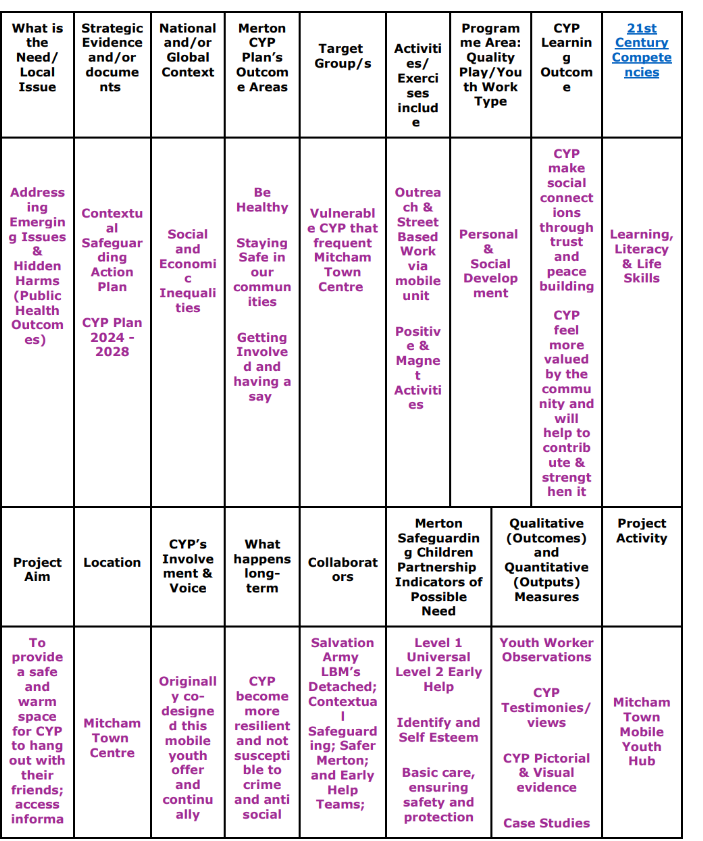
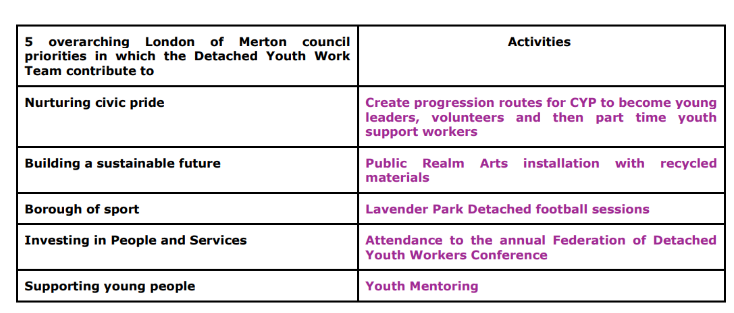
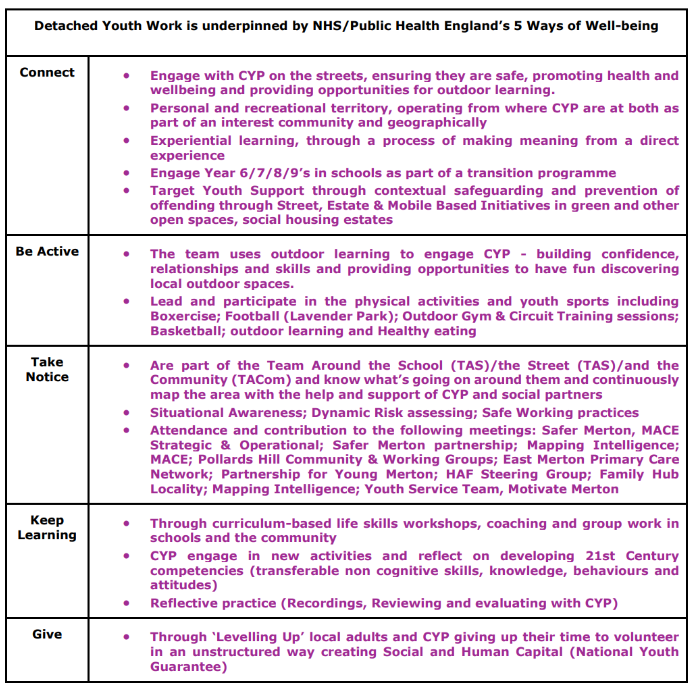
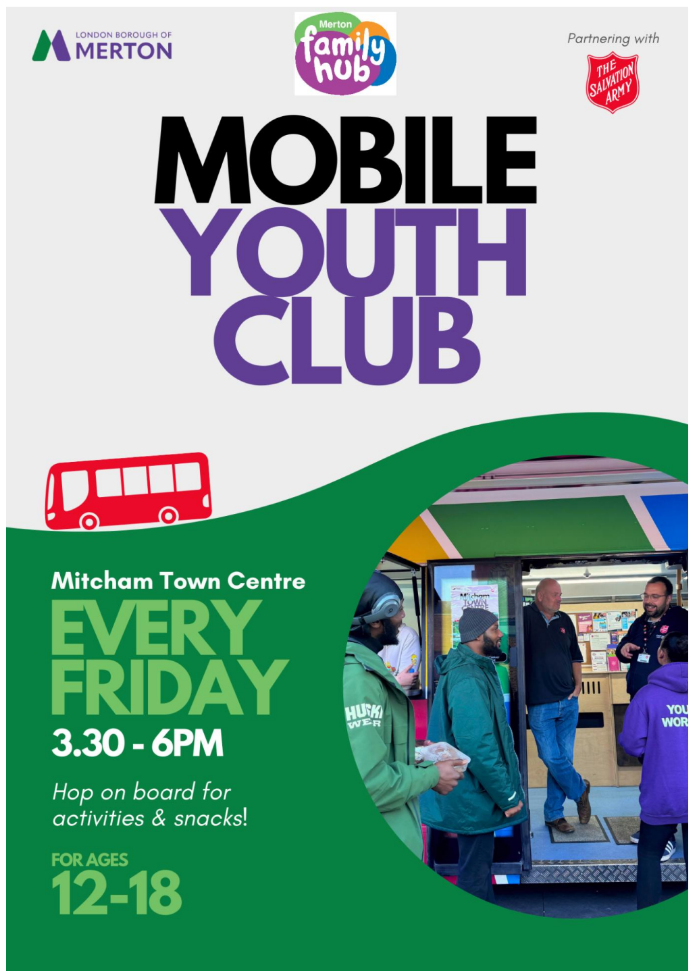
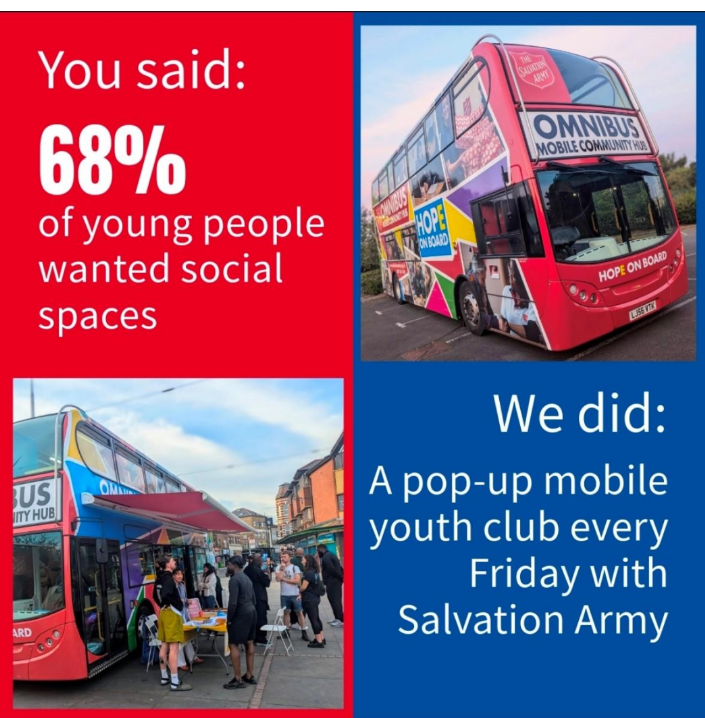
London Borough of Redbridge – Your Choice
Summary of project: Your Choice is an initiative designed to support young people affected by and vulnerable to youth violence.
Key Contact: Lakshmi Sharma, Senior Assistant Educational Psychologist Lakshmi.sharma@redbridge.gov.uk
Read more about this project
Team: Redbridge Educational Wellbeing Team – Claudia Noel-Michael, Marco Temes Serrano, Nuno Felix, Nesrin Fehmi, and Lakshmi Sharma
Main Submission:
The Redbridge Educational Wellbeing Team (REWT) have been actively involved in the Your Choice programme, an initiative designed to support young people affected by and vulnerable to youth violence. It’s developed by the London Improvement and Innovation Alliance and supported by London’s Violence Reduction Unit, and focuses on providing a person-centred approach to reduce youth offending.
REWT is committed to enhancing the mental health and emotional well-being of children and young people. As Educational Psychologists (EPs), Assistant Educational Psychologists (AEPs), and working with Emotional Literacy Support Assistants (ELSAs) in schools, REWT aims to provide early intervention and preventative support. REWT’s approach aligns with the key findings of the Green Paper (2007), emphasising the need to transform mental health support in schools and provide early and effective interventions. Through our participation in Your Choice, REWT has supported schools to foster a child-centred approach to understand and equip young people with coping strategies and make positive decisions through goal setting and behavioural activation.
The focus on utilising ELSAs combined with Your Choice knowledge, has contributed to REWT’s success. ELSAs work closely with young people, developing trusting relationships and provide support to navigate emotional experiences. Involving ELSAs in Your Choice, aligns closely with REWT’s core goal ‘Nurturing mental health and resilience in Redbridge school communities’. By offering a safe space for young people to talk and learn about mental health, REWT helps to reduce stigma and promote emotional resilience within school and wider communities.
REWT were involved in the pilot stage of Your Choice. REWTs AEPs delivered intensive support to young people in Redbridge secondary schools, utilising CBT techniques and goal setting tasks to give young people agency and control over their lives. The successful engagement of young people supported them to work towards their desired goals e.g., one young person gained the confidence to apply for college and was offered two conditional places. these success led to REWTs involvement in the current Efficacy phase of the programme, extending to two groups of schools, control and treatment.
While in most LA’s this work is led by social workers and youth services, in Redbridge it’s uniquely delivered in schools by EPs and trained ELSAs, emphasising early intervention within community spaces aligning with the I-Thrive Framework and the principles of the Green Paper to transform mental health support. The key aspect of REWT’s model is the collaborative work between AEPs, EPs, and ELSAs to deliver a high-intensity, CBT-informed intervention to support young people. Through training, supervision, and mentoring, REWT ensures that ELSAs have the key skills to deliver Your Choice effectively. AEPs provide support to ELSAs offering weekly mentoring and assisting with operational challenges. Monthly clinical supervision, led by an EP who is also the clinical lead for the programme, further strengthens the quality of support provided to ELSAs. Supervisions involve learning and reflective spaces for ELSAs around contextual safeguarding, youth offending and the programme delivery. All topics delivered are evidence based and appropriate to supporting young people affected by youth violence.
REWT also developed the role of project coordinator, an SAEP within the team, to oversee the programme’s implementation in schools including managing data collection, liaising with school leadership and ensuring that all aspects of the programme are running smoothly by facilitating communication between REWT and school staff to ensure that the programme remains effective and responsive to the needs of the young people involved.
Our model has faced several challenges during the programme. The primary challenges included operational and systemic issues within schools, such as difficulties in finding time for ELSAs to deliver sessions due to competing school commitments, as well as staff retention, which impacted the consistency of sessions, school policies related to safeguarding, exclusion, and the logistics of taking students out into the community. To address challenges, REWT has been flexible in providing adapted support to individual schools, having a collaborative approach to overcome barriers and maintain the delivery of the programme.
Despite the challenges faced, the Your Choice programme has had a positive impact on Redbridge school community. Feedback from school staff indicates improvements in student attendance, behaviour, engagement in lessons, and relationships with peers. Young people have reported feeling supported by their ELSAs, stating that they feel listened to and that the sessions have helped them better understand themselves. As a result, the programme has contributed to increased confidence, young people have learnt coping skills and have improved social relationships.
Delivering Your Choice in schools has also highlighted the importance of contextual safeguarding and the need for a preventative approach to supporting vulnerable young people. Through training, events and signposting, REWT has supported schools to reach out to community services to foster partnerships with local organisations to support young people. REWT has helped schools better support students impacted by youth violence. The success of the programme in Redbridge has highlighted the value of early intervention and personalised community-based support for this cohort of vulnerable young people.
Funding is essential in the positive outcomes of REWTs involvement in Your Choice. REWT allocated part of the funding to support schools in delivering the programme, including providing resources for ELSAs and compensating for the time and planning required to facilitate sessions. Funding also supported the roles of the clinical lead and project coordinator, ensuring that the programme maintained high levels of quality assurance and oversight. In addition, funding has and will enable REWT to organise celebration events for the young people and staff involved in the programme, providing an opportunity to recognise their efforts and achievements. Although the programme has been successful, there are still areas for improvement, particularly for ensuring the sustainability of the model across all schools.
REWT’s involvement shows that ELSAs, AEPs, and EPs, collaborative approach provides effective support to young people in the community. Despite challenges, REWTs adaptations and the positive impact on young people and school communities fosters emotional resilience and reducing youth violence. REWT’s innovative approach shows how educational psychology can contribute to supporting young people’s mental health, wellbeing and fostering positive outcomes
in school communities.
London Borough of Redbridge – Redbridge Youth Intelligence Hub
Summary of project: A weekly partnership information sharing forum designed to safeguard and protect children and young people in Redbridge who are at risk of, or exposed to, sexual or criminal exploitation, violence, gangs, knife crime or other forms of exploitation.
Key Contact: Catherine Worboyes, Assistant Director, Children’s Social Care catherine.worboyes@redbridge.gov.uk
Read more about this project
Team: Child Protection
Partners: Metropolitan Police, health, Youth Justice, and Youth services.
Main Submission:
The Youth Intelligence Hub was set up in October 2022 following an incident in which a young person was stabbed and seriously injured in a confrontation involving two rival groups of young people in Redbridge. In the subsequent professionals’ meeting, it became clear there was soft intelligence known to agencies and the voluntary sector which, if shared, could potentially have prevented the incident. At this meeting it was flagged that a regular meeting to share ‘live’/real time soft or hard intelligence pertaining to youth violence, criminal exploitation, gangs, knife crime, criminality or CSE, would enhance the partnership’s ability to keep young people safe in Redbridge.
As a result, the Redbridge Youth Intelligence Hub was formed, to safeguard and protect children and young people in Redbridge involved in or being groomed into violence, gangs, knife crime or any other form of criminality including sexual exploitation. Senior operational leads across the partnership committed through the Youth Intelligence hub to sharing real time intelligence/information about youth crime, violence and exploitation and to use this intelligence to:
- Respond proactively to new and emerging intelligence
- Agree and coordinate an immediate response across agencies
- Inform targeting/deployment of policing and community safety resources
- Agree actions that agencies could take to disrupt criminal activity and safeguard young people
- Identify young people at risk and agree any additional actions required to safeguard them
The Youth Intelligence Hub is a weekly face to face partnership meeting, chaired by Children’s Social Care. In addition to Children’s Services representative, the meeting includes colleagues from the police (Safer Schools officers, Safer Neighbourhoods officers and when required officers from the Gangs unit), Health (0-19 services; safeguarding leads from the local emergency department), the Exploited Children’s Team, Youth Offending Service, Youth Services, Education, Anti-Social Behaviour Team and Community Safety, amongst others.
The Youth Intelligence Hub is now well embedded in partnership working in Redbridge, with soft intelligence being shared weekly from many sources. At the meeting attendee’s share real time intelligence regarding emerging risks to young people. The meeting focuses on actions to disrupt perpetrators and criminal activity, to coordinate a multi-agency response. Attendees initially work through the intelligence to identify the root cause of the problem/issue being
discussed, this in turn leads to a clear plan with attendees taking away actions for their area to address the risks and concerns.
The meeting is the epitome of an open, collaborative and supportive environment across teams and partner agencies. The meeting is more than the sum of its part demonstrating what can be achieved when agencies come together to focus on an issue and commit resources to address it.
Within months, the Youth Intelligence Hub was making a big difference in disrupting and preventing exploitation, including a case of an organised criminal gang perpetrating CSE whereby girls were being taken to known and unknown addresses and sexually assaulted; concerns around men grooming young women at a local college; concerns about the use, purchase and selling of vapes amongst young people and the potential links to gangs/vape wars and anti-social/criminal behaviour in an area of the borough due to the lack of a police presence.
More recently successes included two specialist police operations. One of these focussed on an organised criminal gang working across several local authorities with an active investigation by a specialist police unit responding to the intelligence gathered through the information sharing at the Youth Intelligence Hub. The other resulted in the taking down of several county lines between London and Ipswich, again because of intelligence shared. The Metropolitan Police County Lines Investigation Team describe the Youth Intelligence Hub as a brilliant example of collaborative working and cited the sharing of Local Authority information as an enabler for them to quickly identify those involved in criminality and to take actions thereafter.
Each success has raised the profile of the meeting and as a result membership of the meeting has grown. Most importantly, public spaces in Redbridge have been made safe for children, young people and the wider community.
Supporting Information:
Youth Intelligence Hub Annual Presentation
Youth Intelligence Hub Annual Report 2023-24
London Borough of Redbridge – Family Help – Contextual Safeguarding
Summary of project: A specialist exploitation team supporting Redbridge children and young people at risk of or having experienced criminal, sexual or other forms of exploitation outside the home.
Key Contact: Catherine Worboyes, Assistant Director, Children’s Social Care catherine.worboyes@redbridge.gov.uk
Read more about this project
Team: Specialist Exploitation Team (SET) – Sabina Samad, Head of Service, Siobhan McGeary, Service Manager, Family Help: Contextual
Safeguarding.
Partners: Frenford clubs, Box Up crime, Red Light Busking and Be Heard as One
Main Submission:
In Redbridge, we have recognised the unique needs of our children who are at risk of extra familial harm – the need for trusting relationships with professionals, to receive intensive specialist support and to be met where they are at and kept safe – and we have built a Specialist Exploitation Team (SET) to deliver this service and to keep young Londoners safe.
The SET is comprised of experienced specialist exploitation social workers who work directly with the child and their family. Through forensic analysis of referrals, SET ensures that only children who are experiencing exploitation are allocated to the team, ensuring caseloads are kept low – an average of six to eight children per worker. The combination of direct casework, manageable caseloads, specialist expertise and community partnerships, enables SET social workers to develop deep, meaningful, professional relationships with children and families, frequently spending time with them and focusing on establishing relationships and understanding their unique needs.
DeShawn* (not his real name) is one of hundreds of children who have changed their trajectory through working with SET and a voice that we would like to showcase and celebrate in this application. Subject to a child protection plan and transferred to Redbridge by another local authority, there were significant extra-familial harm concerns for DeShawn – he was just 15 years old, frequently missing and being heavily exploited through the drug supply trade. At the point of transfer, DeShawn and his parents were described as ‘hard to reach’ and ‘non-engaging.’ DeShawn was on the ‘edge of care.’ DeShawn was allocated to C, an experienced social worker within the SET. C was relentless in her approach to building a relationship with DeShawn, meeting him in places of his choosing
like community spaces, home and his alternative school provision. In the early weeks when DeShawn was arrested, C was the first to visit him in custody and attended each court hearing with him, gaining his trust by always showing up and being consistent. Amidst the crises, C made sure she was not just learning about the risks to DeShawn, but who he is as a person – what makes him happy, what he fears and what his hopes and dreams are.
As his trust with C grew, DeShawn developed the confidence to access the specialist interventions that SET have to offer. DeShawn accessed and continues to access the SET’s weekly Engagement Groups. These groups are designed to be as accessible as possible for children experiencing extra-familial harm – they take place after hours, are run by SET social workers and offer a safe community for vulnerable young people to build trusted relationships with safeguarding professionals. The Engagement Groups also bring different services to the young people – including careers, sexual health and drug and alcohol services to name a few – which has been particularly successful in engaging young people with services they may not ordinarily seek out.
Through innovative interventions, SET draw on a range of partners and community resources to build bespoke plans that divert children from harm and risk. This can only be achieved by investing time in getting to know them but also cultivating relationships with partners. C quickly identified that DeShawn’s passion is music; he is an incredibly gifted lyricist and when he performs, his whole demeanour changes.
Knowing this, C was able to engage DeShawn with the Red Light Busking service, a community service diverts vulnerable young Londoners from harm through music. DeShawn was supported to participate in this programme, receiving guidance around his music and spending time recording in a music studio, provided by one of our community partners with whom we work closely to provide a safe space and positive activities for young people open to the SET.
SET recognises the importance of role models, and in DeShawn’s case the importance of him having relatable role models with experiences that he could relate to. C drew on another SET resource, Be Heard as One – a specialist mentoring service. Here, DeShawn was allocated a male mentor with personal experience of criminal exploitation, gang affiliation and the criminal justice system. The mentoring relationship with this professional was pivotal for DeShawn. Connecting DeShawn with somebody who shares elements of his lived experience and speak truth to him about the journey he is on, is incredibly powerful means of connecting with him.
SET ensure that children have realistic options that meet them where they are at, a critical element of deterrence from criminal exploitation. Through tireless relationship-based work, they seek to understand the push and pull factors for extrafamilial harm on an individual basis without trying to make the young person fit a mould or pathway. In DeShawn’s case, this meant listening to his experiences of being excluded from mainstream school and being unsuccessful in his GCSEs and looking at what his other options were.
DeShawn’s life looks remarkably different from before his work with SET. He has never refused to see his social worker – he actively seeks her out; he chooses to attend the weekly Engagement Groups; he no longer goes missing and his contact with the police has been infrequent; he has a part-time job at McDonalds and is getting ready to make a music video. The SET approach has led to a positive engagement from DeShawn’s parents, who now attend all meetings with the local authority. The risks to DeShawn have reduced so significantly, he is no longer on a Child Protection Plan.
In our commitment to building safety for young Londoners, Redbridge recently launched its new Contextual Safeguarding Service. At this launch, DeShawn stood in front of a crowd of over 100, including council leaders, community partners and the Department for Education. He performed a song he had written about his experience of SET, so confident that he was barely recognisable from the young person we started working with. His performance was nothing short of incredible, and he received a standing ovation.
DeShawn’s is one story, of which there are many, about the creative ways in which Redbridge is building safety for young Londoners
Supporting Information:
BIZZ – ASPIRATION STATION AUDIO
London Borough of Redbridge – The Specialist Exploitation Team (SET)
Summary of project: We have recognised the unique needs of our children who are at risk of extra-familial harm – the need for trusting relationships with professionals, to receive intensive specialist innovations and to be met where they are at and kept safe – and we have built a Specialist xploitation Team (SET) to meet this need.
Key Contact: Sabina Samad, Head of Service sabina.samad@redbridge.gov.uk
Read more about this project
Team: Specialist Exploitation Team – Sabina Samad (Head of Service), Siobhan McGeary (Service Manager)
Main Submission:
In Redbridge, we have recognised the unique needs of our children who are at risk of extra familial harm – the need for trusting relationships with professionals, to receive intensive specialist support and to be met where they are at – and we have built a Specialist Exploitation Team (SET) to deliver this service and to keep young Londoners safe.
The SET is comprised of experienced specialist exploitation social workers who work directly with the child and their family. Through forensic analysis of referrals, SET ensures that only children who are experiencing exploitation are allocated to the team, ensuring caseloads are kept low – an average of six to eight children per worker. The combination of direct casework, manageable caseloads, specialist expertise and community partnerships, enables SET social workers to develop deep, meaningful, professional relationships with children and families, frequently spending time with them and focusing on establishing relationships and understanding their unique needs.
DeShawn* (not his real name) is one of hundreds of children who have changed their trajectory through working with SET and a voice that we would like to showcase and celebrate in this application. Subject to a child protection plan and transferred to Redbridge by another local authority, there were significant extra-familial harm concerns for DeShawn – he was just 15 years old, frequently missing and being heavily exploited through the drug supply trade. At the point of transfer, DeShawn and his parents were described as ‘hard to reach’ and ‘non-engaging.’ DeShawn was on the ‘edge of care.’
DeShawn was allocated to C, an experienced social worker within the SET. C was relentless in her approach to building a relationship with DeShawn, meeting him in places of his choosing like community spaces, home and his alternative school provision. In the early weeks when
DeShawn was arrested, C was the first to visit him in custody and attended each court hearing with him, gaining his trust by always showing up and being consistent. Amidst the crises, C made sure she was not just learning about the risks to DeShawn, but who he is as a person – what makes him happy, what he fears and what his hopes and dreams are.
As his trust with C grew, DeShawn developed the confidence to access the specialist interventions that SET have to offer. DeShawn accessed and continues to access the SET’s weekly Engagement Groups. These groups are designed to be as accessible as possible for children experiencing extra-familial harm – they take place after hours, are run by SET social workers and offer a safe community for vulnerable young people to build trusted relationships with safeguarding professionals. The Engagement Groups also bring different services to the young people – including careers, sexual health and drug and alcohol services to name a few – which has been particularly successful in engaging young people with services they may not ordinarily seek out.
Through innovative interventions, SET draw on a range of partners and community resources to build bespoke plans that divert children from harm and risk. This can only be achieved by investing time in getting to know them but also cultivating relationships with partners. C quickly identified that DeShawn’s passion is music; he is an incredibly gifted lyricist and when he performs, his whole demeanour changes. Knowing this, C was able to engage DeShawn with the Red Light Busking service, a community service diverts vulnerable young Londoners from harm through music. DeShawn was supported to participate in this programme, receiving guidance around his music and spending time recording in a music studio, provided by one of our community partners with whom we work closely to provide a safe space and positive activities for young people open to the SET.
SET recognises the importance of role models, and in DeShawn’s case the importance of him having relatable role models with experiences that he could relate to. C drew on another SET resource, Be Heard as One – a specialist mentoring service. Here, DeShawn was allocated a male mentor with personal experience of criminal exploitation, gang affiliation and the criminal justice system. The mentoring relationship with this professional was pivotal for DeShawn. Connecting DeShawn with somebody who shares elements of his lived experience and speak truth to him about the journey he is on, is incredibly powerful means of connecting with him. SET ensure that children have realistic options that meet them where they are at, a critical element of deterrence from
criminal exploitation. Through tireless relationship-based work, they seek to understand the push and pull factors for extrafamilial harm on an individual basis without trying to make the young person fit a mould or pathway. In DeShawn’s case, this meant listening to his experiences of being excluded from mainstream school and being unsuccessful in his GCSEs and looking at what his other options were. DeShawn’s life looks remarkably different from before his work with SET. He has never refused to see his social worker – he actively seeks her out; he chooses to attend the weekly
Engagement Groups; he no longer goes missing and his contact with the police has been infrequent; he has a part-time job at McDonalds and is getting ready to make a music video. The SET approach has led to a positive engagement from DeShawn’s parents, who now attend all meetings with the local authority. The risks to DeShawn have reduced so significantly, he is no longer on a Child Protection Plan. In our commitment to building safety for young Londoners, Redbridge recently launched its new Contextual Safeguarding Service. At this launch, DeShawn stood in front of a crowd of over 100, including council leaders, community partners and the Department for Education. He performed a song he had written about his experience of SET, so confident that he was barely recognisable from the young person we started working with. His performance was nothing short of incredible, and he received a standing ovation. DeShawn’s is one story, of which there are many, about the creative ways in which Redbridge is building safety for young Londoners
Royal Borough of Kingston Upon Thames & London Borough of Richmond (Achieving for Children) – Transitional Safeguarding (violence and exploitation) – VASA
Summary of project: Community safety and violence reduction approach to transitional safeguarding, to support adolescents transitioning into adulthood where there are ongoing concerns around violence and exploitation.
Key Contact:
Roberta Evans, Associate Director Family and Adolescents
roberta.evans@achievingforchildren.org.uk
Stephanie Royston-Mitchell, Community Safety and Resilience Principal – Safer Kingston Partnership
stephanie.royston-mitchell@kingston.org.uk
Read more about this project
Team: Multi-Agency Response
Partners: Contextual Safeguarding Leads, Leaving Care, Targeted Youth Support, Your Healthcare (community health provider), SWL St Georges Mental Health Trust, Substance Misuse Team, Adult Social Care, Virtual School, Housing, voluntary and community sector services e.g. Refuge, Crying Sons and Rescue and Response
Main Submission:
Kingston and Richmond Safeguarding Children’s Partnership (KRSCP) identified a gap in provision for young people transitioning into adulthood, when there is a
medium to high risk of violence and/or exploitation. Safeguarding Adult Review (Slyvia SAR) highlighted transitional safeguarding issues were not fully understood, resulting in significant gaps in the service the young person received.
KRSCP, Kingston Safeguarding Adults Board (KSAB) and Community Safety Partnership (CSP) committed to improving the transitional safeguarding response
and agreed as a shared priority. Through effective systems leadership, we have led the way on this work, driving change and innovation. We have inspired practitioners to develop a shared understanding of transitional safeguarding, develop creative solutions and improved collaboration to safeguard our most vulnerable adolescents.
A Multi-agency task and finish group, chaired by the Associate Director Family and Adolescents, reviewed the multi agency response, pathways and support offer for adolescents transitioning into adulthood. Identified:
Children’s safeguarding and support usually end at 18, but experiences of harm and trauma during childhood, youth and early adulthood may continue to affect
people across the life course, with unmet needs requiring complex (as well as potentially costly) interventions later in life. For example some of our young adults
are causing harm or exploiting others, they are our future parents and/or present later as adults with multiple and complex needs.
Unmet needs for young people transitioning into adulthood where there were ongoing risks of violence and/or exploitation, particularly if they experienced poor
education pathways, substance misuse issues, mental health, family breakdown, or criminal justice processes.
Several panels oversee different groups of vulnerable adults, but not one fit-for-purpose to support those with ongoing risk of violence and/or exploitation, as per the London Child Exploitation Operating Protocol 2021.
VASA protocol developed and includes the referral pathway and Terms of Reference for the VASA Panel, which oversees referrals for young adults with
continued significant risk and whereby a problem solving approach can be applied alongside the additional resources available.
A bespoke budget for the VASA panel, ensuring that the young person was at the centre of the support plan and involved in decisions around the type of support that would best help them.
Exploitation Training programme delivered to build professional’s confidence in responding effectively to exploitation.
Additional investment for 2024-26 includes:
● 18+ Missing and Exploitation Worker and Contextual Safeguarding Lead (£45K)
● Crying Sons Community Outreach (£50K)
● VASA Coordinator (£20K)
● Bespoke budget for VASA panel (£10K)
Exploitation training ensured participants gained a comprehensive understanding of exploitation dynamics and transitional safeguarding. By adopting a whole
system approach, attendees learned how collaboration between various stakeholders is essential for effectively identifying, preventing and addressing exploitation. Attendees were equipped not only to recognise, prevent, and address exploitation risks but also to contribute to disrupting and dismantling exploitation networks.
VASA Panel
66 referrals, mostly from Achieving for Children (AfC) as part of the transitional step-down/exit plans. Consistent for the past two years, showing the importance of
the panel.
65% of referrals are for males, mostly at risk of criminal exploitation. Females most likely to be at risk of sexual exploitation or all three (sexual exploitation, criminal exploitation, high harm).
44% of cases have substance misuse and mental health concerns, heightening levels of vulnerability and exploitation. Housing emerged as the most impactful factor, with 30% of cases experiencing a two-level reduction in risk. Crime and exploitation risk levels showed stability and 30% seeing a reduction by one level.
The panel has been instrumental in supporting case workers to understand risks they may not have previously understood. Minimal increases in risks, with 26% of cases affected. Among these, relationships with others and mental health were the most common areas of concern. Panel discussions played a crucial role in identifying areas where adolescents needed support, uncovering needs that were not initially recognized by the referring agency (65% / 14 cases).
Commissioned Research in Practice to review our transitional safeguarding approach to ensure continuous improvement. This presentation outlines the work. A report will be completed by Research in Practice which will assist us in further developing best practice and mainstreaming this work.
Dez Holmes (Research in Practice) has provided the following feedback:
To my knowledge, Kingston are the first local area in the country to use the community safety and violence reduction agenda as the vehicle to develop their Transitional Safeguarding approach. This has been a hugely exciting opportunity for Research in Practice to learn alongside Kingston colleagues, and we have been delighted by the positive engagement of professionals across all key agencies.
By building on strengths, including the well-established VASA panel, this project aims to refresh and embed an understanding of Transitional Safeguarding across the partnership. Through focus groups and workshops with multi-agency colleagues we have heard first-hand how committed local professionals are to ensuring all young people can be and feel safe as they make their journey into adulthood. It is a privilege to be supporting this kind of innovation.
Voice of the child
Our young people told us:
- “Not much in the way of expectations, being in various other countries that are useless. I hoped I’d get some kind of support but didn’t know what that would look like and I didn’t expect as much support as I got “
- “Getting financial support with food vouchers which has been really helpful and they were really quick in responding and would always grant the application.”
- “All round great support and a massive help to me. Fast response times and very supportive in terms of other help such as mental health referrals.”
The model is transferable to other boroughs as it focuses on systems change, using existing resources. Our transitional safeguarding approach has demonstrated that a small amount of investment has made a significant difference to the outcomes for some of our most ‘at risk’ young people as they transition into adulthood and who would not have had access to any support.
Supporting Information:
VASA protocol
Research in Practice Overview
Sylvia SAR
Feedback from professionals:
“Initially it felt a bit tedious, with the referral to be completed and having to wait for the panel. This was probably because I was after a “quick fix” for my young person. Once I became part of the process, it all made more sense and why things are done the way they are. So it has been a learning process for me. The support has been excellent and those I have been involved with have been very helpful.”
“I feel it was helpful to have lots of practitioners around the table to seek their views in a way that I may not have reflected on, as we all come from different perspectives and areas of expertise. “
“A big thank you to all those that helped my young person feel safer and strong enough to make a disclosure that hopefully has taken him away from some very dangerous people.”
Westminster City Council – Using Video Interactive Guidance with families in Westminster
Summary of project: We have been offering a new and innovative strength-based assessment and intervention method called Video Interactive Guidance, with families in parenting assessments.
Key Contact: Isabella Jewell, Head of Business Intelligence, Strategy & Children’s Workforce Development
Read more about this project
Team: Children and Family Services (Clinical team and Social Work Teams)
Main Submission:
Beginning in March 2020, the Clinical Team in Westminster, working jointly with social work teams, established an embedded service for carrying out, the majority of, family assessments for care proceedings within the service. This is work that has traditionally been outsourced by local authorities when engaging in the Family Justice System. Assessments are now carried out by our clinical and social work staff in Westminster. They develop from the social worker’s existing relationship with, and knowledge of, the family, so as not to introduce too many new professionals to parents and children, at an often stressful and confusing time for them. A clinician joining the assessment brings therapeutic expertise and a new perspective to the assessment. By emphasising the importance of the joint working between clinicians and social workers, social workers’ confidence in their own expertise and knowledge of the families is developed.
A significant advantage for families in Westminster is that the therapeutic interventions is available within the service, so can be offered during the assessment and/or accessed more rapidly and easily following recommendations from the assessments.
An innovative element of parenting assessments and further intervention we offer is video interactive guidance (VIG). The service developed as there were systemic therapists within the team who had previously used VIG within parenting assessments in other services. It is a strength-based assessment and intervention method, which uses filming ‘better than usual’ moments of interaction between parents and their child or children to build strengths within the family. The first step is helping the parent or carer to establish a ‘Helping Question’ by helping them to focus on what they would like to change. The practitioner aims to establish a collaborative relationship, which helps parents to identify and name the areas they want to achieve change in. The VIG practitioner and parent (and child) are then actively involved in creating a film of a successful interactions. The VIG practitioner then edits the film, and in a separate session, called the ‘Shared Review’ shows short excerpts of successful moments to the parent. These are intentionally showing strengths only and are not suitable for evidence in court. Together, parent and VIG practitioner establish what worked well.
Our use of VIG in assessments supports parents to reflect on their parental role, encourage parents to make sense of their thoughts/actions and supports parents to actively explore the changes needed to improve the quality of their relationship with their children.
Impact and feedback
We have utilised VIG in a number of assessments and have seen significant benefits for those families. One mother, who had VIG during her parenting assessment, although the assessment did not recommend that her younger two children return to her care, still requested a second round of VIG post -assessment to continue improving the relationship with her daughter who was in foster care. She described the stills/clips from the VIG as ‘the ‘blueprint’ of who she is, who she can be, that had become lost during the very difficult time for her and her children.’
When asked what it like to experience VIG during the parenting assessment, she said it ‘gave a sense of hope’ and she felt it ‘allowed the assessors to see something else during the assessment beyond a problem saturated story.’ She spoke about VIG ‘planting the seeds for a new narrative about herself.’ Through the VIG she was able to see moments where she was giving something important to her daughter and their relationship. She felt motivated to continue to work on herself and her relationship with her child. Although the conclusion of care proceedings recommended long-term foster care, the judge decided to increase contact with mum as he felt that the mother’s relationship with the child had improved and was a very positive influence on
the child. This recommendation was atypical for the courts, and positive for the mother and child and the possibility of reunification in the future.
In another assessment, the child stayed with dad, who had not previously been the primary carer, during the assessment process and remained living with dad post assessment. We saw changes during the intervention of dad offering his son more attuned interactions and responding more to the initiatives of his child.
One assessment resulted in mum and baby being moved from a foster placement into the community following a successful parenting assessment. The positive and attuned relationship mum has with the baby was positively commented on in her parenting assessment. Another assessment resulted in a son returning to mum’s care, following him being in a family and friends’ placement. Mum was able to attune to her son better through the VIG work, which enabled her to feel that he was also listening better to her when she needed to direct his behaviour.
In a number of the VIG assessments we have carried out, the parents have requested a further intervention of VIG following on from the parenting assessment, including from parents where the parenting assessment was negative. They all expressed that they felt VIG had been a good experience for them, they had learnt a lot from the intervention, and they wanted to extend that learning following on from the assessment.
Practitioners have expressed that VIG has enabled them to maintain a positive relationship with parents, which has continued post the parenting assessment. Having an established and positive relationship with the practitioners then supported the parent accessing further support following the assessment.
Next steps
We are currently at the stage of training more practitioners, social workers, early help practitioners and therapists, so VIG can be offered more routinely in assessments, thinking particularly about opportunities within the family hubs and during single assessments at the front door. Two therapists from the service presented on our work in parenting assessments at the Association of Video Interaction Guidance UK International conference this year, which was positively received by their peers. This presentation included a video interview with a parent four months after her second VIG intervention to explore the mother’s experience of VIG both within the parenting assessment and post assessment.
Practice Spotlight Navigation Panel:
Does your submission information need updating?
Each submission included within the Practice Spotlight Digital Area has been approved by the relevant local authority DCS and Practice Leader prior to inclusion, However, if you spot something in your submission that needs updating such as a change in key contact or a supplementary resource of video that you’d like included then please reach out to LIIA colleagues below;