RESPONSES: Innovations and developments in how services support vulnerable young people
“Care as a verb not a noun: care is something we do for children, not a place we put them” – Dez Holmes, Director of Research in Practice

Navigate SAIL
Topics in this Section
Designing services to keep young people safe
In the first of our examples Sara Rahman describes the approach which is being taken in Lewisham where, as a Families First for Children pathfinder, the children’s services partnership has designed and implemented a Multi-Agency Adolescent Protection Team at the heart of its reformed services.

London continuum of need
Sound decisions in safeguarding rely on practitioners’ ability to synthesise information from a range of sources, critically evaluate the level and nature of risk, and remain alert to missing, conflicting, or ambiguous evidence.
High-quality safeguarding depends on high-quality decision-making. This is particularly true when working with adolescents, whose experiences often span multiple environments and whose vulnerabilities may be complex, dynamic, and less immediately visible.
A shared understanding of thresholds of need is crucial for ensuring consistent and appropriate responses across all services. In London, the key reference point for this is the London Continuum of Need Matrix. Although not a statutory instrument, it has been endorsed by all of London’s Local Safeguarding Children Partnerships as a shared reference point for practitioners. The Matrix provides a common language and framework for identifying risk and vulnerability, encompassing both familial and extra-familial harm.
Its purpose is to support consistent and proportionate responses to concerns by outlining four levels of need and offering illustrative indicators for each. These levels range from universal support to acute or specialist intervention, helping professionals to make informed judgments about when and how to escalate concerns.
The document sets out a clear framework for understanding different levels of need and the appropriate service responses. It emphasises the importance of early help, outlines the graduated approach to intervention, and promotes a common language for assessing and discussing concerns. The aim is to support informed and proportionate decision-making, ensuring that children and young people receive the right support at the right time.
It stresses that all practitioners need to be alert to bias and inequality that can affect decision making and to reflect on assumptions related to identity, background and behaviour.
- Adultification – seeing children as more mature and less vulnerable than they are
- Diffusion of responsibility – waiting for someone else to act
- Source bias – judging information by who says it, not what it is
- Confirmation bias – focusing on information that supports what you already believe
- Risk aversion – avoiding uncertain options even when they may be better
While all sections of the matrix are relevant to young people, there are specific sections which have particular relevance to working with adolescents. Notably, these include:
- Education
- Sexual Abuse or Activity
- Police Attention
- Extra Familial Harm
This document should be used alongside the London Safeguarding Children Procedures to support thoughtful, and safe decision-making.
Safeguarding Adolescents in the MASH
In practical terms, the London Continuum of Need Matrix should be an essential point of reference from the outset, particularly in the Multi-Agency Safeguarding Hub (MASH).
This is especially important when working with adolescents, whose experiences often span multiple contexts and whose vulnerabilities may be harder to interpret.
Practitioners in the MASH should avoid applying thresholds solely on the basis of the referral content and instead remain alert to the full range of possible, sometimes overlapping, harms whether from family relationships, peer associations, exploitation, online activity, or community dynamics. It is vital that practitioners in the MASH can see beyond a binary distinction between harm within the home and harm outside it.

Continuum of Need – Useful Links
ROTH (Risk Outside the Home) pathways
ROTH (Risk Outside the Home Pathways) were introduced by Professor Carlene Firmin in recognition of the fact that traditional child protection processes were rooted in assessing and intervening where intrafamilial abuse or neglect was occurring and where such harm was attributable to the (in)action of parents or carers.
These processes were often perceived as blaming and disproportionately focused on parental deficiencies and failure to ‘control’ their children and keep them safe.
The ROTH Pathway, as defined by Professor Carlene Firmin and embedded within the contextual safeguarding framework, recognises the importance of parents as partners and that significant harm to children and young people can occur in contexts beyond the family such as peer groups, schools, neighbourhoods, and online spaces.

The focus of a ROTH pathway is on the collective capacity of a partnership to safeguard young people at risk of significant harm, rather than solely their parents, As such is ensures a child protection level responses to children and young people who historically could have been screened out of child protection processes, not because they were not at risk of significant harm, but because that harm was not attributable to their parents or carers. It loses none of the oversight and rigour of child protection plans but does this using a contextual lens to assess and intervene where traditional child protection methods may not be sufficient or appropriate.
ROTH Pathways were designed to complement existing child protection pathways but:
- Focus on where a young person is safest and least safe – weighting the influence of different contexts to develop a plan for to build safety around young people.
- Recognise parents as potential protective partners in the child protection process, rather than the subject of the process.
- Adopt contextual safeguarding principles, to explore young people’s needs, access to safe adults and environmental drivers of harm in the contexts where young people are unsafe, and build the collective capacity of a partnership to respond accordingly.
- Use different tools and frameworks, such as context assessment and planning tools, safety mapping and peer assessment activities with young people, community-facing family group conferences, and other welfare-orientated interventions that move beyond ‘disruption’ and ‘dispersal’ as mechanisms for responding to extra-familial contexts.
In efforts to avoid the punitive feel of traditional Child Protection Plans, some local authorities have chosen to hold these cases at Child in Need level. However, this is not acceptable where the threshold for significant harm is met. Holding young people at children at Child in Need status in order to avoid statutory child protection processes undermines the seriousness of the risk and the legal safeguarding responsibilities involved. ROTH pathways provide a middle-ground – by removing the sometimes punitive and/or parent-focused feel of a child protection process, while also creating space for collaboration with parents/carers and young people to build safety for those who have reached a threshold of significant harm.
That said, some local authorities have found value in the ethos and methods of contextual safeguarding, and have embedded those approaches into Child in Need plans in cases where the harm is concerning but does not meet the threshold for significant harm. This is an appropriate and creative use of the framework – provided that the level of risk and legal duties are properly recognised.
In summary:
- If significant harm is suspected – whether within or outside the home – Section 47 enquires must be initiated.
- The ROTH pathway can enhance, but does not replace, statutory safeguarding processes.
- Contextual safeguarding approaches can be usefully incorporated into Child in Need planning - but not used to avoid child protection duties where they apply.
The following diagram taken from Binaries and Blurred Lines: The Ethical Stress of Child Protection Social Work in the Grey of Extra-Familial Harm (cite properly) illustrates the pathway.
Stages to risk outside of the home child protection pathway (in grey).
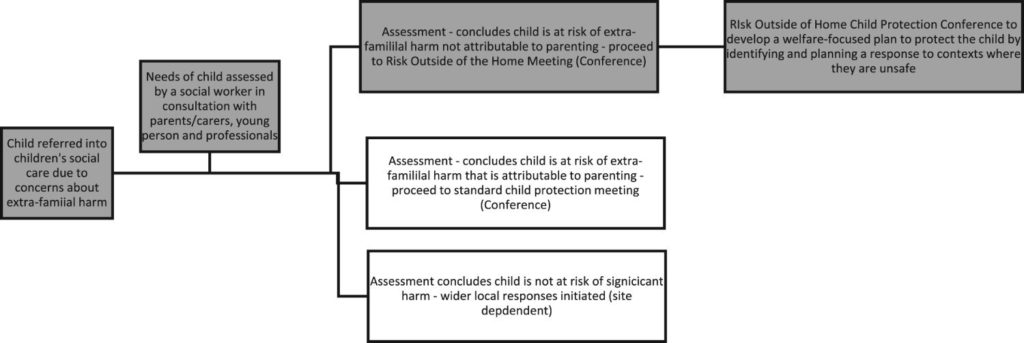
A ROTH pathway should sit alongside, not outside of, traditional child protection. The pathway is underpinned by s.47 and utilises the same activities such as strategy discussions, enquiries, conferences and reviews. Professionals involved in ROTH pathways may still connect into wider pathways within social care and the wider safeguarding partnership including:
- Panels and multi-agency structures that coordinate safeguarding responses to groups and locations.
- Screening and assessment tools tailored to extra-familial risk (e.g. exploitation risk assessments, peer assessments, safety planning in public spaces).

Contextual safeguarding – co-produced with Professor Carlene Firmin, Professor of Social Work at Durham University

Contextual Safeguarding is term introduced by Professor Carlene Firmin in 2015 to describe her vision of a safeguarding system that would be able to assess and intervene to create safety in the extra-familial contexts where young people often experience harm.
While adolescent safeguarding refers to the broad system of protecting young people from harm, contextual safeguarding is a specific approach within that system that emphasises the importance of understanding and responding to the social, school, peer, and community contexts in which harm occurs.
This focus makes it ideally suited to the complexities of adolescent risk, and it is widely recognised as a progressive way forward in safeguarding practice. However, as Professor Firmin notes, Contextual Safeguarding remains an evolving approach and is designed to offer a set of principles upon which practices/policies can be built rather than provide an established ‘model’.
As initially developed by Professor Firmin and her colleagues at Bedfordshire, and further implemented and enhanced at Durham University, Contextual Safeguarding:
- recognises relationships young people form in peer groups, neighbourhoods, communities, schools and online can feature harm, abuse and violence
- recognises that parents sometimes have little influence over these contexts, and young people’s experiences of extra-familial abuse can undermine child-parent and family relationships, and
- expands the objectives of child protection systems in recognition that young people are vulnerable to abuse in a range of different social contexts
The approach is organised into four system ‘domains’ or ‘objectives’, and underpinned by six values:
- Collaborative practice with young people, families, and communities—not as passive recipients of services, but as active partners in building safety
- A rights-based lens, upholding both children’s and broader human rights in the safeguarding process
- Strengths-based thinking, which seeks not only to mitigate risk but to build on existing protective factors and capabilities within individuals and their environments
- Grounding in lived realities, which means understanding safety and vulnerability from the perspective of the young person—not just through professional interpretation
- An ecological model, which views harm as shaped by layers of context—individual, group, place, system—and encourages intervention across those levels. It also recognises the influence of broader structural factors such as inequality, discrimination, and marginalisation.
- Caring: which means responding to extra-familial harm through relationships between young people, their parents/carers, wider communities, and with and between the professionals who support them, that are characterised by care.
This concept of Contextual Safeguarding has led many safeguarding partnerships to reconsider their models of assessment, intervention, and response. However, as the framework gained prominence, the term ‘Contextual Safeguarding’ began to be used more broadly – and inaccurately – to describe any response to risk outside the home or extrafamilial harm, rather than recognising that it is a distinct approach requiring a commitment to whole system change.
Even when that commitment is made, meaningful implementation requires intense and sustained change management to move beyond surface-level compliance.
This is not simply a structural shift – it’s a cultural and operational one. It demands that practitioners and organisations actively reflect on their own positioning and practice, move beyond case-by-case thinking, and commit to creating safety within the spaces where young people live their lives.
One of the greatest challenges to implementing a contextual safeguarding approach lies in confronting the professional habitus – the deeply ingrained dispositions, assumptions, and practices that shape how practitioners interpret risk, assign responsibility, and construct interventions.
Without conscious effort to challenge these default settings, even well-intentioned practitioners may revert to familiar, individualised approaches that fail to address the social and structural dimensions of harm. For it to be effective, practitioners must be willing to share power, think beyond individual cases, and design interventions that reshape the environments around young people, not just their behaviour within them.
Learn more about Contextual Safeguarding from Professor Carlene Firmin herself, in her below video prepared for SAIL.
Contextual safeguarding – Useful Links
London Borough of Redbridge – Family Help – Contextual Safeguarding
Summary of project: A specialist exploitation team supporting Redbridge children and young people at risk of or having experienced criminal, sexual or other forms of exploitation outside the home.
Key Contact: Catherine Worboyes, Assistant Director, Children’s Social Care catherine.worboyes@redbridge.gov.uk
Read more about this project
Team: Specialist Exploitation Team (SET) – Sabina Samad, Head of Service, Siobhan McGeary, Service Manager, Family Help: Contextual
Safeguarding.
Partners: Frenford clubs, Box Up crime, Red Light Busking and Be Heard as One
Main Submission:
In Redbridge, we have recognised the unique needs of our children who are at risk of extra familial harm – the need for trusting relationships with professionals, to receive intensive specialist support and to be met where they are at and kept safe – and we have built a Specialist Exploitation Team (SET) to deliver this service and to keep young Londoners safe.
The SET is comprised of experienced specialist exploitation social workers who work directly with the child and their family. Through forensic analysis of referrals, SET ensures that only children who are experiencing exploitation are allocated to the team, ensuring caseloads are kept low – an average of six to eight children per worker. The combination of direct casework, manageable caseloads, specialist expertise and community partnerships, enables SET social workers to develop deep, meaningful, professional relationships with children and families, frequently spending time with them and focusing on establishing relationships and understanding their unique needs.
DeShawn* (not his real name) is one of hundreds of children who have changed their trajectory through working with SET and a voice that we would like to showcase and celebrate in this application. Subject to a child protection plan and transferred to Redbridge by another local authority, there were significant extra-familial harm concerns for DeShawn – he was just 15 years old, frequently missing and being heavily exploited through the drug supply trade. At the point of transfer, DeShawn and his parents were described as ‘hard to reach’ and ‘non-engaging.’ DeShawn was on the ‘edge of care.’ DeShawn was allocated to C, an experienced social worker within the SET. C was relentless in her approach to building a relationship with DeShawn, meeting him in places of his choosing
like community spaces, home and his alternative school provision. In the early weeks when DeShawn was arrested, C was the first to visit him in custody and attended each court hearing with him, gaining his trust by always showing up and being consistent. Amidst the crises, C made sure she was not just learning about the risks to DeShawn, but who he is as a person – what makes him happy, what he fears and what his hopes and dreams are.
As his trust with C grew, DeShawn developed the confidence to access the specialist interventions that SET have to offer. DeShawn accessed and continues to access the SET’s weekly Engagement Groups. These groups are designed to be as accessible as possible for children experiencing extra-familial harm – they take place after hours, are run by SET social workers and offer a safe community for vulnerable young people to build trusted relationships with safeguarding professionals. The Engagement Groups also bring different services to the young people – including careers, sexual health and drug and alcohol services to name a few – which has been particularly successful in engaging young people with services they may not ordinarily seek out.
Through innovative interventions, SET draw on a range of partners and community resources to build bespoke plans that divert children from harm and risk. This can only be achieved by investing time in getting to know them but also cultivating relationships with partners. C quickly identified that DeShawn’s passion is music; he is an incredibly gifted lyricist and when he performs, his whole demeanour changes.
Knowing this, C was able to engage DeShawn with the Red Light Busking service, a community service diverts vulnerable young Londoners from harm through music. DeShawn was supported to participate in this programme, receiving guidance around his music and spending time recording in a music studio, provided by one of our community partners with whom we work closely to provide a safe space and positive activities for young people open to the SET.
SET recognises the importance of role models, and in DeShawn’s case the importance of him having relatable role models with experiences that he could relate to. C drew on another SET resource, Be Heard as One – a specialist mentoring service. Here, DeShawn was allocated a male mentor with personal experience of criminal exploitation, gang affiliation and the criminal justice system. The mentoring relationship with this professional was pivotal for DeShawn. Connecting DeShawn with somebody who shares elements of his lived experience and speak truth to him about the journey he is on, is incredibly powerful means of connecting with him.
SET ensure that children have realistic options that meet them where they are at, a critical element of deterrence from criminal exploitation. Through tireless relationship-based work, they seek to understand the push and pull factors for extrafamilial harm on an individual basis without trying to make the young person fit a mould or pathway. In DeShawn’s case, this meant listening to his experiences of being excluded from mainstream school and being unsuccessful in his GCSEs and looking at what his other options were.
DeShawn’s life looks remarkably different from before his work with SET. He has never refused to see his social worker – he actively seeks her out; he chooses to attend the weekly Engagement Groups; he no longer goes missing and his contact with the police has been infrequent; he has a part-time job at McDonalds and is getting ready to make a music video. The SET approach has led to a positive engagement from DeShawn’s parents, who now attend all meetings with the local authority. The risks to DeShawn have reduced so significantly, he is no longer on a Child Protection Plan.
In our commitment to building safety for young Londoners, Redbridge recently launched its new Contextual Safeguarding Service. At this launch, DeShawn stood in front of a crowd of over 100, including council leaders, community partners and the Department for Education. He performed a song he had written about his experience of SET, so confident that he was barely recognisable from the young person we started working with. His performance was nothing short of incredible, and he received a standing ovation.
DeShawn’s is one story, of which there are many, about the creative ways in which Redbridge is building safety for young Londoners
Supporting Information:
BIZZ – ASPIRATION STATION AUDIO
Transitional safeguarding – co-produced with Dez Holmes, Director of Research in Practice
Transitional safeguarding is a term coined by Dez Holmes, Director of Research in Practice, in 2018 which describes an approach to safeguarding adolescents and young adults across the life stage between mid-teens and mid-twenties. The development of this approach has particular importance because of the disconnect that occurs between how we safeguard under eighteens and over eighteens, where there are completely different systems, different legislation, different eligibility criteria.
Transitional safeguarding is not only about those who are making a transition between services, it’s about the whole of the young people in our area having a smooth and positive transition into adulthood, preparing them for healthy, happy, safe adult lives.
In her video prepared for SAIL, Dez Homes gives a brief overview of transitional safeguarding and shares her aspirations and encouragement to practitioners and service leaders in London to seize the opportunities to shape systems which give young people the best chance of making a smooth and safe transition to adulthood.

In the accompanying video from Sara Rahman you will hear how services are being shaped in Lewisham, as a pathfinder for the Families First reforms, to give their young people the best support as they move into adulthood, informed by the transitional safeguarding principles outlined by Dez.


Royal Borough of Kingston Upon Thames & London Borough of Richmond (Achieving for Children) – Transitional Safeguarding (violence and exploitation) – VASA
Summary of project: Community safety and violence reduction approach to transitional safeguarding, to support adolescents transitioning into adulthood where there are ongoing concerns around violence and exploitation.
Key Contact:
Roberta Evans, Associate Director Family and Adolescents
roberta.evans@achievingforchildren.org.uk
Stephanie Royston-Mitchell, Community Safety and Resilience Principal – Safer Kingston Partnership
stephanie.royston-mitchell@kingston.org.uk
Read more about this project
Team: Multi-Agency Response
Partners: Contextual Safeguarding Leads, Leaving Care, Targeted Youth Support, Your Healthcare (community health provider), SWL St Georges Mental Health Trust, Substance Misuse Team, Adult Social Care, Virtual School, Housing, voluntary and community sector services e.g. Refuge, Crying Sons and Rescue and Response
Main Submission:
Kingston and Richmond Safeguarding Children’s Partnership (KRSCP) identified a gap in provision for young people transitioning into adulthood, when there is a
medium to high risk of violence and/or exploitation. Safeguarding Adult Review (Slyvia SAR) highlighted transitional safeguarding issues were not fully understood, resulting in significant gaps in the service the young person received.
KRSCP, Kingston Safeguarding Adults Board (KSAB) and Community Safety Partnership (CSP) committed to improving the transitional safeguarding response
and agreed as a shared priority. Through effective systems leadership, we have led the way on this work, driving change and innovation. We have inspired practitioners to develop a shared understanding of transitional safeguarding, develop creative solutions and improved collaboration to safeguard our most vulnerable adolescents.
A Multi-agency task and finish group, chaired by the Associate Director Family and Adolescents, reviewed the multi agency response, pathways and support offer for adolescents transitioning into adulthood. Identified:
Children’s safeguarding and support usually end at 18, but experiences of harm and trauma during childhood, youth and early adulthood may continue to affect
people across the life course, with unmet needs requiring complex (as well as potentially costly) interventions later in life. For example some of our young adults
are causing harm or exploiting others, they are our future parents and/or present later as adults with multiple and complex needs.
Unmet needs for young people transitioning into adulthood where there were ongoing risks of violence and/or exploitation, particularly if they experienced poor
education pathways, substance misuse issues, mental health, family breakdown, or criminal justice processes.
Several panels oversee different groups of vulnerable adults, but not one fit-for-purpose to support those with ongoing risk of violence and/or exploitation, as per the London Child Exploitation Operating Protocol 2021.
VASA protocol developed and includes the referral pathway and Terms of Reference for the VASA Panel, which oversees referrals for young adults with
continued significant risk and whereby a problem solving approach can be applied alongside the additional resources available.
A bespoke budget for the VASA panel, ensuring that the young person was at the centre of the support plan and involved in decisions around the type of support that would best help them.
Exploitation Training programme delivered to build professional’s confidence in responding effectively to exploitation.
Additional investment for 2024-26 includes:
● 18+ Missing and Exploitation Worker and Contextual Safeguarding Lead (£45K)
● Crying Sons Community Outreach (£50K)
● VASA Coordinator (£20K)
● Bespoke budget for VASA panel (£10K)
Exploitation training ensured participants gained a comprehensive understanding of exploitation dynamics and transitional safeguarding. By adopting a whole
system approach, attendees learned how collaboration between various stakeholders is essential for effectively identifying, preventing and addressing exploitation. Attendees were equipped not only to recognise, prevent, and address exploitation risks but also to contribute to disrupting and dismantling exploitation networks.
VASA Panel
66 referrals, mostly from Achieving for Children (AfC) as part of the transitional step-down/exit plans. Consistent for the past two years, showing the importance of
the panel.
65% of referrals are for males, mostly at risk of criminal exploitation. Females most likely to be at risk of sexual exploitation or all three (sexual exploitation, criminal exploitation, high harm).
44% of cases have substance misuse and mental health concerns, heightening levels of vulnerability and exploitation. Housing emerged as the most impactful factor, with 30% of cases experiencing a two-level reduction in risk. Crime and exploitation risk levels showed stability and 30% seeing a reduction by one level.
The panel has been instrumental in supporting case workers to understand risks they may not have previously understood. Minimal increases in risks, with 26% of cases affected. Among these, relationships with others and mental health were the most common areas of concern. Panel discussions played a crucial role in identifying areas where adolescents needed support, uncovering needs that were not initially recognized by the referring agency (65% / 14 cases).
Commissioned Research in Practice to review our transitional safeguarding approach to ensure continuous improvement. This presentation outlines the work. A report will be completed by Research in Practice which will assist us in further developing best practice and mainstreaming this work.
Dez Holmes (Research in Practice) has provided the following feedback:
To my knowledge, Kingston are the first local area in the country to use the community safety and violence reduction agenda as the vehicle to develop their Transitional Safeguarding approach. This has been a hugely exciting opportunity for Research in Practice to learn alongside Kingston colleagues, and we have been delighted by the positive engagement of professionals across all key agencies.
By building on strengths, including the well-established VASA panel, this project aims to refresh and embed an understanding of Transitional Safeguarding across the partnership. Through focus groups and workshops with multi-agency colleagues we have heard first-hand how committed local professionals are to ensuring all young people can be and feel safe as they make their journey into adulthood. It is a privilege to be supporting this kind of innovation.
Voice of the child
Our young people told us:
- “Not much in the way of expectations, being in various other countries that are useless. I hoped I’d get some kind of support but didn’t know what that would look like and I didn’t expect as much support as I got “
- “Getting financial support with food vouchers which has been really helpful and they were really quick in responding and would always grant the application.”
- “All round great support and a massive help to me. Fast response times and very supportive in terms of other help such as mental health referrals.”
The model is transferable to other boroughs as it focuses on systems change, using existing resources. Our transitional safeguarding approach has demonstrated that a small amount of investment has made a significant difference to the outcomes for some of our most ‘at risk’ young people as they transition into adulthood and who would not have had access to any support.
Supporting Information:
VASA protocol
Research in Practice Overview
Sylvia SAR
Feedback from professionals:
“Initially it felt a bit tedious, with the referral to be completed and having to wait for the panel. This was probably because I was after a “quick fix” for my young person. Once I became part of the process, it all made more sense and why things are done the way they are. So it has been a learning process for me. The support has been excellent and those I have been involved with have been very helpful.”
“I feel it was helpful to have lots of practitioners around the table to seek their views in a way that I may not have reflected on, as we all come from different perspectives and areas of expertise. “
“A big thank you to all those that helped my young person feel safer and strong enough to make a disclosure that hopefully has taken him away from some very dangerous people.”
Transitional Safeguarding – Useful Links
Developing racial equity in adolescent safeguarding
Introduction to disproportionality adolescent safeguarding

Virtually every corner of the adolescent safeguarding landscape displays disproportionality in outcomes and experiences by race/ethnicity. This inequity, at the most extreme end, costs young lives.
For many more, it results in an intersecting web of serious harm, potential unfulfilled, and cost to individuals and systems.
Put simply, every aspect of our adolescent safeguarding practice needs to highly attuned and responsive to racial inequities – this is not only the ‘right’ thing to do, but also the only way of being effective in our safeguarding practice.
Some data snapshots
The data on racial disproportionality in adolescent safeguarding is comprehensive, unarguable, and impossible to replicate here in full. Some illustrative data sources and statistics are as follows:
Homicides
Data from the Home Office Homicide Index 2019/20 – 2021/22 shows that Black males between the ages of 13-29 are 13 times more likely to a victim of homicide than similarly aged White males. This disproportionality becomes even more extreme the younger the population analysed. In London, 44% of the victims of teenage violence are black males, with this increasing to 73% when homicides are looked at in isolation..
The Homicide Index analysis doesn’t mince its words:
‘the inequitable risk of homicide faced by Black boys and men aged between 10 and 29 years of age should be considered a public health problem that requires urgent and sustained attention’.
Care, Youth Justice and Ethnicity
Two reports taking different approaches illustrate disproportionalities relating to the intersection of these factors:
ADR UK’s analysis of over 2.3 million children born between 1996 and 1999. This research finds severe disproportionality in the number of children in care having youth justice involvement (compared with their non care experienced peers), that the gap in involvement widens over time, and that they received proportionately higher numbers of custodial sentences. All these disproportionalities were further enhanced for certain ethnicities, notably Black Caribbean, White/Black Caribbean, White/Black African, Gypsy Roman, and Irish Traveller. Custodial sentences were twice as common among Black and Mixed ethnicity care-experienced children (9% of those in care) compared to White care-experienced children (5%).
HMIP’s 2021 thematic report into ‘The experience of black and mixed heritage boys in youth justice system’ looks in detail at the experience of 179 children across 9 youth justice services. There is nuanced and important analysis in the report, a key conclusion being that:
‘Addressing ‘disproportionality’ has been a longstanding objective in most youth justice plans, but our evidence indicates that little progress has been made in terms of the quality of practice. At a strategic partnership level there is a lack of clarity and curiosity about what is causing the disparity and what needs to be done to bring about an improvement.’
A further piece of key analysis points to the failure to meet needs upstream:
‘the large majority of black and mixed heritage boys in the youth justice system had experienced multiple adverse childhood experiences (ACEs) and had high levels of need, such as special educational needs (SEN) and mental health difficulties, which had not always been identified or properly addressed until they came into contact with the YOS. This raises questions and concerns about the support they received from mainstream services before their involvement with the youth justice system.”
Importantly, the report also makes a series of recommendations for YOSs and wider systems around what must happen to increase racial equity.
Some data snapshots – Useful Links
Why achieving racial equity feels hard and what we can do
It can seem impossibly difficult to tackle such a deep and intractable issue. The drivers of racial disproportionality in adolescent safeguarding are complex and wide-ranging, with roots that stretch back far upstream – for example into education, early years, and maternity settings (and further).
We have consciously chosen to refer to our ambition for ‘racial equity’ rather than ‘anti-racism’ to reflect some of this complexity.
Racism, both individual and systemic, is clearly a key driver of disproportionality and must be called out when encountered (as an example, Baroness Casey’s 2023 review of London policing clearly does this 3). However, racism intersects with wider inequalities, for example of income, health, housing, education, geography, as well as other protected characteristics.
Setting out to tackle ‘racism’ is essential, but also insufficient if done in isolation. We need to understand and respond to its intersection with other inequalities and causal factors. The following short paper, set in a health rather than adolescent safeguarding context, explains intersectional inequalities helpfully and reminds us that public health is a good prism through which to see adolescent safeguarding.
The second reason for referring to ‘racial equity’, rather than ‘equality’, is the recognition that historical and systemic factors create different starting points and therefore require different types of response. ‘Equity’ requires us to be proactive, allocating support and resources as needed to overcome disparities and achieve fairer outcomes.
So, given its intractable nature, how do we set about working towards racial equity in Adolescent Safeguarding? As good a starting point as any is the principle that ‘it starts with me’. This approach, borrowed (and slightly adulterated) from the Australian Human Rights Commission and NHS pledges on tackling racism, achieves several things. Firstly, it encourages self-reflection, an examination of the biases we hold and our own racial equity ambitions. Secondly, it makes our ambition manageable, with a focus on our own sphere of influence. Thirdly, it recognises the systemic nature of racism and disproportionality, and that if each part of the system (including each of us) can make change happen within its sphere of influence, then the collective effect is extremely powerful.
The systemic nature of racism and disproportionality means that any response must play out multiple levels. Within our own services this means at practitioner, team, senior leader and organisational levels. Across our partnerships, this means a shared understanding and response to racial equity from safeguarding partners. Scale of response is also key, with strategic co-ordination needed across Local Authority, Sub-Regional, Regional and National structures. Research also reminds us to look outside of the immediate adolescent safeguarding sphere into upstream services in social care, health, and education – something that is essential if we are to make a difference at scale. Finally, we must be attuned to, and actively influencing, political and social climates, which will ultimately have a major, perhaps the defining, impact on efforts to secure racial equity.
In this ambition, a torch is shone by the best of existing practice. What follows is not exhaustive, but a sample of approaches with proven impact and by experts in the field.
Why achieving racial equity feels hard and what we can do – Useful Links
Resources and existing practice

The Association of London Directors of Children’s Services (ALDCS) Racial Equity And Leadership Programme was established in 2020, initially as a direct response to the ethnic disproportionality in senior leadership within London’s Children’s Services.
The programme commissions leadership programmes to support the development of the black and global majority workforce, as well as supporting organisations and senior leadership in cultural competence activities.
Over time, the scope of the programme has expanded, recognising that the experiences of children, families, communities and the workforce are intertwined, and ALDCS REAL principles are ‘baked in’ to each of its five priority workstreams (one of which is Adolescent Safeguarding).
You can find out more about ALDCS REAL activity here.
In the below video filmed at the launch of the R.E.A.Lising Potential programme, Bev Hendricks, the Executive Director for Children, Lifelong Learning and Families in Merton and DCS Co-Lead of the ALDCS Racial Equity And Leadership (REAL) programme, shared a powerful message about leadership, purpose and racial equity.
Hackney – Anti-Racist Practice in Youth Justice
Hackney’s Anti-Racist Practice Standards have had major impact within the Local Authority as well as being drawn on by their peers. Recognised by Ofsted as ‘sharpening workers’ focus on anti-racist practice, and helping them better understand the needs, trauma and systems that affect children and their families’, the LA has also shared the trauma and learning from the Child Q strip-search, which is of particular relevance to adolescent safeguarding attitudes and practice. Also of note is Hackney’s youth justice prevention and diversion work, a critical ‘upstream’ space for developing racial equity.
https://www.younghackney.org/advice/staying-safe/child-q/
London Borough of Hackney – Improving youth voice and the understanding of the lived experience of young people coming into contact with the Police and Youth Justice system
Summary of project: The Prevention and Diversion Team’s child-first, systemic, anti-racist, restorative, and trauma-informed approach Improving outcomes for children at risk of entering the Youth Justice System
Key Contact: Lisa Aldridge, Head of Safeguarding and Quality Assurance
Read more about this project
Team: Prevention and Diversion Service, Early Help and Prevention
Main Submission:
Hackney’s Youth Justice Board Good Practice Grant funds the Prevention and Diversion Team within Young Hackney. This team provides Out-of-Court Diversionary interventions (OoCD) for young people aged 10-18, working with various agencies to address the complex needs of these children.
Over 80% of the children in the cohort are Black and Global Majority, often facing complex, traumatic family situations like domestic violence, parental mental health issues, substance misuse, SEND needs, and school exclusion, frequently in the context of systemic racism.
The team’s child-first, systemic, anti-racist, restorative, and trauma-informed approach has been successful in engaging children and building strong relationships. Additionally, the Involvement of residents aged 19-25 in Out of Court Joint Decision (OoCD) Making Panels has helped build trust within the community. The P&D team’s commitment to anti-racist and anti-oppressive practices is evident in their assessment process, which allows for open discussion of experiences of racism and discrimination from children and families’ perspectives and enables practitioners to advocate alongside and on their behalf. The collaboration with Speech and Language Therapists and the establishment of a Youth Justice Health Huddle have further improved the support provided to young people. If the SaLT therapist identifies any potential communication triggers, they immediately inform the judge, which has proven to be a significant asset to the YJS. Additionally, when a young person known to the YJS has communication needs, SaLT makes themselves available in court. Their presence, along with their engagement with parents, is making a marked difference in young people’s experience and outcomes. The HMiP Joint Inspection Report (May 2023) highlighted this approach as an area of outstanding practice.
Outcomes show that diversion from the formal YJS is effective, over the last 7 years we have had fewer than 1 in 5 children go on to enter the formal Youth Justice System after receiving our diversion support. Over 80% do not go on to become First Time Entrants within the following 18 months (82%-86% of children receiving a Triage Disposal). Importantly, despite what the Lammy Review found in 2017, Black and Global Majority children are volunteering to engage in Hackney’s offer (this cohort is over-represented in the makeup of our work) and there is strong evidence that they achieve the same positive outcomes as their White counterparts. Research from Middlesex University (2023) also indicates that ethnic background does not affect outcomes once children are referred to
P&D.
Feedback from children and parents
Parent: “(Worker), where do I begin? You worked with us once and I was happy. You worked with us for a second time and I was even more happy. You have changed our lives. The biggest thing was our home, we lived there (hostel) since we moved to the UK and never thought it would happen for us, but you always make it happen. Then (Child) and his education. I am speechless, thank you for everything”.
Parent: ‘’I was very pleased with the level of support offered to my daughter, stating that, though it is a shame something bad had to happen, (child) was able to work with a department that was able to help her in ways I could not, your communication with both schools and with other workers and to then report back to me was helpful to knowing (child) progress, so thank you for that”.
Child: “It was needed, as if this didn’t, who knows what further trouble I could have got into. I would have never done the victim stuff, which has really helped me to be a better person. So, yeah, I think more people should do this. I am definitely not as distracted as I was before, I feel like I have grown, doing that stuff with the email (restorative justice), I know I did wrong, but I have done something positive from it. You gave me feedback, printed the document for my Mum and you sent screenshots to my Mum, telling her about my hard work and then today, (victim worker) joined to tell me how positive and impactful my efforts were in giving the victim something. All this stuff has helped me realise and focus on what’s important, ME.”
Child: “I’m so much calmer now, I actually felt like I might be going crazy before so it was a big relief just to talk to someone about it. Do you know that I never mentioned those things to a single person before? You guys came at the right time for me – regardless of getting in trouble for the knife, I just needed to talk to someone. Yeah I’m calm now and I won’t get in trouble again. I know that things are normal and it happens to everyone, and I know how to relax my brain now! I do need a job though and I’ll keep applying and I’ll talk to the lady from Prospects, and I’ll have another try with Supporting Families if you tell them to contact me
again as well. Thank you for helping me, I definitely won’t pick up anything like that again, It’s not worth it. Thank you to the guy (clinician) as well.”
Next Steps
We have a project pending approval within our CE police locally to reduce the numbers of Black and Global Majority and White children who appear in court for low level offences following a ‘no comment’ interview. This proposes using a Deferred Prosecution offer (or Outcome 22 on the police record) made by Hackney YJS to the child, their family and their defence team.
Lewisham – Anti-Racist Strategy
Lewisham’s anti-racist strategy and practice is another flagship example within the sector, featuring in case studies by Research in Practice and CYP Now. Like Hackney, it is striking for its breadth of ambition, both for workforce and children and families. Of particular relevance to adolescent safeguarding is its TI –AR- RA (Trauma Informed, Anti Racist, Restorative in Approach) model, and the scale of its ambition in its partnership work, including safeguarding partnerships and with schools.
London Borough of Lewisham – Children’s Services: anti-racist practice framework
Summary of project: To support staff who work in Children’s Services to feel safe and allow them to challenge any attitudes or beliefs that may be discriminatory on the grounds of race at work or with partners or families
Key Contact: Kiren Ali, Media and Campaigns Officerkiren.ali@lewisham.gov.uk
Read more about this project
Team: Workforce Development and Senior Leadership Team in Lewisham Children’s Services
Main Submission:
The anti-racist practice network group was a group set up by Karen Morgan, Group Manager, as a response to the murder of George Floyd to address concerns that the black and ethnically diverse staff had around raising issues of racism and discrimination in the workplace and within the work they do with children, young people and families. Karen wanted to create a safe space where anyone who was concerned about racism and discrimination in Children’s Services can meet with others who can share and voice their problems and can receive support and guidance if there is a particular issue or grievance
they are dealing with.
From the establishment of the anti-racist network group a whole framework was developed by Karen Morgan, Sara Taylor and Julia Stennett around ‘anti-racist practice’ in Children’s Services that became integral to the ethos and the way Children’s Services wanted to operate with each other and with families and young people they looked-after. It was also championed and supported by the executive team with Director of Children’s Services Lucie Heyes and Pinaki Ghoshal, Executive Director of the Children and Young People’s Directorate.
Complementing the grass roots approach was also a focus on leaders so that when staff came to managers and leaders to raise their concerns an appropriate response was initiated, and it wasn’t simply brushed under the carpet because it felt ‘too uncomfortable” to deal with. Senior leaders knew that to deal with the issues effectively they have to be shown to take a lead to deal with issues raised by staff. The senior leadership team (SLT) in children’s services all received training on racism and anti-racism leadership from the Tavistock to ensure that they can deal with the issues raised at the group.
Initiatives that have been taken on the approach to anti-racism include:
- Establishing the anti-racist network – creating strategy, framework, statement, action plan with clear goals and outputs within timeframes
- Anti-racist training from Tavistock with the senior management team on what racism is and how it manifests, impacts and causes trauma with workforce, children and families
- Creating open space for black and non-white colleagues to have a safe space in which they can express their thoughts, feelings, experiences of racism that can be challenged if necessary
- Creating thinking spaces/reflective work around impacts of racism and trauma related to racism
- Sessions work on terminology around race and how it is used
- Workforce mentoring and the impact and experiences of trauma that they may be carrying
- Embedding anti-racist practice across all aspects of social work including the Signs of Safety Framework
The Ofsted inspection showed the good work that has been done in this area. They were particularly impress with it, saying, “The exemplary anti-racist practice network and safe space platform has positively supported staff from black and global majority backgrounds.”
The leadership in Children’s Services was particularly praised by Ofsted to drive cultural and
organisational change using anti-racist practices and embedding into all aspects of work done in Children’s Services, so that staff feel safe to practice and say things knowing they won’t be judged and it will be taken seriously and any aspects of racism or discrimination towards staff, families or children will be challenged.
This work is ongoing and is part of long-term strategy which is something that is of primary importance to the leadership, especially as the workforce is made up primarily of black and non-white staff.
Survey questionnaire results from CYP staff from March 2024:
•87% are aware of Lewisham Children’s Social Care work to promote anti-racist and anti-discriminatory practice and working conditions
•72% describe Lewisham as an anti-racist and anti-discriminatory department which promotes inclusivity for all
•76% feel they make a positive difference in their families’ lives
Supporting Materials:
Research in Practice article published article written on anti-racist practice and approach in Lewisham’s Children’s Services
CYP Now interviews with Pinaki Ghoshal on anti-racist practice in Lewisham Council’s Children’s Services
https://www.cypnow.co.uk/content/best-practice/local-spotlight-lewisham-council
https://www.cypnow.co.uk/content/features/making-children-s-services-leadership-more-diverse
London Borough of Haringey – Stop and Search Safeguarding Project
Haringey
Haringey’s Stop and Search project is an example of a project that began at pilot stage and has grown to become a key regional driver of partnership safeguarding practice. Launched in partnership between Haringey and their BCU, the project screens stop and search incidents for safeguarding concerns, sharing information and linking children with support. The project has now spread to 29 Local Authorities and 12 BCUs
London Borough of Haringey – Stop and Search Safeguarding Project
Summary of project: The project aims to consider the information obtained by the police in using their power of stop and search and, where there are wider safeguarding concerns, how these young people can benefit from timely support and interventions.
Key Contact: Sarah Ayodele, Safeguarding Project ManagerSarah.Ayodele@haringey.gov.uk
Read more about this project
Team: Stop and Search Safeguarding Project
Partners: Metropolitan Police Service North Area BCU, London Innovation and Improvement Alliance (LIIA)
Main Submission:
Stop and Search through a Safeguarding Lens
Collaboration is the bedrock of effective child safeguarding. The London Borough of Haringey Children’s Services and the Metropolitan Police Service in North Area BCU have, since 2020, been working on a phased project to improve the safeguarding response to children who are stopped and searched. The project aims to consider the information obtained by the police in using their power of stop and search and, where there are wider safeguarding concerns, how these young people can benefit from timely support and interventions.
The learning from this project has been invaluable and has informed changes to systems and processes in Haringey including adjusting the screening within the Multi Agency Safeguarding Hub and requesting individualised child stop and search data to enhance risk prevention plans via Multi Agency Child Exploitation meetings.
Together with London Innovation and Improvement Alliance (LIIA) we are delivering this pan London project phase and have 29 Local Authorities and 12 BCUs participating. Galvanising the safeguarding body of professionals, we are working to strengthen the mechanism by which children at risk are identified through stop and search, how information is shared, and to ensure children are provided with better safeguarding support interventions. Our project builds on a child centred approach, serves to create safer communities and reduce trauma to children where this could occur. It aligns with the commitments made in a New Met for London and delivers on the priority set by the Association of London Directors of Children’s Services to build safety for young Londoners.
Racial Equity resources and existing practice – Useful Links
Extreme ethnic inequalities in the care system – University of Huddersfield
Safeguarding children from Black, Asian and minoritised ethnic communities | NSPCC Learning
Safeguarding reviews silent on Black, Asian and Mixed Heritage children – GOV.UK
https://www.cypnow.co.uk/content/best-practice/local-spotlight-lewisham-council
https://www.cypnow.co.uk/content/features/making-children-s-services-leadership-more-diverse
Adultification – in development with Jahnine Davis, National Kinship Care Ambassador and Child Safeguarding Practice Review Panel member
This section is in development with Jahnine Davis, National Kinship Care Ambassador and Child Safeguarding Practice Review Panel member. For now we are sharing some key resources and foundational literature
Adultification bias:
“The concept of adultification is when notions of innocence are not afforded to certain children. This is determined by people and institutions who hold power over them. When adultification occurs outside of the home it is always founded in discrimination and bias. There are various definitions of adultification, all relate to a child’s personal characteristics, socio economic influences and / or lived experiences. Regardless of the context in which adultification takes place the impact results in children’s rights being either diminished or not upheld.” Davis and Marsh 2020
“Adultification may differ dependent on an individual’s intersecting identity, such as their gender, sexuality, and dis/abilities. However, race and racism remain the central tenant in which this bias operates” (Davis, HMIP 2022)
“This concept is where adults perceive Black children as being older than they are. It is a form of bias where children from Black, Asian and minoritised ethnic communities are perceive, as being more ‘streetwise’, more ‘grown up’, less innocent and less vulnerable than other children. This particularly affects Black children, who might be viewed primarily as a threat rather than as a child who needs support” (from Child Q Child Safeguarding Practice Review)
“While research indicates Black children are most likely to experience adultification bias, it is important to understand the different contexts in which it can feature, which places all children at risk of this discrimination. However, this should not mean shifting a focus from Black children but instead a curiosity to understand how race/ethnicity and other aspects of a child’s identity compounds these different contexts” (Davis, HMIP 2022)
Adultification – Useful Links
Child-Q-PUBLISHED-14-March-22.pdf : Child Safeguarding Practice Review into the experience of a 15 year old girl strip searched by police at school, which is recognised as a high profile example of the damaging impact of adultification bias.
Child Q Update Report – Why was it me? – YouTube : a video delivered by Jim Gambol on behalf of the Hackney Safeguarding Children’s Board updating on progress one year on from the publication of the Child Q Child Safeguarding Practice Review.
Adultification bias within child protection and safeguarding: HMIP academic insights series report produced by Jahnine Davis.
cspr_lilo_-_june_2023.pdf This Child Safeguarding Practice Review was commissioned by Lewisham Safeguarding Children Partnership in respect of a Black British Caribbean male, ‘Lilo’, who died at the age of 17 in 2021. He died as a result of being stabbed, in the context of extra-familial harm. Adultification bias was found to be significant in the context of Lilo’s life.
Safeguarding children from Black, Asian and minoritised ethnic communities | NSPCC Learning
Boys to men: the cost of ‘adultification’ in safeguarding responses to Black boys in: Critical and Radical Social Work Volume 8 Issue 2 (2020): in this paper Davis and Marsh argue that in order to provide meaningful and effective support to Black boys, both the use of an intersectional lens and an awareness of adultification is necessary.
“It’s Silent”: Race, racism and safeguarding children – Panel Briefing 4: The national safeguarding children panel report analysing responses to race and racism in CSPRs (authored by Jahnine Davis).
Girls-in-the-YJS-webinar-Tues-10-June-2025-Slide-pack.pdf: Presentations including Jahnine Davis on adultification
Children in care and care leavers
“Care as a verb not a noun: care is something we do for children, not a place we put them”
Being in care can be protective against adolescent risk. High quality homes, whether foster care or residential children’s homes, can promote safety and well-being. The principles which underpin SAIL, which prioritise caring, trauma-informed relationships, that centre children and young people’s voice and participation, are also the principles which are most important in supporting the safety of children in care.
Those working to safeguard adolescents need to be particularly attuned to its intersection with being care experienced. Broadly speaking, this includes an awareness that:
- Children going into care will have experienced Adverse Childhood Experiences (ACES). These may manifest in multiple ways (for example mental health/emotional wellbeing concerns, attachment difficulties, substance use, offending) each of which in turn may amplify the adolescent safeguarding risk.
- Children in care may have additional needs that are related to or alongside their ACES. As noted above, children with a neurodivergence or Speech, Language and Communication Need may be less able to communicate when exploitation or abuse is happening, and we have an opportunity for children who are being cared for to these ensuring these needs are supported and met where in some cases they may not have been. Working to understand what is driving a young person’s behaviour through careful and curious relational practice, and well-informed assessment is vital.
- Entering the care system may increase adolescent safeguarding risk. There is a shortage of placements for adolescents presenting complex needs, with some being placed in environments that struggle to keep them safe. One aspect of this, the placement of children away from their home area, is detailed in the 2019 APPG report No Place Like Home Another aspect may include increased exposure to other children/young people facing adolescent safeguarding risks, which has the potential for both peer influenced escalation and the removal of a safe home place from where to escape their concerns (even if temporarily).
- No Place Like Home also notes the loss of protective factors for children placed out of area. Placement geography is just one element of a wider loss of protective factors. Children in care may have less in the way of strong, potentially protective family relationships. Peer, educational, mentoring and other relationships may be disrupted, especially in the case of frequent moves. Children in care and care leavers also comment on their frustration at frequently changing professional relationships, including having to ‘re-tell my story’ of trauma or abuse.
- Some children will go into care specifically because of an adolescent safeguarding risk. Historically, children’s systems have not been a good fit for these children, with the child protection framework being designed for a younger age group. The emergence of specialist adolescent safeguarding services are a response to this, however the fit across child/adolescent and inter/extra familial harms can still prove clunky in terms of service provision.
- Children in care are more likely to go missing, and during this time may be at increased risk of grooming, abuse, or exploitation. In the case of care leavers, as young adults they are unlikely to be considered ‘missing’, though they may face the same risks.
- Perpetrators of exploitation are attuned to the vulnerabilities noted above and will specifically target children in care and care leavers because of them.
A note on Care Leavers
It is essential that all partners (and indeed society) recognise there is a need for adolescent safeguarding beyond a young person’s 18th birthday – please see the section on Transitional Safeguarding for more detail on this. It is also important to understand the specific position of care leavers within this cohort. The factors noted above for children in care remain relevant, yet the legislative framework and availability of professional support declines notably after an 18th birthday. A group already disadvantaged by their care experience (Independent Review of Children’s Social Care 2023), is expected to transition to adulthood earlier, and with less support and protection, than their non-care-experienced peers. Inevitably, this results in an over-representation of care experienced people amongst the population of young adults facing adolescent safeguarding risks.
Care Leaver status is defined by law and places duties on a Local Authority to provide support services until the age of 25. These ‘corporate parenting’ duties are due to be extended to other government departments and relevant public bodies through the Children’s Wellbeing and Schools Bill (2025). This is a welcome development that, with sufficient focus, should enhance the multi-agency safeguarding approach to care leavers.
A group already disadvantaged by their care experience is expected to transition to adulthood earlier, and with less support and protection, than their non-care-experienced peers.
What does this mean regarding our approach to working with Children in Care and Care Leavers?
Those designing and working within adolescent safeguarding services will be aware of the increased risks facing children in care and care leavers. The principles of good practice encountered in SAIL are equally applicable to this cohort – with the proviso that some, for example the importance of strong relational practice – may be even more important for a cohort that can have less secure attachments.
Some areas warrant new or additional consideration, which is particularly timely as safeguarding approaches change in response to new legislation and national reforms. One such area is information sharing and the co-ordination of multi-agency approaches beyond the age of 18, and transitional safeguarding more widely.
There are two specific recent developments to be aware of in London:
- MOPAC’s Reducing Criminalisation of Children in Care and Care Leaver’s Protocol
Exposure to the criminal justice system has the potential to increase adolescent safeguarding risks. This partner protocol significantly strengthens its predecessor as well as offering stronger protections for care leavers. It includes recommendations for Local Authorities, Police, and Children’s Homes/Supported Accommodation that have strong crossover with Adolescent Safeguarding activity.
- Pan London Care Leavers Compact
The Pan London Care Leavers Compact is an ALDCS sponsored partnership led regional programme that seeks to improve care leavers’ experiences and outcomes. It brokers specific regional offers for care leavers (such as free prescriptions, council tax exemption and transport discounts), as well as making longer term improvements in four themed areas of housing, health, ETE, and criminal justice. All these areas strongly intersect with adolescent safeguarding, both in terms of risk (when they are inadequate) and in terms of protection (when they are strong). The find out more about this work please see the LIIA Care Leavers Priority Area.
Children in care and care leavers – Useful Links
https://www.childrenssociety.org.uk/sites/default/files/2020-10/no-place-at-home.pdf
Resource
This LGA resource is aimed at councillors but provides an excellent source of information for anyone interested to understand the statutory duties and guidance in relation to children in care and care leavers.
Corporate parenting: Resource pack for councillors | Local Government Association
Reducing the criminalisation of children looked after and care leavers
Extract from the foreword by Kaya Comer-Schwartz, Deputy Mayor for Policing and Crime

Ensuring every child and young adult in London has a fair and safe start in life is a responsibility we all share, and it matters most for children in our care and care leavers. I’m genuinely thankful to all the partners and young adults who have shaped the review of this Protocol. Your voices and your collaboration will help to drive positive change across London.
This updated version of the Protocol sets out a clear agenda to reduce the unnecessary criminalisation of children looked after and care leavers, featuring shared principles, and commitments across partner agencies. Ambitiously and importantly, it now includes care leavers up to the age of 25.
At the heart of the Protocol is the question ‘would this response be good enough for my child?’
Reducing Criminalisation of Children Looked After and Care Leavers | London City Hall
Reducing criminalisation of children looked after and care leavers – Useful Links
Girls and young women
Practice with girls and young women – by Abi Billinghurst, Founder and CEO of Abianda
The National Police Chiefs’ Council confirmed in 2024 that “violence against women and girls (VAWG) has reached epidemic levels in England and Wales.” [1] In the same year, 1.6 million women and girls over the age of 16 experienced domestic abuse [2]. One in four women have been raped or sexually assaulted since the age of 16 [3], and since 2009, one woman has been killed every three days – most often by a partner, family member, or someone known to them [4]. Young women aged 16-19 face the highest risk of domestic abuse compared to any other age group [5].
Sexual harassment and abuse are pervasive and normalised in the everyday lives of young women and girls. They report feeling unsafe in public spaces, experiencing harassment on public transport, on the streets, and in schools. This includes unwanted attention, leering, groping, touching, being rubbed against, and, in some cases, being forced into sexual acts in public.
Pornography has become mainstreamed, often depicting misogynistic and violent sex. Acts such as strangulation and the eroticisation of rape now permeate many young women’s experiences of sex and relationships. Meanwhile, a relentless tide of online misogyny and gendered violence continues to intensify.

Across different intersections of identity – race, class, sexuality, disability, and gender identity – experiences of harm can be unique, multi-layered and often exacerbated. [6][7][8]
Young women’s experiences are fundamentally different from those of young men, simply as a result of their sex. Recognising this epidemic and its distinct impact on girls means our safeguarding efforts must be viewed through a gendered lens. Just as gendered violence affects every aspect of young women and girls’ lives, our understanding, services and safeguarding responses should be integrated across all directorates, infrastructures and policy areas – not confined to a single one.
The reality is that the outcomes for young women and girls are directly influenced and impacted by the perception, response and understanding of professionals who may not take a gendered approach to their work or experience with them. VAWG doesn’t exist in a vacuum, it stems from a societal approach to women and girls – we need to understand and proactively look for nuance in the ways that young women’s behaviour manifests, or explains their experiences.
More bluntly, the fact that girls and young women are missing from offending, gang and knife crime data is critical. The distinctly different ways these issues affect their lives are rendered invisible, and as a result the systems and services built to address them are not designed with young women and girls in mind.
- How adolescent young women’s experiences of sexual exploitation have been consistently missed by professionals who have lacked the curiosity and mistaken the grooming, coercion and control that they experience, as them being complicit, ‘promiscuous’, and having sex with older men because they have ‘chosen’ to [9[10]
- The way that Black girls are subject to adultification which lessens recognition of their vulnerability, and results in less support or protection [11]
- The failure of statutory services to respond to the complex situations of girls and young women who come to the attention of appropriate adults only when the risk and harm is so acute that the system cannot respond quickly enough.
- The way that young women’s ‘survival behaviour’ is misunderstood, misinterpreted and often results in a punitive and criminal response from those who could help her. This might include angry and violent ‘outbursts’ in school, or when she’s not getting what she needs from services; engaging in risky sexualised behaviour as a way of avoiding further harm; bringing in friends and other girls as a way to divert harmful attention from herself; carrying drugs and weapons for partners, family or friends in the complicated context of her relationships.
Support for girls and young women
The importance of relationships in the lives of young women and girls should not be understated. Often a source of community, support and safety, relationships with people around them can play a key part in helping young women to build their resilience and tackle challenges (including where they feel unsafe to seek help from the police). However, relationships are often the key source of harm in young women’s lives, and the significance of relationships in their lives forms an important part of the complex drivers of offending, coercion, control and harm. Whilst the nature of relationships can shift from within the home, to outside of it, the fact is that they persist as a specific source of harm, and a key factor in their safety.
In the context of these specific and unique experiences, we can serve girls and young women best if we consider the principles of specialist work with them.[12]
Often this is about creating safe spaces (a term which will mean different things to different young women), but women-only spaces can offer a sense of safety. In these spaces we can support young women’s sense of power and empowerment in the context of trauma, addressing normalised and high levels of violence, supporting young women to master relationships, such are the important roles that they play in their lives. A focus on skills development is essential, including leadership skills, agency and self efficacy.

At Abianda we work to ensure young women develop independence and agency. Our one-to-one and group work programmes support young women to master safe, and consensual relationships, with peers and adults. We create spaces where they are supported to think critically across issues that affect young women in relation to criminal exploitation and violence, and for groups to develop a collective and new narrative about young women’s experiences that moves away from the pathologising individual experience, and towards a collective understanding of the gendered and intersectional experiences of girls and young women.
This, along with critical thinking, are vital skills for young women in being able to navigate relationships, spaces and systems as safely as possible, and so they can understand and advocate for their own needs in systems that are often not designed for them.
We adhere to the principle that we cannot just work with individuals to bring about lasting and sustainable change, but that we must take an ecological approach. This means working in the spaces and places to increase safety using principles of contextual safeguarding ; we endeavour to bring about practice and service change through our national training programmes; and, working alongside young women with lived experience to influence policy and wider systems change
Other specialist work with girls and young women
- Agenda Alliance: a brilliant source of research and learning, they advocate and campaign for systems and services to respond appropriately to women and girls with unmet needs.
- Advance, women’s organisation, delivering systems change and trauma and gender-informed community-based support for women and girls affected by domestic abuse, including those in contact with the criminal justice system. Advance and partners, deliver the Maia and Lift Project across eight London boroughs for girls and young women aged 9 – 25.
- Sister System: Rooted in race and gender equity, Sister System works alongside girls and young women aged 13-24 affected by care, offering early intervention mentoring and educational programmes.
- Daddyless Daughters: Provide physical and emotional safe spaces for girls and young women aged 11 – 25 years old, who have been affected by family breakdown, abuse and adversity
- Make Space for Girls: campaign for parks and public spaces to be designed for girls and young women
- Milk Honey Bees: Provides safe spaces for Black girls to flourish. Rooted in the creativity, celebration, and liberation of Black Girlhood, Milk Honey Bees also produce research and amplify the voices of Black Girls.
- Young Women’s Trust
- Girls Empowerment Team (Brimming YOS): An example of embedding girls work in local authority and youth offending systems. GET recognises and responds to the specific needs and vulnerabilities of girls who are at risk of offending,or have offended.
- LB Islington VAWG Practice and Development Team are doing some interesting and important work looking at the triangulation between childhood experiences of domestic violence, the use of violence in their adolescent relationships, and offending activity.
Girls & Young Women – Useful Links
Young women and neurodiversity
Males often outnumber females in diagnoses of autism, and there is a growing school of thought that suggests particularly with certain Neurodivergences such as Autism and ADHD, young women are often generally underdiagnosed. At the most extreme end, for some women these diagnoses only come after a period in hospital. There are lots of potential reasons for this, but it is important to consider when dealing with girls who may be being exploited that there may be additional vulnerabilities that have not been picked up and perhaps are less well supported than they might be in boys.
A significant concern from some young people, and parent/carers that we speak to is that neurodiversity and trauma are complex and have significant overlap in terms of symptoms. Really getting to know the young person and their network is important in working out how best to pitch interventions.
This page from the National Autistic Society explains more: https://www.autism.org.uk/advice-and-guidance/topics/identity/autistic-women-and-girls
Practice with boys and young men – in development
This topic within SAIL is still in development with colleagues and partners and will be coming soon!
If you’d like to directly contribute to this section then we’d love to hear from you – whether it be providing written content, sharing research, resources being part of the ‘Talking Head Series’ – you can read more about the ‘SAIL talking head’ series here!
What to do when working with exploitation and harm through violence
County lines
Safeguarding – What to do if you are concerned
If you are concerned that a young person is being exploited then a referral to Children’s Services should be made. All concerns that a child may be at risk of, or experiencing, exploitation or violence must be referred to the Multi-Agency Safeguarding Hub (MASH), following standard referral protocols. Exploitation and harm through violence must be treated with the same urgency as all other forms of abuse.
Partnerships and multi-agency working
Effective collaboration and information sharing between agencies is essential to protecting victims and disrupting offenders. It is therefore important to provide as much information as possible as part of the safeguarding referral process. This will allow any assessment to consider all the available evidence to address harm.
If you are aware that a potential victim may have come from / travelled to another area as part of their involvement in county lines, you should include this information to enable liaison between safeguarding agencies in the different areas. However, remember that this cross-county travel is not necessary – where you have concerns about criminal exploitation for the supply of drugs locally, victims will need safeguarding in the same way. Likewise, the absence of a phone line for supply of the drugs should not prevent you from making a safeguarding referral as county lines activity can be conducted online. The type of technology used should not determine whether action is taken to safeguard victims.
Proactive sharing of other contextual information, such as assessments that have been undertaken, referrals for support or other measures that are in place for a vulnerable person will help partners act more effectively.
Parents and families should also be considered safeguarding partners. Listen to their concerns seriously and discuss solutions with them as they could help practitioners recognise what will work best for their child.
County lines – Useful Links
Modern slavery and human trafficking
National Referral Mechanism (NRM)
Criminal exploitation is a form of modern slavery and as such, if you are a designated First Responder for the National Referral Mechanism (NRM), you must also refer any child you suspect of being a potential victim of modern slavery to the NRM using the online referral form. If you are not a designated First Responder for the NRM you should work with a designated First Responder who may make such a referral where deemed appropriate.
The NRM is a framework for identifying potential victims of modern slavery and ensuring they receive the appropriate support. In London there are two NRM pathways – local decision-making and central. Any referral should be after appropriate safeguarding steps have been taken and in light of any required multi-agency discussions. As the child is at risk of significant harm, a referral should also be made to the local Multi Agency Safeguarding Hub or if they are already open to Children’s Services, notification sent to the child’s social worker.
Following referral, a Competent Authority decision maker will consider the case and make a Reasonable Grounds decision. The Reasonable Grounds threshold is an objective one. The decision maker must agree with the statement that there are “reasonable grounds to believe that a person is a victim of modern slavery (human trafficking or slavery, servitude, or forced or compulsory labour)”. A decision maker should take into account all of the information available, including the victim’s account and any other relevant information that supports or undermines it, but should also consider whether, in the circumstances of the case, it is reasonable to expect supporting evidence or corroborating information to be available. Therefore, when a referral is made the first responder should consider what supporting evidence or corroborating information can be provided with it to support a decision.
- Referrals to the NRM should be made using the online referral form here.
- Home Office, Modern slavery: how to identify and support victims – statutory guidance for England and Wales, describing the signs that someone may be a victim of modern slavery, the support available to victims, and the process for determining whether someone is a victim.
If a young person is in police custody
If a young person in custody is suspected to have experienced exploitation, police officers must use their local safeguarding arrangements to respond to safety and welfare concerns. Being arrested can be a key reachable moment and so a joined-up multi-agency approach should be used to prevent further exploitation. The Engage programme provides an opportunity for young people to talk with a youth worker whilst in custody. You can read more about this here (anchor to Custody based youth work).
Modern slavery and human trafficking – Useful Links
Violence Reduction Unit (VRU) commissioned services
The Violence Reduction Unit (VRU) have a number of commissioned services available to support professionals in their response to children and young people at risk of County Lines exploitation.
VESS London (Violence & Exploitation Support Service)
Commissioned by the Mayor of London’s Violence Reduction Unit (VRU), VESS London is delivered by a pan-London alliance of expert organisations: Safer London, St Giles Trust, New Horizon Youth Centre, Anna Freud and the VRU.
VESS London provides tailored, trauma-informed support for children and young adults in London who are affected by violence and exploitation. Each young Londoner is matched with a dedicated caseworker who offers consistent, one-to-one support shaped around their individual needs. Sessions take place in safe, trusted locations like schools, cafés or community spaces.
VESS London also operates a ‘Rescue’ service to safely return children and young people who have come into contact with authorities outside London due to suspected county lines activity.
VESS London is for any young Londoner who is:
- Aged 25 or under
- Living in any London borough
- Experiencing (or at risk of) violence or exploitation – including group violence, county lines and criminal or sexual exploitation.
The service also support parents and carers whose children meet this criteria. Referrals can be made by professionals, family members or the young Londoner themselves.
Click here to make a referral or email referrals@saferlondon.org.uk with any enquiries.
If a young Londoner requires the rescue service, call 020 3911 9391 (open 9am-10pm Mon to Fri; 2pm-10pm Sat & Sun).
Hospital-Based Youth Work
The VRU embeds youth workers in 12 hospitals across London when young people present at A&E with an injury through violence. Youth workers help change behaviour and cycles of violence, leading to increased feelings of safety and reductions in young people’s risk of involvement of violence.
Since April 2022, over 3000 young people have been supported by youth workers through this service and 15,000 hospital staff have been trained in how to recognise possible signs of exploitation, professional curiosity, culturally sensitivity and trauma informed practice. 77 per cent of young people reduced their risk of harm from others following the intervention and 69 per cent feeling safer post intervention.
Contact Chloe Holnessfor more information.
Custody-Based Youth Work
The VRU embeds youth workers in in police custody suites across all 12 BCUs in London when young people are arrested for a violent offence. Youth workers help change behaviour and cycles of violence, leading to increased feelings of safety and reductions in young people’s risk of involvement of violence.
Youth workers embedded in police custody have reached 10,000 young people at a point of crisis with two-thirds achieving positive outcomes in reintegration into education, training or employment. For those up to 18, we’ve seen nearly 80 per cent of young people arrested for violent offences prevented from reoffending over the next 12 months following engagement with a youth worker.
Contact Bolanle Anyaegbu for more information.
Community-led Approaches to Violence Reduction
The VRU’s award-winning MyEnds programme leads a community-driven approach to violence reduction across 11 hyper-local neighbourhoods and estates in London. Using data, the VRU identify specific areas with high levels of knife crime and violence – often concentrated within small clusters of estates or roads.
Evidence shows that empowering communities to lead solutions is the most effective way to prevent violence. MyEnds takes a place-based approach, investing directly in local people and organisations to develop sustainable responses. The programme puts communities at the centre – providing data, funding, and support to networks of VCS and grassroots organisations, in partnership with local authorities.
To date, MyEnds has delivered over 60,000 targeted interventions and positive opportunities for young people in high-violence areas. These have helped reduce risk factors linked to violence and exploitation, improving young people’s mental health, wellbeing, engagement with services, sense of safety, resilience, and participation in education.
Contact Arnold Yousaf for more information.
Working with families
The VRU is supporting families affected by violence or at risk of exploitation by establishing a London-wide network of 22,000 parents and carers to help them navigate the criminal justice and education system, and to better support children online. 1500 parents have been trained as ‘parent carer champions’ to deliver support to peers.
80 per cent of parents/carers are now better informed of support offered by statutory or community services, and 95 per cent expressed high levels of satisfaction with the support they have received.
Contact Kelly Reid for more information.
Violence Reduction Unit commissioned services – Useful Links
Other services supporting young people affected by exploitation

Catch 22 County Lines Support & Rescue
Providing specialist support and rescue service for young people and their families who are criminally exploited through county lines.
Catch 22 caseworkers provide one-to-one support to young people and their families, working closely with other agencies and professionals and tailoring the support to each young person’s individual needs and circumstances.
They deliver a rescue service, with out-of-hours capacity, to secure the safe return home, at a critical teachable moment, of young people from London, the West Midlands, Merseyside and Greater Manchester who are identified outside of their home police force area as a result of their involvement in county lines activity.
Their support and rescue service operates alongside SafeCall, a dedicated confidential county lines national helpline for young people, parents and carers across England and Wales run by Missing People.
Their service has been designed to ensure close, collaborative working with existing statutory agencies, local multi-agency working structures and families to ensure the safety of young people and maximise outcomes.
They accept referrals for young people aged under 25, who are resident in one of the four service areas (London, West Midlands, Merseyside or Greater Manchester), and a victim of county lines exploitation.
Please follow this link to submit a referral, or contact the team using the details below, and a member of the team will get back to you as soon as possible.
Missing People’s SafeCall – a confidential and anonymous helpline and support service for young people and family members in England and Wales that are affected by county lines and criminal exploitation. The service also provides confidential support and advice for professionals in relation to their work with an exploited young person or family. Call or text 116000 for free, 9am to 11pm, 7 days a week.
Barnardo’s Independent Child Trafficking Guardianship Service in 17 sites in England and Wales, providing an independent source of advice and advocacy for children who have been trafficked and somebody who can speak up on their behalf. ICTGs are provided in addition to the statutory support provided by local authorities to all children in their area.
TIGER Service – Barnardo’s
As a Pan London service, Barnardo’s support children and young people where there are concerns around child sexual abuse and sexual exploitation, harmful sexual behaviours, and domestic abuse. They also work alongside safe primary caregivers to support the child to recovery.
Through 1-1 emotional wellbeing support interventions, Barnardo’s support children and young people aged between 4-18 (up to 25 with special educational needs & disabilities).
Referrals are accepted from social care, health professionals & police from these London local authorities: Barking & Dagenham, Bexley, Brent, Bromley, Ealing, Greenwich, Hackney, Hammersmith & Fulham, Harrow, Havering, Hillingdon, Hounslow, Kensington & Chelsea, Lambeth, Lewisham, Newham, Southwark, Redbridge, Tower Hamlets, Waltham Forest and Westminster.
https://www.barnardos.org.uk/get-support/services/tiger-service
Crying Sons
Crying Sons provides specialist outreach, mentoring and family support to young people aged 11–25 across London. The team works with those affected by exploitation, criminality, violence, emotional wellbeing difficulties and school disengagement.
They offer one-to-one outreach, mentoring, prison resettlement support, County Lines intervention, emotional support, training for parents and professionals, and school-based programmes. Our approach is trauma-informed, relationship-focused and centred on long-term trusted support.
We work closely with local authorities, community safety teams and partner agencies to reduce risk, build resilience and create safe pathways into education, employment and positive opportunities.
The Lighthouse | Child Sexual Abuse Service for Barnet, Camden, Enfield, Haringey, and Islington https://www.thelighthouse-london.org.uk/
The Lighthouse is a multi-disciplinary service for children and young people who have experienced sexual abuse including exploitation, delivered by University College London Hospital, working with the Metropolitan Police and the NSPCC.
The service sees children and young people aged between 0 and 18 (or up to 25 with learning delay or disability, for whom a child or young person-oriented service is more suitable). We are a holistic child-centred Barnahus (Child House) service, providing physical and emotional health assessment and treatment to help children, young people and their carers begin to recover. We also provide criminal justice advice and advocacy.
Our service comprises Health, CAMHS and Case Management (comprised of Social Workers and Children’s Independent Sexual Violence Advisors) teams.
We work in partnership with our professional colleagues in the community supporting their work with children and young people who have experienced sexual abuse.
This service is available to children and young people living in, or looked after by Barnet, Camden, Enfield, Haringey and Islington.
To self-refer to our service, please call 0808 169 8112
For professionals looking to refer, please visit our website and download the referral form The Lighthouse | Support for Children and Young People Affected by Sexual Abuse | UCLH We also offer pre-referral consultation and advice. You can also call us on 0203 049 0010.
Together for Mental Wellbeing - www.together-uk.org – support for mental health concerns
XLP – https://www.xlp.org.uk/ - short for ‘The eXceL Project’ – working in Camden, Islington, Hackney, Tower Hamlet, Newham, Lambeth, Southwark, Lewisham and Greenwich – To engage in long-term relationships that empower young people from disadvantaged backgrounds to complete their education, avoid anti-social behaviour
Other services supporting young people affected by exploitation – Useful Links
Resources that might be helpful when you are worried that a child is being exploited
Safeguarding
- Department for Education, Working together to safeguard children – statutory guidance on safeguarding and promoting the welfare of children and young people.
- Report Child Abuse to Your Local Council – an online tool which directs to the relevant local authority children’s social care contact number.
- Department for Education, Information sharing advice for safeguarding practitioners – guidance on information sharing for people who provide safeguarding services to children, young people, parents and carers.
Sexual abuse and exploitation
- Centre of Expertise on Child Sexual Abuse, Signs and Indicators: A template for identifying and recording signs of child sexual abuse – to support professionals across a range of organisations and agencies in systematically observing, recording and communicating their concerns about possible child sexual abuse.
- Centre of Expertise on Child Sexual Abuse, Communicating with Children Guide – a guide for those working with children who have or may have been sexually abused.
- Centre of Expertise on Child Sexual Abuse, Helping education settings identify and respond to concerns – three resources tailored to help all education professionals when they have concerns of child sexual abuse or behaviour.
- NCA, CEOP Education Programme – Protecting children and young people from online child sexual abuse through education.
Debt bondage and financial exploitation
Responding to debt bondage and financial exploitation is complex. The confiscation of money or drugs from victims can unintentionally create a debt that they will be forced to pay off and supporting attempts to make payments are unlikely to result in debts being written off. It is therefore important that professionals provide support and open dialogue to discuss risks with victims, including to their families, and consider safety plans and disruption interventions to break the cycle of exploitation.
The following resources might be helpful when working with s young person at risk or experiencing debt bondage and financial exploitation
- The Children’s Society, Debt Bondage in a Criminal Exploitation and County Lines Context – a support resource for professionals.
- NCA, Money muling – National Crime Agency – NCA advice for young people, parents and education professionals on money muling.
Coerced internal concealment
A victim who has been coerced into internally concealing drugs may have suffered serious physical harm as a result of the insertion or forced removal of items and so may require immediate medical treatment. In addition, they may require ongoing support to address their emotional and psychological needs.
The following resources might be helpful;
- NHS, County Lines: Coercive Internal Concealment – a rapid read document on internal concealment.
- College of Policing, Children and young persons – authorised professional practice for policing on intimate and strip searches of children and young people.
Disruption
- Home Office, Child exploitation disruption toolkit – disruption tactics for those working to safeguard children and young people under the age of 18 from sexual and criminal exploitation.
Ways of working
- Multi-agency Practice Principles for responding to child exploitation and extra-familial harm – non-statutory guidance for local areas, developed by the Tackling Child Exploitation (TCE) Support Programme, funded by the Department for Education and supported by the Home Office, the Department for Health and Social Care and the Ministry of Justice.
- Contextual Safeguarding research programme – publications and practice resources produced by the Contextual Safeguarding research programme.
- Office for Health Improvement and Disparities, Working definition of trauma-informed practice – guidance on trauma-informed practice.
Language
- The Children’s Society, Child Exploitation Appropriate Language Guide – guidance to professionals on the appropriate use of language when discussing children and their experience of exploitation in a range of contexts.
- Parents Against Child Exploitation, County lines slang – some words/terms that are commonly used when describing county lines activity.
Education
- Department for Education, Keeping children safe in education – statutory guidance for schools and colleges in England on the legal duties that must be followed to safeguard children.
Health
- County Lines exploitation: applying All Our Health – a resource to help health professionals prevent child exploitation and protect vulnerable children that have been manipulated and coerced into crime.
Prisons, probation and youth justice
- Ministry of Justice, County Lines Exploitation: Practice guidance for YOTs and frontline practitioners – practice guidance, providing clear referral pathways to follow and use as a best practice template, when responding to, and safeguarding children involved in county lines.
- HMPPS, Modern slavery guidance – modern slavery guidance for staff.
Local government
- Local Government Association, Tackling child exploitation: resources pack – guidance for councillors, outlining local authorities’ responsibilities with regard to child criminal and sexual exploitation.
- Local Government Association, LGA resources on modern slavery – a range of guidance documents and toolkits to support councils with their work on modern slavery.
Youth justice and adolescent safeguarding
Introduction to the role of youth justice in adolescent safeguarding
In this section it is the intention to explore the part played by youth justice within the broader adolescent safeguarding endeavour, or to put this another way, how do our responses to children in conflict with the law relate to, overlap, and integrate with the range of other disciplines and responses to promoting safety for all children and young people in London?
There is no need here to describe youth justice processes in detail, as these can be accessed through the YJB’s case management guidance, supported by the rich array of materials collated in the YJB’s Resource Hub (see links below). What we do provide are examples of notable practice and resources which have been developed in London. There is also a section for those practitioners less familiar with youth justice which contains some pointers and questions you may want to ask when supporting children who come into conflict with the law.
Youth justice as adolescent safeguarding
Youth Justice is both a specialist area of practice and a core component of adolescent safeguarding. Increasingly the divisions, which previously saw youth justice as a discrete and separate area of practice, siloed from the wider responsibilities of children’s services for safeguarding young people, are being broken down.
There are a number of drivers for this move of practice with children in conflict with the law into the mainstream of safeguarding. The first is the widespread acceptance of the Child First principles, originally espoused within youth justice but increasingly adopted across partners’ responses to adolescent safety. This has seen a move away from approaches targeted principally at offending / offenders to those which see the child as first and foremost a child, experiencing distinct developmental and maturational changes, which distinguish them from adults.
Child First places the onus on adults to protect, nurture and create environments which enable children to thrive; this is in contrast to previous approaches which focused on culpability and responsibility of the child. The Child First principles have become a means of orientating practice with all children; those in conflict with the law and in responding to other adolescent needs, risks, safety and harm.
The Child First principles have become a means of orientating practice with all children; those in conflict with the law and in responding to other adolescent needs, risks, safety and harm.
A second driver which has brought youth justice and children in the youth justice system into the fold of mainstream safeguarding has been the increasing recognition of child criminal exploitation. Previously children carrying drugs and / or knives and affected by serious violence would have been primarily seen as the responsibility of the youth justice system. In recent years the appreciation that in many instances these are exploited children, who need protection from their exploiters through safeguarding and child protection responses, has meant that they are now firmly located within children’s services safeguarding arrangements.
Finally, the development of integrated adolescent services with a focus on risk outside the home has meant youth justice delivery (in most places in London) is increasingly a part of wider services for young people, with shared management, overlapping practitioner responsibilities and shared access to resources. This development of genuinely integrated services, which have as their starting point the needs of the child, as opposed to the requirements of separate regulatory frameworks, case management guidance and systems, is far from complete. The specialist nature of aspects of youth justice practice can mean that it is genuinely challenging to integrate within a wider response to adolescent need.
The Families First for Children reforms are bringing renewed attention to the organisation of adolescent services and are providing further opportunities to design around the child, which will no doubt hasten the integration of youth justice with other adolescent services. SAIL will provide examples to encourage innovation in this space, sharing Child First practice and service design.
Supporting a child in contact with the youth justice system
This section is aimed at non-Youth Justice specialists and is designed to provide some context and pointers to enable you to better support children who are coming into conflict with the law. The accompanying youth justice flowchart also be helpful.
When will a Youth Justice Service become involved with a child?
As youth justice services are devolved to local authority level there are often different resources available dependent upon where a child lives. The important starting point is to ensure you know what is available in your area and the best way to do this is to establish a strong working relationship with your YJS.
Any child who attends court will be on the radar of the YJS’s court team and if required the YJS can provide support to the child and family during the court bail period while a trial or sentencing is awaited. At minimum the YJS court team will be able to offer support and advice while at court regarding the criminal justice process. When a child is sentenced they are likely to have formal (court mandated) intervention from the YJS. The exception is if they receive a fine or discharge but this is only likely when the YJS advise the court that the risk of re-offending is low.
The YJS will always remain involved with a child when they are on a community sentence or community component of a Detention and Training Order but these are time limited. Some services will offer continued support after an order is completed but even where this is the case a child does not have to take up this support once their court order has expired. It is important to understand the timeframes of youth justice involvement for any child you are supporting.
A child I am working with has been arrested what support will be available?
When a child is arrested a risk assessment will be undertaken in police custody and children’s services will be notified. Custody suites also have a range of resources such as health liaison and diversion workers and Divert / Engage youth interventions designed to offer post-arrest support when this is assessed as being required. Many youth justice services also offer support for children who are on police bail through Turnaround or other prevention schemes. Again, knowing your local resources and understanding what has been offered through liaising with the YJS is important.
When is youth custody used for children?
It is recognised that incarcerating a child is almost always damaging and as a result the youth justice system is set up to keep the use of custody to a minimum. There are only around 400 children in youth custody at any one time (approximately 100 London children) and these children will typically have been involved with serious violent offending. The childhood experiences of children in custody are a litany of abuse, loss and insecurity; they have high levels of additional learning and speech and language needs, with very poor experiences in education typically leading to exclusion. It is right that all alternatives to custody are explored for these children and many complex and vulnerable children are successfully supported through services in the community.
If a child is found to be being exploited are they still subject to criminal justice sanctions?
The Modern Slavery Act provides a defence to criminal charges when it is deemed a child (or adult) is subject to exploitation (see section on National Referral Mechanism) but this does not provide a blanket rebuttal of any criminal charges and is often the subject of protracted court hearings and deliberations. Any child, where there is evidence of exploitation, should be referred to the NRM as this provides a route for support and for actions to be viewed primarily through a safeguarding lens. The use of children by organised criminal gangs is an established business model, which places children at huge risk. Concerns about child criminal exploitation should always be diligently pursued through a Child First lens – particularly recognising the dangers of adultification for this cohort of children.
You may also be interested in exploring other related SAIL topics such as: Child First Principles
Supporting a child in contact with the youth justice system – Useful Links
Child First principles – YJB
Child First principles – YJB – Search
Camden Child First YJS’s intervention plan
https://www.liia.london/wp-content/uploads/2025/11/3_month_plan_revised_with_examples.docx
HMIP webinar Camden / Merton
Invitation – Webinar on the New HMIP Inspection Framework 22 September 2025

YJB Resource Hub
Home – Youth Justice Resource Hub
YJB Case Management Guidance
yjb-case-management-guidance-final-feb-2024.pdf
National Standards for Children in the Youth Justice System
Standards for children in the youth justice system – GOV.UK
The Child First Evidence Base – Steve Case, Loughborough University and YJB
Child First Justice: the research evidence-base [Full report]
How to do participation well
Young peoples voices in safeguarding
This section is in development with Sharon Long (Partnership for Young London), Nicky Hill (MOPAC) and Abi Billinghurst (Abianda). For now we are sharing principles of participation and useful links and resources.
“Participation is protection” (Abi Billinghurst, CEO of Abianda)
Principles which should inform participative work with young people:
- Relational practice
- Effective communication and active listening
- Supporting young people to make informed choices
- Strengths-based approaches
- Owning and sharing stories with care and purpose
- Supporting young people’s involvement in formal decision-making
- Managing and holding risk and conflict
(taken from ‘Nothing about me without me’ Hill, C., Warrington, C. in Safeguarding Young People ed. Holmes, D.)
Young people’s rights of participation are enshrined in the United Nation Convention on the Rights of the Child
I have the right to be listened to and taken seriously – UNCRC Article 12 – I have the right to be listened to and taken seriously – CYPCS
The practice which supports the implementation of the UNCRC has been codified in a framework known as the Lundy Model. The model clearly sets out four criteria that must be fulfilled to help inform understanding of participation and support improvements in practice. These are: space, voice, audience and influence. Read more about these in the resources included within the useful inks.
Young peoples voices in safeguarding – Useful Links
Examples of practice in participation
Partnership for Young London (PYL)
PYL have three key objectives which guide our work as a regional youth policy and practice infrastructure body.
- We’re connecting everyone who cares about young people – bringing together organisations, local and regional government, and young people.
- We’re developing and sharing knowledge and skills – equipping others to help young people in London access the support they need
- We’re influencing policy and practice – involving young people in research and campaigning to make the change they want to see.

Approach
Partnership for Young London try to look at young people’s engagement across our work in multiple ways, ranging from paid members of staff and peer researchers, youth advisory boards, wider youth engagement as well as building on what they know already. More details can be found here.
They have a number of key principles we embed across our approaches:
- Collaboration – we know that change happens when we work together and we take a systemic approach across our work.
- Equity – we believe that tackling inequalities is core to everything we o.
- Youth-Led – we believe that young people’s voices and needs are a key part of our decision-making processes
Additionally as part of the Network of Regional Youth Work Units we have two new programmes of work underway to enhance both the quality and impact of youth voice.
The Centre for Youth Voice is a programme of work that was initiated by the Centre for Youth Impact and they have re-located the resources and also the training offers for the youth sector. They have three key areas that we are exploring:
The Centre for Youth Voice strengthens how organisations listen to, involve, and learn from young people by providing evidence, training, and networks that embed meaningful participation across the sector.
- Insight focuses on generating and sharing evidence about young people’s experiences, views, and priorities. Through youth-led research, national surveys, and analysis of existing data, we aim to build a clearer picture of what matters to young people and ensure their voices are central to decision-making.
- Involve focuses on creating meaningful opportunities for young people to participate in shaping the decisions, services, and systems that affect their lives. Through initiatives like the Youth Voice Ambassadors, we support young people to lead, advise, and co-produce work across the sector.
- Impact showcases how youth voice is making a difference across the sector. It highlights the outcomes of participation – from changes in services and policy to improvements in young people’s lives – and shares stories, case studies, and evaluations that demonstrate the real-world value of youth voice
Additional the Centre for Youth Impact created a really helpful resource to assess the type of youth engagement organisations are looking at developing in line with the work they are undertaking.
The typology of youth voice can be found here. This report, produced by the Centre for Youth Impact, sets out a typology of youth voice practice to give organisations, funders, evaluators, and young people a shared language for describing the different ways youth voice happens across the UK.
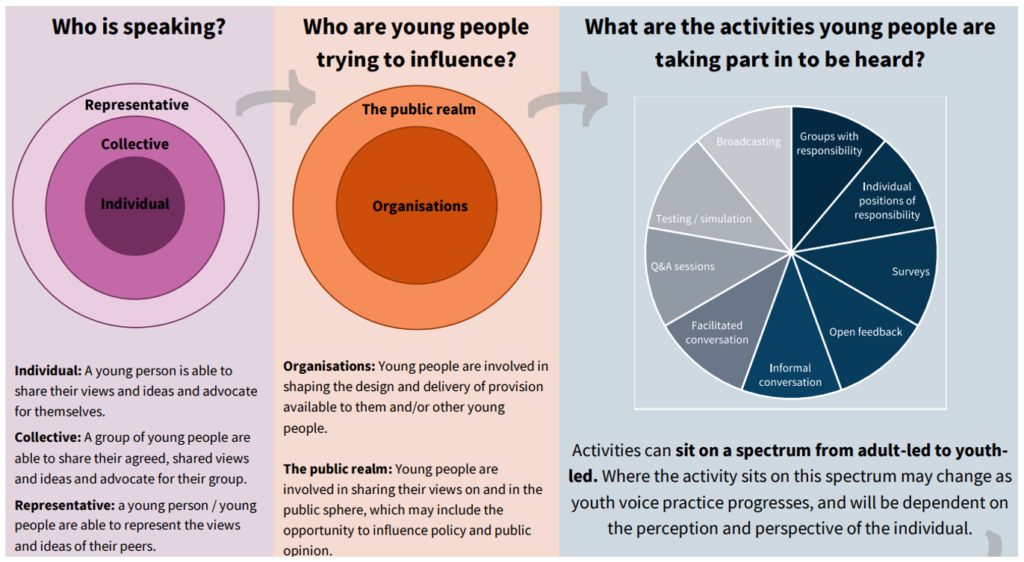
Peer research as an approach
Peer research is research that is steered and conducted by people with lived experience of the issue being studied.”
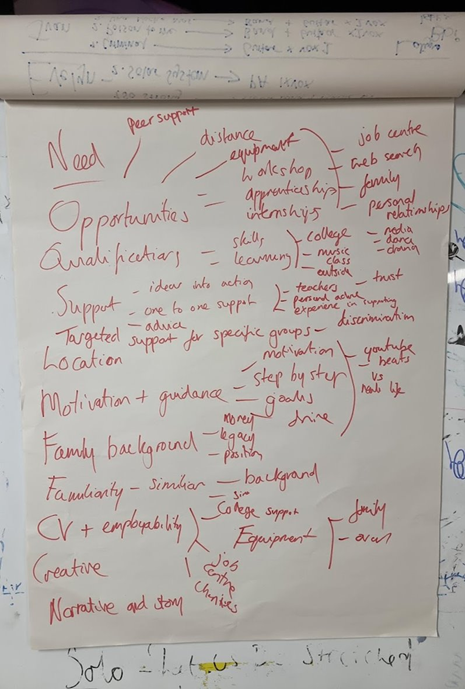
Authorising our own stories
- Aim: To give young people from underrepresented groups a platform to explore their civic identities
- Impact: Wide range of creative resources co-produced exploring themes such as lived experiences of identity, race/ethnicity, civic identity, mental health, belonging, and more. Resources created to upskill workforce to better respond to the needs of young people and the sector
Pan-London CICC advisory board
- Aim: The London CiCC aims to enable opportunities to influence policy and services affecting looked after children & young people and care leavers in London.
- Impact: Through advocacy and campaigning, the board was able to get discounted travel for care leavers across the Capital.
Examples of practice in participation – Useful Links
https://www.partnershipforyounglondon.org.uk/youthengagement
Partnership for Young London
•https://www.partnershipforyounglondon.org.uk/
Centre for Youth Voice
https://www.regionalyouthunits.com/centre-for-youth-voice
Amplify
•https://www.regionalyouthunits.com/amplify
Network of Regional Youth Work Units
Workforce development for adolescent safeguarding
Workforce development and keeping adolescents safe
Adolescents face complex risks – often outside the home – and need a system of professionals who are equipped to recognise harm, build trust and act decisively.
Workforce development is essential to building a safeguarding system that is suitably skilled, confident, inclusive and responsive to keeping children and young people safe.
The adolescent safeguarding workforce is of course vast; made up of a diverse, alternatively skilled, multi-agency and multi-level network of individuals. From frontline practitioners (youth workers, social workers, teachers, health professionals), to strategic leaders and policy professionals, academics, trainers and researchers as well as voluntary, community and faith sector colleagues.
So, whilst our roles and responsibilities differ, our purpose is shared – keeping children and young people safe.
By definition this shared purpose cannot be achieved without the whole system working together, and staff receiving the right support and training. Our diversity demands a shared language, common standards, collaborative learning and recognition of different professional cultures and contexts if we are to effectively safeguard children and young people. We each have a responsibility to understand what one another do, not do what each other do.
Training and Continuous Professional Development (CPD)
Safeguarding risks evolve – so must the workforce. CPD and training ensures professionals remain alert, informed and responsive. It promotes consistency, builds expertise, and supports a proactive safeguarding culture of continuous improvement.
A well-supported workforce is better able to engage young people, work collaboratively, and challenge structural inequalities.
In the work led by Dr Elly Hanson and Dez Holmes – That Difficult Age: Developing a more effective response to risks in adolescence – ensuring practitioners receive high quality training is identified as a key principle to suitably ‘equip and support the workforce’.
In their suggested five training areas for all practitioners who routinely work with adolescents facing risk, they emphasise that whilst ‘training is a primary means of developing understanding’, to truly embed this understanding it must be applied, and ‘training transfer’ – getting learning into practice – enabled.
“This work is complex, emotionally demanding and often politically charged. To ask practitioners to work in such an environment without high-quality training, support and supervision undervalues them and the young people they support.”
Continuous Professional Development (CPD) is essential for safeguarding professionals working with adolescents. It ensures that practitioners remain current, confident and competent in responding to the evolving risks and challenges faced by young people who require a workforce that is not only knowledgeable but also reflective, relational and responsive.
There are many benefits to CPD, including;
- Keeping practice current: ensuring practitioners stay up to date with legislation, guidance, emerging risks and best practice.
- Building specialist knowledge: deepening our shared understanding of adolescent development, trauma, contextual safeguarding, and restorative approaches.
- Promoting multi-agency collaboration: encouraged shared understanding and language across sectors, improving joint working and safeguarding decisions and outcomes.
- Supporting reflective practice: providing space for practitioners to reflect on their experiences, challenge assumptions and improve decision-making.
- Growth mindset: dedication to professional growth and continuous learning and improvement builds trust with young people, families, colleagues and multi-agency partners.
LB of Sutton – ‘Better Together’ DSL Network
A borough-wide network for Designated Safeguarding Leads (DSLs) that provides regular training, peer learning, and reflective sessions. It promotes consistency and shared safeguarding standards across schools.
LB of Sutton – ‘Better Together’ – Strengthening our Designated Safeguarding Lead Network
Summary of project: Empowering and supporting our DSLs, validating their emotions and recognising that they are ‘human first’: ‘you cannot pour from an empty cup’.
Key Contact: Hayley Cameron – Education Safeguarding Manager, Cognus Ltd. – hayley.cameron@cognus.org.uk
Read more about this project
Team: Cognus Education Safeguarding Team
Main Submission:
Cognus has developed a strong, collegiate and supportive Designated Safeguarding Lead Network in Sutton – endorsed and recognised last year in the Local Authority Joint Targeted Area Inspection:
“One school DSL reflected the thoughts of many when they said that the education safeguarding services in the borough were ‘the best they have ever been (Lead Inspector, JTAI, July 2023).”
However, the role of the DSL is forever expanding due to guidance updates, highlighted most recently in KCSIE, 2024. Our DSLs are managing high levels of risk and complexity daily and avoiding burnout and supporting wellbeing must be a focus. Our DSLs need a safe, reflective space to talk about what is going well, what is causing frustration, whilst also being able to validate their own feelings. They need to remember that they are ‘human first’. It is important to recognise that to be able to fully ‘show up’ for others, they must ensure their own needs are met.
Our Education Safeguarding Manager introduced Group DSL Supervision in 2021 with all DSLs receiving 1 session per month facilitated with the Education Psychology Service for the last 3 years. Since 2021, 28 local schools have signed up.
‘We have found the group supervision to be highly supportive. The team are always available, non-judgemental and extremely helpful. Supervision has increased our confidence in making the right decisions for our pupils’ (Secondary DSL, February 2024)
In Sutton, we have created a ‘better together’ culture within our DSL Network which was recognised as excellent practice in case study for the DfE (November 2024) and this will be shared nationally. The case study articulated the achievements and impact of Education being the fourth partner in the Local Arrangements for the multi-agency safeguarding partnership in the London Borough of Sutton.
Gathering feedback from our network is key. In our annual survey to schools and partners for 2023-2024, we received 91 responses from schools, with 99% very satisfied or satisfied, and 24 responses from partners, with 100% very satisfied. The feedback is used to inform our delivery of the service and improve practice, liaising with colleagues in Education, Police, Health and Social Care to ensure ongoing support and challenge amongst local area partners.
Our DSLs attend half-termly training updates and online network meetings where they can share their experiences (average attendance is 93%+). The Safeguarding Manager creates a monthly multi-agency safeguarding briefing which is circulated monthly to ensure a continuous drip-feed of information is shared. The team have facilitated peer networking, and the development of a Sutton DSL WhatsApp Group has supported this, with someone always on hand to offer advice.
‘The DSL Whatsapp Group is a game changer. I needed help with a policy and soon after reaching out, I received three examples and a template to use. Another colleague invited me into their school to see what they had in place. This is so different to the previous borough I worked in’ (Secondary DSL, April 2024).
DSLs are supported to develop their own CPD by shadowing the Education Safeguarding Team in training events and safeguarding reviews, some also contribute to these sessions.
‘The culture of vigilance in schools is strong because of the consistent information and training from the Education Safeguarding Team’ (Lead Inspector, JTAI, July 2023).
To meet the needs of our DSLs we wanted to expand our ‘Reflective Safeguarding Supervision’ offer. Over the last 6 months, we have circulated a ‘supervision survey’ to understand the needs in the local area which has led to piloting 1:1 sessions and bespoke group supervision inside and outside of the borough (ie with Sutton, Croydon, Merton and Kingston). We have featured on Safeguarding Podcasts to talk about the importance of supervision and the work we do at Cognus, as well as created a bank of testimonials from DSLs already engaging in our sessions.
Throughout November we developed a comms programme for schools/settings and widened our target audience to Designated Safeguarding Leads and Safeguarding Teams (including pastoral staff, family support workers and senior leadership); we also added to our existing offer of Group DSL Supervision. Going forward our offer will also include 1:1 supervision, ad hoc supervision and bespoke group supervision.
To date (10th December) we have had 18 expression of interest forms completed, requesting the following:
Ad hoc supervision – 5
1:1 supervision – 11
Sutton Group DSL Supervision – 10
Bespoke Group Supervision – 0
Throughout this process, we have also increased sign-up to the Group DSL Sessions that we are currently offering.
Evidence of impact is illustrated through examples of participant feedback:
‘Supervision helps me to see things differently. In this role you never feel that are doing a good enough job. You constantly worry about missing something and we are talking about children’s lives. This session is a safe, reflective space to talk about how I am really feeling’ (Primary DSL, January 2024).
‘These supervision sessions have honestly changed my life – I feel less isolated and alone’ (Secondary DSL, November 2024)
Effective partnership working, building trusting and transparent relationships, has been key to the success of our DSL Network in Sutton. The Education Safeguarding Manager has worked in Sutton for over 20 years and was previously a DSL and Headteacher. Sharing her own experiences, vulnerabilities and learning has helped DSLs feel safe to ‘open up’ and share what is really going on for them.
‘The service we receive in Sutton continues to be excellent – with concerns/calls/queries responded to quickly. You are never made to feel like you are asking a silly question or wasting time, and advice is helpful. You see me!’ (Primary DSL, March 2024)
In Sutton, we are keen to share our journey in terms of strengthening the DSL Networks across boroughs and welcome DSLs to access our reflective supervision offer. Our Education Safeguarding Manager has also been approached to ‘share her story’ at conferences and would be keen to do this across boroughs to highlight the importance of recognising that we are ‘human first’, highlighting the importance of accessing reflective safeguarding supervision.
Reflective Safeguarding Supervision Offer – Cognus
RB of Greenwich – Greenwich Practice Academy
A structured academy model offering bespoke training pathways for practitioners, including safeguarding modules, leadership development, and trauma-informed practice. It supports career progression and builds a confident, skilled workforce.
Greenwich Practice Academy
Summary of project: Alongside strengthening recruitment processes and increasing opportunities for existing staff to gain social work qualifications, Greenwich’s response to national and local shortages of social workers has therefore also included a clear focus on staff wellbeing.
Key Contact: Karl Mittelstadt – Assistant Director Children’s Services – Karl.Mittelstadt@royalgreenwich.gov.uk
Read more about this project
Main Submission: The programme of activity to improve staff wellbeing, recruitment and retention has included:
- The introduction of our Practice Academy
Since its launch in autumn 2022, our Practice Academy has acted as a focal point delivering workforce development and training opportunities. bringing together. The academy offers continuing professional development opportunities and structured learning and support across Children’s Services including Children’s Social care, the Youth Justice Service, the Family and Adolescent Support Service (FaASS) and the Disabled Children and Young People’s Service.
We have invested heavily in our workforce development to support the introduction of systemic and compassionate practice. Since 2023, we have been working with the Institute of Family Therapy to run a rolling 5-day introduction to systemic practice – mandatory for all social workers. We provide a number of foundation year and masters-level qualifications in Systemic Practice.
In keeping with RBG’S ‘Grow Your Own’ ethos, the Practice Academy introduced a Social Work Apprenticeship Programme. We partnered with Middlesex University and have a cohort of 8 Apprentices who started their Social Work Apprenticeship in Sep 2023.
We have a well-established in-house ASYE programme offering 22 places a year (across 2 cohorts). It has evolved over this period to offer more tailored support for newly qualified social workers thereby strengthening our pipeline. Content is mapped to Skills for Care guidance, the Professional Capabilities Framework (PCF), Post Qualifying Standards (PQS), and the Compassionate and Systemic practice framework unique to Greenwich.
We also run a ‘step-up to Social work programme – delivered in-house.
- Introduction of a unifying Practice framework
Coinciding with the launch of our Practice Academy, we introduced a unifying practice framework, which is rooted in systemic and compassionate practice. Our Practice Framework has not only unified our methods across the directorate but has fostered a supportive and compassionate environment and enhanced our workforce development and wellbeing to ensure the long-term success of our services.
The introduction of systemic approaches – such as regular Practice Meetings or the use of systemic genograms – has created additional spaces for staff to reflect on their practice in supportive and strength-based environments.
- Strengthening Practice – introducing Practice Educators and Clinical support
We have introduced a small team of ‘Practice Educators’. Each Practice Educator is linked to a social care team with the aim of embedding the practice framework and providing input and advice on practice matters. These staff are managed by our Principle Social Worker and supporting the delivery of her responsibilities in relation to practice development.
Working alongside the Practice Educators, we furthermore introduced a Clinical Team with the specific responsibility to embed systemic and compassionate practice. The main focus has been on delivering compassion minded training to all staff across the directorate – including staff in education, commissioning and -support roles. Alongside this, the clinical team has been instrumental in introducing regular practice meetings based on systemic principles and embedding the use of systemic genograms across all social work teams.
- A focus on staff wellbeing
We provided compassion-minded training to all children’s services staff (including staff working in education, commissioning and other professionals. Importantly, we saw this as an approach suitable for all staff working in Children’s Services – including staff in education roles and supporting professions. We also delivered a bespoke training to senior leaders.
- Creating psychological safety – a focus on inclusion and tackling structural racism
The Royal Borough of Greenwich has taken steps towards understanding and tackling race inequality. In November 2020, in response to feedback from discussions with staff and initiated by the Director, we set up a tackling structural racism group, providing staff with a forum to share experiences, learn and lead on actions for race equality and equity. Complimenting the work of the group is a programme of activities which contributes to the directorate’s focus on understanding and tackling race equality and ensures this important topic influences our practice.
Taken together the above actions have created conditions for social work to thrive in Greenwich. This, in turn, has resulted in high staff retention and satisfaction rates.
The impact on our staff has been tangible. Several colleagues who have left our organisation and returned have noted the impact of this work including the change of culture and the vast array of opportunities for professional development provided by our Practice Academy and supportive leadership.
Our use of agency staff has reduced over time. Currently, around 80% of our social care practitioners are in permanent positions and nearly all of our management roles are permanent. Our annual social work staff return suggests we have a high number of staff who have been here longer than 5 years pointing to staff stability.
We believe the introduction of systemic and compassionate approaches also has had a positive impact on sickness rates. Stress-related sickness absences in Children’s Services have reduced significantly. Rates of stress-related absence in Children’s Services is the lowest in the council. The evaluation report on Compassion Mind Training furthermore showed that our approach to practice has positively impacted on staff wellbeing.
In our recent inspection, Ofsted noted that: ‘Leaders take their responsibility to promote the well-being of staff seriously. Practice meetings, easily accessible clinical support and flexible support to workers who are parents all contribute to workforce stability in the borough’.
Training and Continuous Professional Development (CPD) – Useful Links
Professional curiosity
Professional curiosity is a critical and invaluable skill in adolescent safeguarding. It speaks to our ability and willingness as practitioners to look beyond the surface-level information, and ask thoughtful and often challenging questions and triangulate what we see, hear and are told.
In the context of working with adolescents, professional curiosity helps all practitioners to avoid assumptions, explore inconsistencies, and to better understand the lived experiences of young people. It supports the early identification of harm, promotes respectful engagement, and strengthens our collective safeguarding decisions.
Waltham Forest’s Professional Curiosity Resource Pack offers practical tools, scenarios and prompts to embed this approach across multi-agency teams. It encourages practitioners to be “respectfully nosey,” challenge their own biases, and remain open-minded, especially when working with adolescents whose risks may be hidden or minimised.
Reflective practice and supervision
Please note that this section is subject to ongoing input from experts,and the content will continue to evolve.
The work of an adolescent safeguarding practitioner is emotionally demanding and ethically complex. Reflective practice and supervision helps professionals to process experiences, challenge their own assumptions and improve decision-making.
“Without support to help [practitioners] understand adolescent choices, harness adolescent agency and build engagement, workers can be left feeling demoralised and disempowered. They may also have little support to deal with the emotional impact of working with high levels of risk and frequent rejection, and can feel isolated and without the necessary levers to achieve change.” – That Difficult Age
Practitioners need the time and space to think critically and reflect on their practice to learn and improve as well as experiment with new ideas in supervision. In busy, fast-paced practice environments, it is all too easy for reflection time to be squeezed out.
In the 2023 Big Listen research, 95% of the 1,200 social workers, managers and students who took part in the research reported an overwhelming belief that supervision is critical to their work. Despite this more than a third of staff felt that they did not receive good quality supervision, with poor supervision and management cited as one of the top reasons for staff leaving their job.
Comparatively, good supervision was identified as a key factor in staff feeling valued and in supporting retention.
Good supervision first requires trust. Whilst a trusting relationship may take time to develop, there are some key features of good supervision that ensures strong foundation. Good supervision should be regular, though available at point of need, reflective, supportive yet challenging, focused on outcomes for children, and promote practitioner well-being and development.
What good supervision looks like?
- Relational and trusting: Effective supervision is built on trust, honesty and mutual respect, supporting confidence, competence and critical thinking.
- Reflective and a safe space: Practitioners need to feel safe to discuss challenges so creating a safe space is essential to meaningful supervision. This support essential reflection on decisions and the impact of practice on children and families.
- Structured, regular and available at point of need: Supervision should be delivered through planned and consistent sessions, whether individual or group, and make use of case examples to strengthen discussions and performance review, as well as provide space for emotional support. While supervision should be planned and regular, there is also a point where it should be available at point of need.
- Emotionally supportive but challenging: Good supervision strikes the balance of empathy and constructive challenge. This allows for understanding – managing stress and preventing burnout – whilst supporting development and improved decision-making.
- Focused on outcomes for children: Supervision links to the purpose of improving safety and wellbeing for children and young people. Remaining child-centred in supervision ensures that discussions and actions are purposeful.
- Promoting professional growth: Supervision is an opportunity to both identify and develop learning needs and gaps in knowledge, promoting the application of theory to practice.
Research in Practice define the role of a practice supervisor as performing four functions;
- Management – ensuring competent accountable practice and performance.
- Development – supporting continuing professional development and promoting learning.
- Support – providing a secure and trusting relationship.
- Mediation – engaging practitioners with the organisation and being a bridge between practice and organisational priorities.
They highlight that ‘all four functions are needed to provide a balanced approach to supervision’ and caution that the ‘management’ function does not override the supervision.
LB of Lewisham – Multi-agency Borough-wide Therapist Meetings
Regular reflective forums for therapists and managers across agencies. These meetings promote shared learning, emotional support, and consistent safeguarding responses.
LB of Lewisham – The establishment of multi-agency Borough-wide meetings for therapists working across the Local Authority and their managers.
Summary of project: Establishment of monthly reflective network meetings for therapists and therapeutic practitioners working across the local authority and additionally monthly network meetings for their service managers.
Key Contact: Keith Cohen – Youth Justice Service Manager Lewisham Council – Keith.cohen@lewisham.gov.uk Gill Westwood – Gill.westwood@lewisham.gov.uk
Read more about this project
Main Submission:
The establishment of multi-agency Borough-wide meetings for therapists working across the Local Authority and their managers
In 2022, Lewisham’s Clinical Commissioning Team recognised the value of family therapy as part of early intervention for children at risk of involvement in the criminal justice system. They funded a fixed-term, senior therapist post, based in the Youth Justice Service, to develop this work. At this time, Lewisham was beginning to employ systemic therapists across several Local Authority (LA) teams. This was a new development for those services and the therapists appointed were often new to a LA setting.
However, recruitment to and retention of these posts was challenging. Mangers were unsure of what support was needed, what practice models to use, and how new roles meshed with the Family Practitioners, Parenting Workers, and others already in post. The Senior Therapist met with mangers and therapists to discuss what might be helpful to improve outcomes for the new therapists, and the families they worked with.
We worked with therapists directly employed by the Local Authority; placed in a Local Authority-commissioned service; or working in a Local Authority setting such as a school. Currently 10 agencies are part of our network. It was decided to set up monthly, 1½ hour, network meetings, for Therapeutic Leads and separate monthly meetings for their managers. We currently have 22 staff invited to the Therapeutic Leads meeting (attendance usually ranges from 6-13) and 13 managers invited to the Service Manager meetings (attendance ranges from 5-8). These meetings began in April 2023, were evaluated after a year and are ongoing.
Therapeutic Leads Network meetings
Initially we created Terms of Reference. We agreed to meet on the 26th of every month ensuring meetings happened on different days of the week to be as inclusive as possible. It soon became clear that we were unaware of the other therapeutic services on offer across the authority. Initially meetings focussed on learning more about each other and our offers. This supported our aim of improving onward referrals and ensuring families are initially referred to the most appropriate service. Gradually we introduced more reflective practice sessions. We have used different lenses and models for this practice, thus offering models that, as well as having immense value in the meeting, can also be taken back to services. We are a multi-disciplinary team of therapists and different members of the network have led sessions on play therapy and drama therapy to support us all in our own practice. We have considered our families through the lens of autism and domestic abuse. We are also planning a training programme: initially this would be delivered to the Therapeutic Leads and then cascaded to their wider teams of Family practitioners, Recruit to Train trainees, parenting workers etc.
Service Manager meetings.
Service Managers were also invited to a monthly network meeting; the aims of this meeting were to:
• offer an opportunity to network,
• consider how best to support therapists employed in their teams,
• support Managers’ own wellbeing.
• engage together in strategic thinking.
Recently, the service managers have been working together on a Theory of Change for family work across the borough. Managers report finding the meeting immensely important, valuing the relationships built, the support offered and the reduction of isolation in their roles. The two network meetings work feed into each other. The third partner in this feedback loop is the commissioning service.
Evaluation
An evaluation form was given to participants in the Therapeutic Leads in April ‘23. A follow up evaluation took place a year later. Questions considered:
• awareness of other therapeutic services in the Borough the value of the Therapeutic Leads network sessions and connection with other professional
RESULTS
Some of the comments from the therapists involved in the Therapeutic Leads meeting:
• I’ve really appreciated the space to come together and reflect as a wider therapeutic team.
• Thanks for creating this space!
• I always value the space but it’s hard to attend regularly.
• It’s just been really great to all meet, to have this space to connect and learn. • I think it’s well run and it has a contained and relaxed atmosphere
Awareness of other therapeutic services in the Borough
Those ‘somewhat aware/aware’ of the therapeutic models used by other family services increased from 46% to 84%
• Those who were ‘somewhat confident/confident’ that they could signpost families onto the most appropriate service increased from 53% to 84%
• Those who felt that the therapeutic service offer in Lewisham was ‘Somewhat integrated/ integrated/very integrated’ increased from 53% to 83%
The value of the Therapeutic Leads network
• Those who found it ‘helpful/very helpful’ to meet regularly with other therapeutic
practitioners across Lewisham increased from 69% to100%
• Those who found it ‘important/very important’ to be able to connect with other
therapeutic practitioners and to share ideas increased from 78% to 100%
In the final evaluation
• 76% of practitioners said it had been ‘helpful/very helpful’ for them professionally
• 84% of practitioners said it had been ‘helpful/very helpful’ for them personally.
It is our hope that better signposting will lead to and reduced waiting lists and less drop-out from services; the offer of reflective space will lead to better wellbeing for therapists improving recruitment and retention, and shared learning and training opportunities will upskill the workforce across the borough.
Supporting Information:
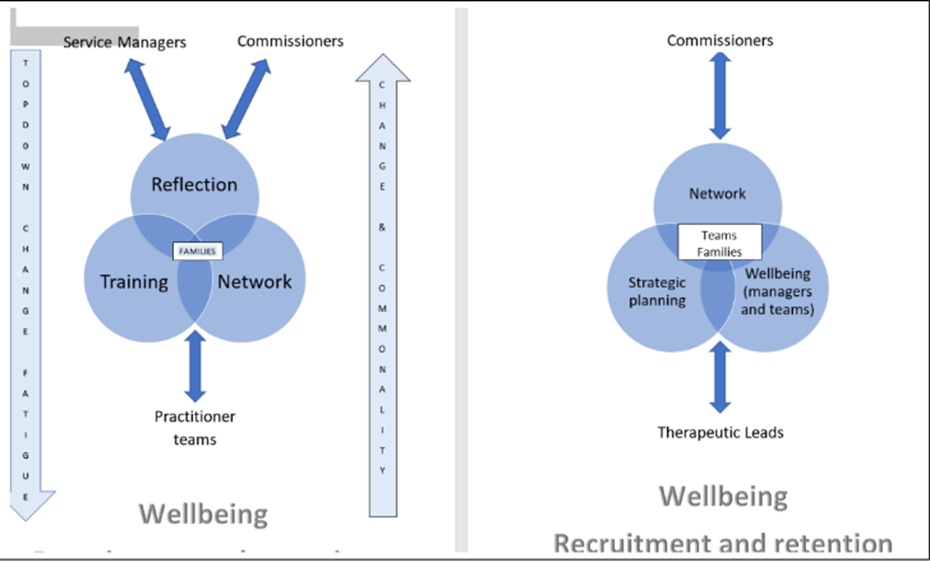
Westminster City Council, RB of Kensington & Chelsea, LB of Hammersmith & Fulham – Centre for Systemic Social Work
A collaborative centre offering systemic training and reflective supervision for social workers. It embeds relational and trauma-informed approaches into everyday practice and supports practitioner wellbeing.
Westminster City Council, RB of Kensington & Chelsea, LB of Hammersmith & Fulham – Centre for Systemic Social Work
Summary of project: The Centre for Systemic Social Work continues to lead sector-led improvement and innovation across London and beyond.
Key Contact: Isabella Jewell – Head of Business Intelligence, Strategy & Children’s Workforce Development – Bella.jewell@rbkc.gov.uk
Read more about this project
Team: Centre for Systemic Social Work
Main Submission:
In 2014 the Local Authorities of Hammersmith and Fulham (LBHF), Westminster (WCC) and Kensington and Chelsea (RBKC) Children’s Services launched a large-scale transformation programme to embed a systemic practice model across all areas of Children’s Social Care, establishing and committing to a Theory of Change Practice Model, delivering systemic training to leaders, managers and practitioners, reviewing and changing systems and relationships.
Following, in 2016 and in partnership, all 3 LAs establish the Centre for Systemic Social Work (CfSSW) to be the delivery vehicle to train and embed systemic practice and deliver sector led improvement support to other local authorities. The three local authorities take joint responsibility for the CfSSW and decision making is shared equally. Since the establishment of the CfSSW, we have trained over 2,500 staff, from 21 local authorities and have observed improvements in the ratings of 11 of the 15 LAs inspected by Ofsted who have engaged with the CfSSW.
All three LAs who established the CfSSW are committed to supporting a motivated and highly skilled workforce to work collaboratively with children, families and communities to achieve sustainable improved outcomes. We continue to develop practice to improve the way we engage and support families through a co-ordinated innovation programme.
The benefits in practice to the three LAs can be observed in feedback received from Ofsted on our systemic practice:
LBHF
“Hammersmith & Fulham adopted a systemic practice model in 2014, and a significant proportion of the workforce has undertaken systemic training courses. The systemic model is supported by an embedded clinical team, whose members’ impact is evident in practice with children and families across the social work teams.”
Source: London Borough of Hammersmith and Fulham, May 2024: Children’s Services Inspection
RBKC
Since the last inspection, leaders have maintained their unwavering commitment to improving outcomes for children through systemic social work practice.”
Source: Royal Borough of Kensington and Chelsea, September 2019, Children’s Services Inspection
WCC
“Interventions are sophisticated and often underpinned by highly skilled systemic direct work. Social workers receive frequent support from highly qualified clinicians based in their teams, including joint direct work with children and families.”
Source: London Borough of Westminster September 2019: Children’s Services Inspection
Outcomes from Local Authorities we have worked with
Additionally, we are very proud of our work to lead the development of systemic practice in the sector. Over the last decade we have learnt how to enable change within complex organisations and ensured that this is embedded and further refined and developed. We believe that this experience and learning benefits other LAs who are looking to embed systemic ideas within social care practice. Our operating model means teachers deliver training and senior and middle leaders provide consultancy, coaching and shadowing as appropriate.
Fifteen of the local authorities we have worked with have been inspected since we began working with them, with eleven improving. Systemic practice contributes to improvements through, strong and coherent leadership, relational working, a coherent and embedded model of practice, reflective supervision, and the quality of direct work. Our work at the CfSSW seeks to lead the embedding of systemic practice within other LAs through training consultancy and support. We seek to empower other organisations to implement change and ensure they do not become dependent on us.
Additionally, between 2017 and 2022 the CfSSW delivered the Practice Leaders Development Programme. This was a practice-based programme that was designed around the Department of Education Knowledge and Skills Statement for practice leaders to facilitate leadership within social work, preparing participants for a role as a practice leader. The programme offered support and assistance through a network of development coaches and colleagues within the sector. We delivered five cohorts of the programme and a total of 117 participants. At the point when the programme ended, 62% of participants had been promoted and 44% were in a Practice Leaders or DCS role.
Workforce Data
Our staff turnover and use of agency workers rates have remained significantly lower than the London and nationwide averages. We believe this is in part due to the Systemic Practice model and the training opportunities that the CfSSW provides.Performance and Outcomes Data
Performance and outcomes data, analysed by University of Bedfordshire, Kantar and Tilda Goldberg independent research teams published by the DfE in 2020, found strong and continued evidence of the impact of each LAs continued commitment to their social care Systemic Practice Model resulting in;
- A larger reduction in the rate of child protection plans (18.5 fewer per 10,000 children) compared to a comparison group of similar local authorities (7.6 fewer per 10,000 children).
- A reduction in the rate of child in need plans (of 75.8 fewer per 10,000 children) compared to an increase among the comparison group of similar local authorities.
- Evidence of transfer of learning from discussions in supervision to conversations with families: “Families interviewed had positive feedback on their experience with their social worker, saying it was a collaborative process and had helped to strengthen family relationships and recognise their family’s inherent strengths to bring about change”.
- Pupils eligible for free school meals in RBKC and WCC achieved higher GCSE scores than pupils not eligible for free school meals outside London, with Westminster having the highest number of care leavers attending at university – with 1 in 4 of our young people going to university.
Evaluation Findings
The Kantar and Tilda Goldberg findings of the H&F and Bi-Borough Systemic Practice model for social care, found the model to be:
- Understood, interpreted, and practiced at all levels of the organisation
- Children Services made better than expected improvements across a range of outcomes in relation to child-centred outcomes
- “Positive impact was expressed as a strengthening of family relationships, collaborative working with their social worker and a recognition of and belief in their own ability to effect change”.
- Workforce-related outcomes that have an impact on the quality and stability of service delivery to young people such as turnover rates, vacancy rates, absence rates.
Reflective practice and supervision – Useful links
Trauma-informed, relational and restorative practice
Please note that this section is subject to ongoing input from experts by experience and by specialism, and the content will continue to evolve.
Many adolescents have lived through, or are living through, trauma, adversity or systemic inequality. They are more likely to engage with professionals who understand their experiences and who build trust over time. If you’ve got time for them, they’ve got time for you.
Trauma-informed, relational and restorative approaches help practitioners build trust, understand behaviour through a lens of development, and respond in ways that encourage healing, accountability and safety.
No one approach is a standalone intervention, they are behaviours that shape how practitioners engage with young people, families and one other.
“Trauma-Informed Care is a strengths-based framework that is grounded in an understanding of, and responsiveness to, the impact of trauma, that emphasises physical, psychological and emotional safety for both providers and survivors, and that creates opportunities for survivors to rebuild a sense of control and empowerment.” (Hopper et al, 2005)
Trauma-informed, relational and restorative practice – Useful links
– RIP Trauma-informed-approaches-with-young-people-Frontline-briefing.pdf
– VRU Trauma Informed Research | London City Hall
– British Journal of Community Justice – Spacey.Beyond-Individual-Trauma.2022.pdf
Racial equity, leadership and psychological safety
Strategic leaders across multi-agency settings shape the culture, priorities and systems that enable adolescent safeguarding to thrive. Leadership grounded in racial equity is essential for an equitable workforce that feels psychologically safe.
“Psychological safety is crucial to having a positive, supportive and productive working environment. It’s also a crucial component in the journey to advancing race equity.” – Royal College of Nursing
Psychological safety is essential for all safeguarding professionals, and for our Black and Global Majority colleagues it is important to acknowledge that their experience of psychological safety is rarely equal, with forms of racial prejudice and discrimination, such as unconscious bias and microaggressions, experienced on a daily basis.
It’s important then to think about our own role in ensuring the psychological safety of others, as leaders, as colleagues and as practitioners.
The Royal College of Nursing presents psychological safety as people feeling free to;
- challenge the status quo
- make mistakes and admit to them
- share feedback with junior staff, peers and leadership alike
- work through disagreements together
It doesn’t mean universal agreement, in fact the opposite can often be a sign of psychologically safe teams, where resolution is efficient. Improved performance, increased creativity and innovation, strong communication and a growth mindset are just some of the benefits cited from having a psychologically safe workplace. In practice a team that feels psychologically safe has a more positive impact on decision making and the ability to identify blind spots.
Addressing racial bias and structural inequalities sits at the heart of psychological safety for our workforce and our children, young people and their families.
Teresa Hills, Director of Operations for Children’s Services in Luton Borough Council, writes powerfully about love at the heart of our intentions and provides a practical set of ‘Racial Equity Takeaways’ for both system leaders and the wider workforce to hold themselves, and one another, accountable to.
“We are increasingly aware of the need for love in our work with children. The importance of nurturing loving relationships and making love the core of our decisions for our children. That love must extend to our colleagues. We need to be loving and compassionate in our intentions and interactions with each other. As once we start operating from that space, we naturally become more inclusive and connected allowing each of us to be our best and most powerful.” – Teresa Hills, Director of Operations for Children’s Services in Luton Borough Council
Four Racial Equity Takeaways
- Include Global Majority colleagues at your top table, not as a token, and truly engage with difference as you will see the ripple effect in your organisation. You will see problems and solutions from a varied lens. Remember the golden thread of disproportionality in outcomes for our children.
- Pound the table for Global Majority colleagues, use your social networks and name drop for them or agencies will. The real need for a thriving permanent workforce that is valued and elicit loyalty.
- Walk the difficult path, be authentic, credible and intentional about inclusion and equity (it’s not just about shoes for all, but shoes that fit for all). Racism is real. (please don’t let the fear of getting it wrong get in the way). Clumsiness will happen, allow for vulnerability and please allow the same for your Global Majority colleagues as this allows for psychological safety in organisations. The link to staff well-being when we move away from blame.
- As System Leaders, share your good examples, use Global Majority groups and networks as critical friends, lets learn together. Please go above and beyond coaching and mentoring – start sponsoring! To reshape the system we must challenge the status quo rather than locating it in individuals, especially our Global Majority colleagues, to fit into the existing system.
In adolescent safeguarding then, psychological safety – for all – is foundational to effective practice, ethical and inclusive leadership and a continuous learning culture. Its absence undermines the system’s collective ability to safeguard children and young people effectively.
In the below video Jacquie Burke, Director of Children’s Services and DCS Co-Lead of the ALDCS Racial Equity And Leadership (REAL) programme speaks about the importance of collaboration in advancing racial equity, highlighting that leadership isn’t about one person; it’s about working together to ensure all children and families receive fair and effective services.
You may wish to read the developing racial equity in adolescent safeguarding section,
Racial equity, leadership and psychological safety – Useful links
- DfE Employer Standards – Promoting psychological safety
The workforce ‘Working Together to Safeguard Children’ (statutory guidance)
“Working Together to Safeguard Children” (2023) places strong emphasis on the workforce as a critical component of effective safeguarding.
The guidance recognises that everyone in the workforce, from frontline practitioners to senior leaders, has a role in safeguarding children and young people. The framework aims to embed strong, effective, and consistent child protection practices. Local areas are expected to embed these expectations into their safeguarding arrangements. The DfE is supporting implementation through funding, tools, and sector-led improvement initiatives.
You may be interested in reading the Designing services to keep young people safe > Pathways Section
From a workforce perspective Working Together outlines expectations for:
1. Shared responsibility across the system
- Safeguarding is a shared responsibility and a collaborative endeavour. All professionals must work together effectively, to help, support and protect children and families.
- Working Together promotes consistency and quality with shared language, standards and expectations to reduce variability in practice and improve outcomes.
You may be interested in reading the Working Together to Safeguard Children > Systems Section
2. Clarity of roles and responsibilities
- Multi-agency professionals across the system are supported to understand their responsibilities and how they fit into the wider safeguarding landscape.
- The framework defines the roles of:
- Lead Safeguarding Partners (LSPs): senior leaders in each statutory agency responsible for strategic oversight.
- Delegated Safeguarding Partners (DSPs): operational leads who ensure implementation and accountability.
3. Child-centred and whole-family practice and approach
- Practitioners are expected to build positive, trusting relationships with families.
- Together the workforce should deliver tailored support that is child-centred and considers the needs of the whole family.
- They emphasise keeping the child’s voice and experience central to all decisions.
You may be interesting in reading the Working creatively > Practice Section
4. Information sharing and communication
- There is emphasis on the importance of timely, accurate, and proportionate information sharing across multi-agency partners.
- They seek to dispel common myths that hinder effective communication between agencies.
You may be interested in reading the Effective Information Sharing > Systems Section
5. Joint decision-making and planning
- Multi-agency partners and practitioners must work together at all levels in order to safeguard effectively. This includes;
- Conducting joint assessments.
- Developing shared plans for children and families.
- Participating in strategy discussions and child protection conferences.
You may be interested in reading the London Continuum of Need > Systems Section
6. Learning and continuous improvement
- The importance of supportive supervision and leadership to enable practitioners to make sound decisions in complex situations is emphasised.
- It encourages a culture of multi-agency training and reflective practice.
- Independent scrutiny and peer challenge is promoted to contribute to the improvement of safeguarding arrangements.
The workforce ‘Working Together to Safeguard Children‘ – Useful links
Safer recruitment practices
Though the last topic in this section, it is important to remember that safer recruitment is the first safeguard. It ensures that only individuals with the right values, skills and integrity enter the workforce. Key components of Safer Recruitment as outlined by the NSPCC, include;
- Creating a safer recruitment policy
- Developing a clear policy outlining your commitment to safeguarding. Including procedures for vetting, interviewing, and supervising staff and volunteers.
- Defining roles clearly
- Writing accurate job descriptions and person specifications that highlight safeguarding responsibilities and expectations.
- Advertising safely
- Using adverts that reflect your safeguarding values. Being clear that safeguarding checks will be part of the recruitment process.
- Using a rigorous application process
- Requiring a standard application form (not just CVs). Asking for full employment history and explanations for any gaps.
- Conducting thorough interviews
- Including safeguarding-related questions. Using structured interviews, with an expert panel, to assess suitability for working with children.
- Checking references carefully
- Always request at least two references. Verifying references directly and ask about the applicant’s suitability to work with children.
- Carrying out background checks
- Performing appropriate criminal record checks. Checking identity, qualifications, and right to work. Only confirming an offer of employment once all checks are satisfactorily completed.
- Monitoring and reviewing
- Regularly review recruitment practices. Encourage a culture of vigilance and continuous improvement.
Safer recruitment practice – Useful links
Navigate SAIL
SAIL Disclaimer
SAIL is a collaborative effort. It draws on the work of many researchers, writers, and practitioners across disciplines and perspectives who have generously contributed their time and permitted us to link to their work.
You’re welcome to use and build on these resources but please credit SAIL or the original authors.
We want SAIL to be shaped by its users. We see diversity of perspective underpinned by dialogue and discussion as essential to progress. As a living resource in a rapidly evolving field there will be gaps, variations, and evolving interpretations. Inclusion does not equal endorsement.
We welcome clarifications, corrections, and contributions to keep it growing. Please get in touch using the contact details provided.
Get In Touch with the SAIL Team
SAIL guidance aims to bring together the principles and practice that, as statutory safeguarding partners, we believe should underpin the work of agencies in London. Anything that helps multi-agency practitioners work better with and for adolescents will be included in this digital resource. It will continue to move with the times as new research and evidence of what works continues to emerge.
If you’d like to directly contribute to SAIL then we’d love to hear from you – whether it be providing written content, sharing links to other resources and websites or being part of the ‘Talking Head Series’ – you can read more about the ‘SAIL talking head’ series here!